
When I think about where technology is heading, I’m not just thinking about faster phones or smarter apps, I’m thinking about machines that can move, decide, and work beside us in the real world, and that is exactly why Fabric Protocol feels different to me because it is not trying to build another digital experiment but instead it is building the foundation for something much bigger, something that connects robots, intelligence, governance, and accountability into one shared system that anyone can verify and trust. Fabric Protocol is a global open network supported by the Fabric Foundation, and what they’re really doing is creating an environment where general purpose robots are not isolated machines owned by a single company, but evolving agents that operate on verifiable computing and agent native infrastructure, which means every action, every decision, and every update can be tracked, validated, and improved in a transparent way that protects humans instead of replacing them blindly.
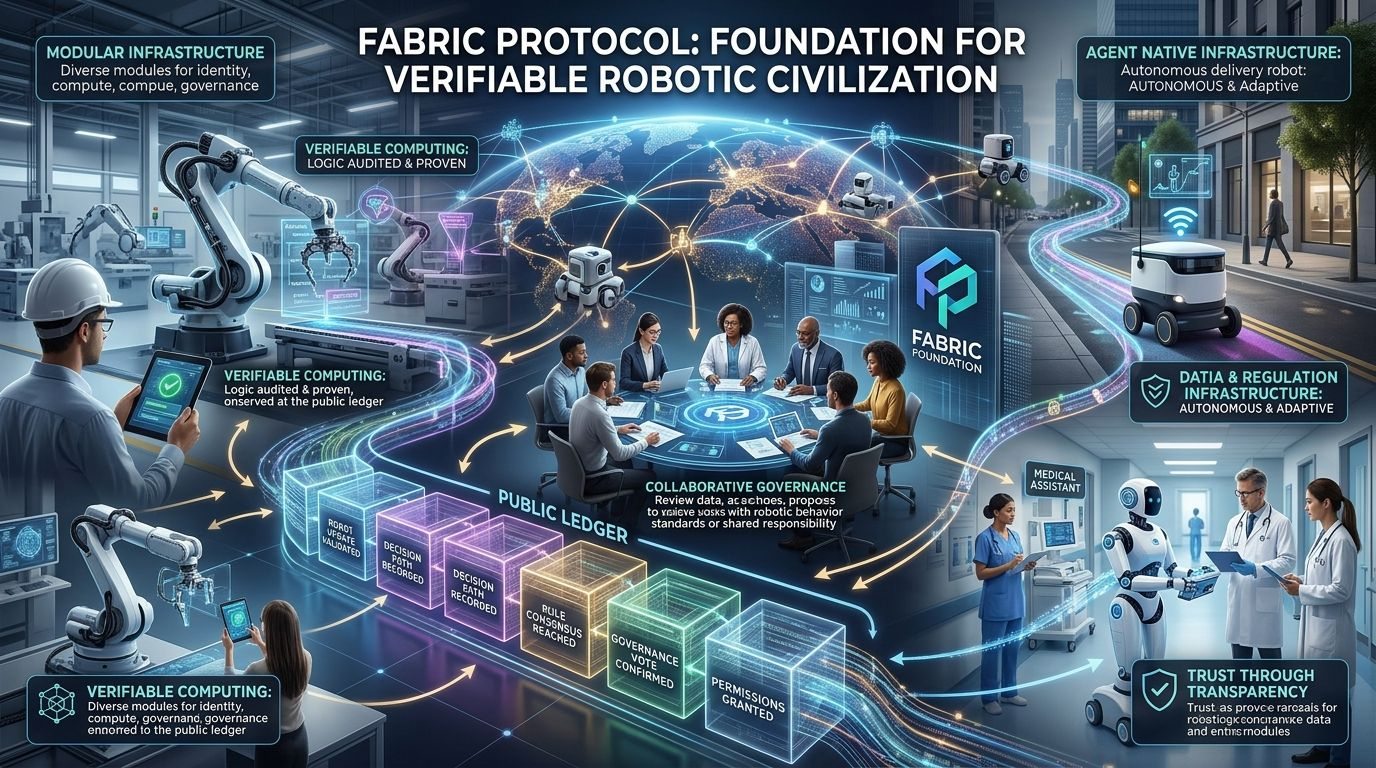
What makes this vision powerful in my eyes is that they’re not ignoring the hardest questions about robotics, because building a robot that can move is not the same as building a robot that can be trusted, and trust is the part that most people underestimate until something goes wrong. Fabric Protocol coordinates data, computation, and regulation through a public ledger, and that might sound technical at first, but when I break it down in simple words, it means that robots connected to Fabric are not operating in darkness but inside a system where their learning, updates, and decisions are recorded in a structured and verifiable manner. I’m imagining a world where a robot helping in a hospital, a warehouse, or even a farm is not just running on hidden code but is part of a shared ecosystem where improvements are collaborative and accountability is built into the foundation rather than added later as an afterthought.
The idea of verifiable computing is something I personally find very important because we are entering a time where machines are making more decisions without direct human control, and if those decisions cannot be proven or audited, then we are basically asking society to trust a black box. Fabric Protocol changes that dynamic by making computation provable, meaning that when a robot processes data or executes a task, there is a way to confirm that it followed the correct logic and rules defined by the network. They’re combining this with agent native infrastructure, which means the system is not forcing robots to behave like traditional software clients but is instead designed specifically for autonomous agents that learn, adapt, and collaborate with other machines and humans.
I also feel that the governance aspect of Fabric Protocol is one of its most underestimated strengths because technology without governance can become chaotic, especially when robots are involved in real world environments that affect safety, privacy, and economic stability. Fabric allows collaborative evolution, which means updates to robotic behavior, policy frameworks, and operational standards can be proposed, validated, and implemented through structured processes instead of being dictated by a single centralized authority. This creates a sense of shared responsibility, and I believe that shared responsibility is what makes human machine collaboration sustainable over decades rather than just hype for a few years.
When I think about modular infrastructure, I see flexibility rather than rigidity, and that matters because robotics is not a one size fits all industry. A delivery robot, a manufacturing arm, and a home assistant all have different requirements, yet Fabric Protocol is designed in modules so that different components such as identity systems, computation layers, and governance mechanisms can be combined according to the needs of specific robotic ecosystems. They’re not forcing every builder into the same mold, and that openness creates space for innovation while still maintaining a unified standard of verification and coordination.
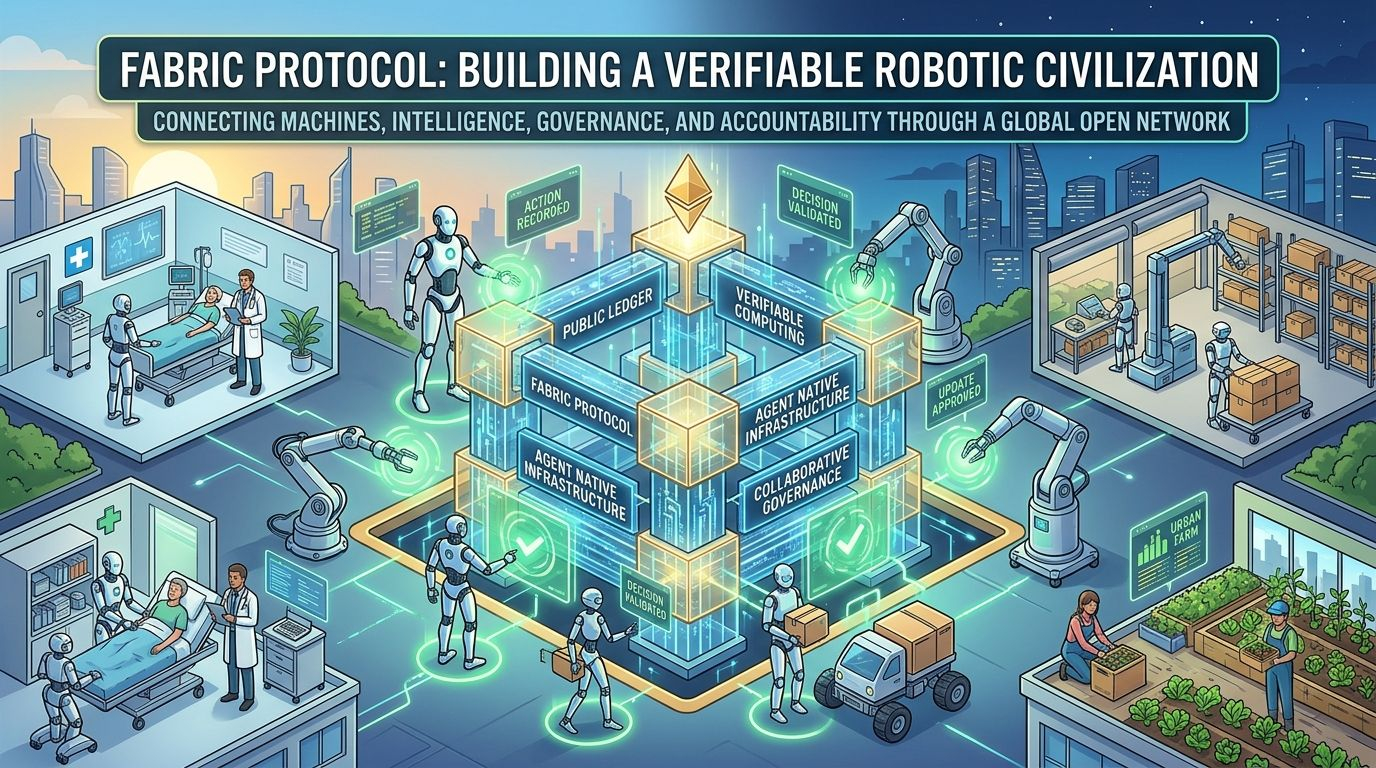
Another thing that stands out to me is how Fabric connects data and regulation in a public ledger environment, because data alone is not powerful unless it can be structured and governed responsibly. By anchoring robotic operations to a transparent ledger, Fabric makes it possible to trace how models are trained, how permissions are granted, and how operational rules evolve over time. I’m thinking about the emotional side of this too, because for many people the idea of robots taking over jobs or making independent decisions creates fear, and that fear often comes from uncertainty and lack of visibility. When actions are verifiable and governance is participatory, it reduces that anxiety and replaces it with clarity, and clarity is something our technological era desperately needs.
Fabric Protocol is not just about connecting machines, it is about redefining how machines earn trust in society, and I believe that trust will become the most valuable currency in the age of intelligent automation. They’re building a system where robots are not isolated proprietary products but participants in an open network that encourages collaboration across developers, researchers, regulators, and everyday users. This collaborative model can accelerate progress because improvements made in one part of the network can be validated and shared across others without compromising safety or transparency.
I’m also aware that building such an infrastructure is not simple because it requires alignment between hardware manufacturers, software engineers, policy designers, and economic participants, and yet that complexity is exactly why a structured protocol is necessary. Without a common coordination layer, robotics could fragment into incompatible systems that cannot safely interact with each other, but with Fabric Protocol acting as a unifying framework, there is potential for interoperability that respects both innovation and accountability. They’re essentially trying to create the internet of robots, but with governance and verification built into its core instead of bolted on later.
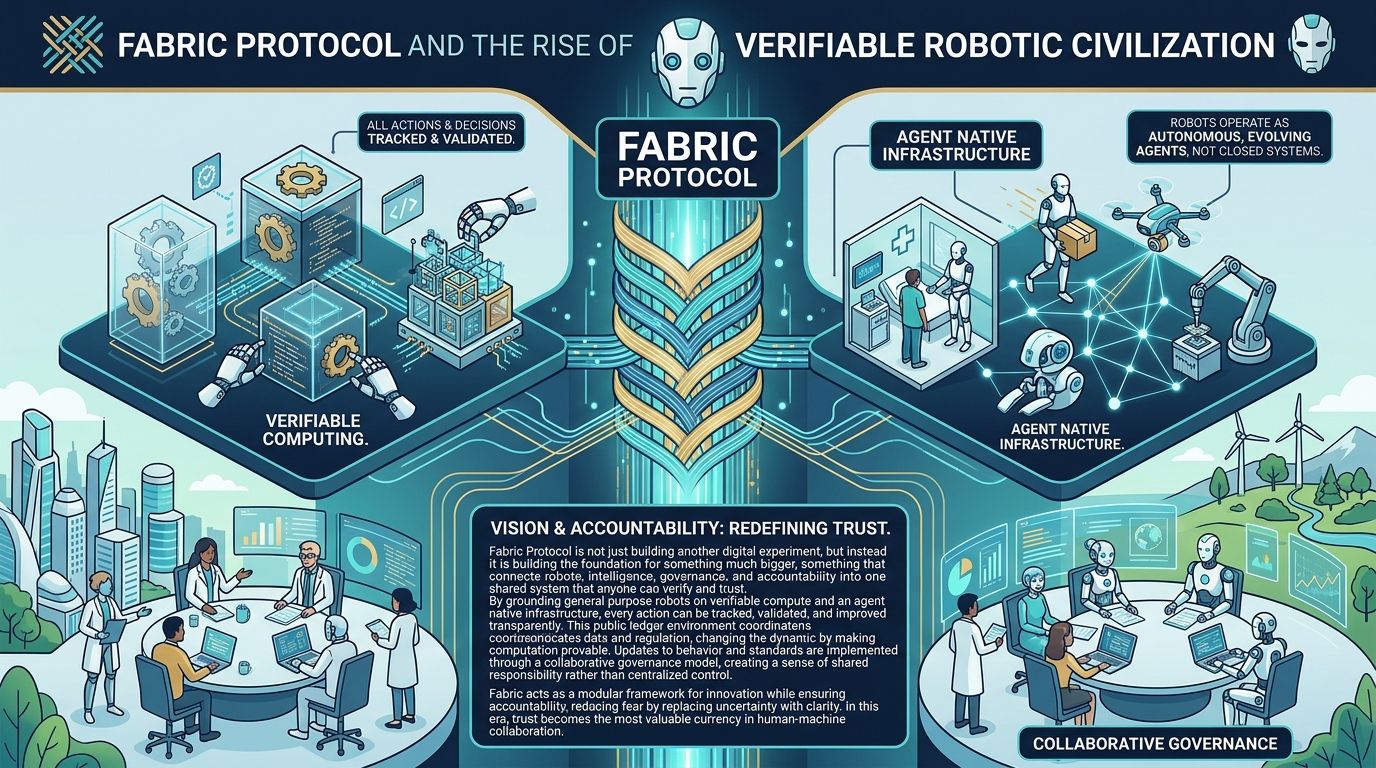
From an economic perspective, I can see how this could unlock new forms of collaboration where robots provide services across borders while adhering to shared standards, and where incentives are aligned through transparent mechanisms recorded on the ledger. This kind of system could allow robots to perform tasks, earn rewards, and reinvest those rewards into maintenance, upgrades, or shared research, creating a self reinforcing ecosystem that benefits participants rather than extracting value without oversight. The emotional trigger here for me is the idea that technology does not have to be exploitative or opaque, it can be structured to serve communities while remaining open and competitive.
As we move deeper into an era where artificial intelligence and robotics are blending together, I feel that protocols like Fabric represent a shift from isolated innovation to coordinated evolution. They’re not just building tools, they’re building a civilization layer for machines that operate alongside us, and that vision carries responsibility as much as ambition. If robots are going to become part of our daily lives in factories, cities, hospitals, and homes, then we need systems that ensure they evolve with human values rather than drifting away from them.
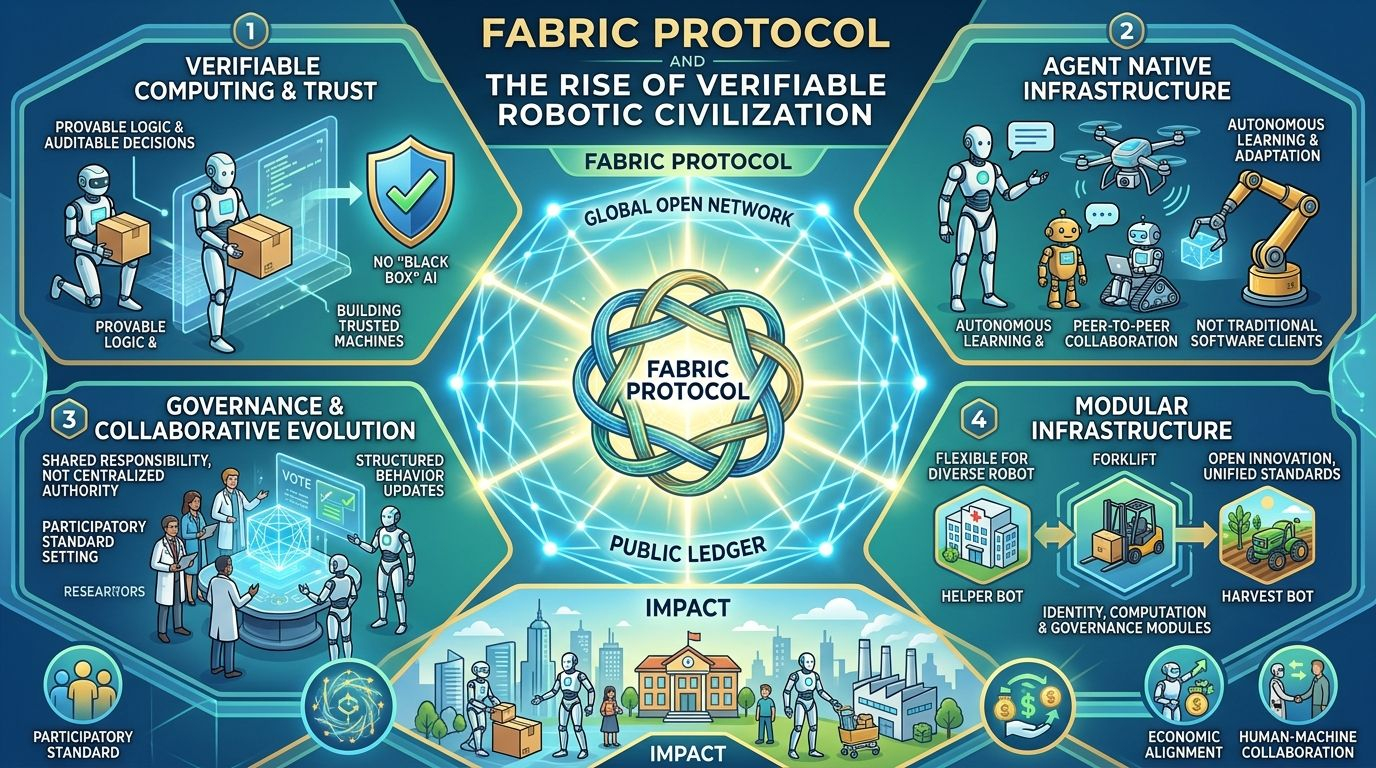
In the end, what resonates with me most about Fabric Protocol is that it treats robotics not as a product category but as a social infrastructure challenge, and that perspective changes everything. They’re acknowledging that the future of machines is not only about performance metrics or speed benchmarks, it is about governance, verifiability, transparency, and shared ownership of progress. I’m convinced that if human machine collaboration is going to succeed in a meaningful way, it will require networks that are open yet accountable, innovative yet responsible, and ambitious yet grounded in real world safety, and Fabric Protocol appears to be moving in that direction with a seriousness that feels both technical and deeply human at the same time.