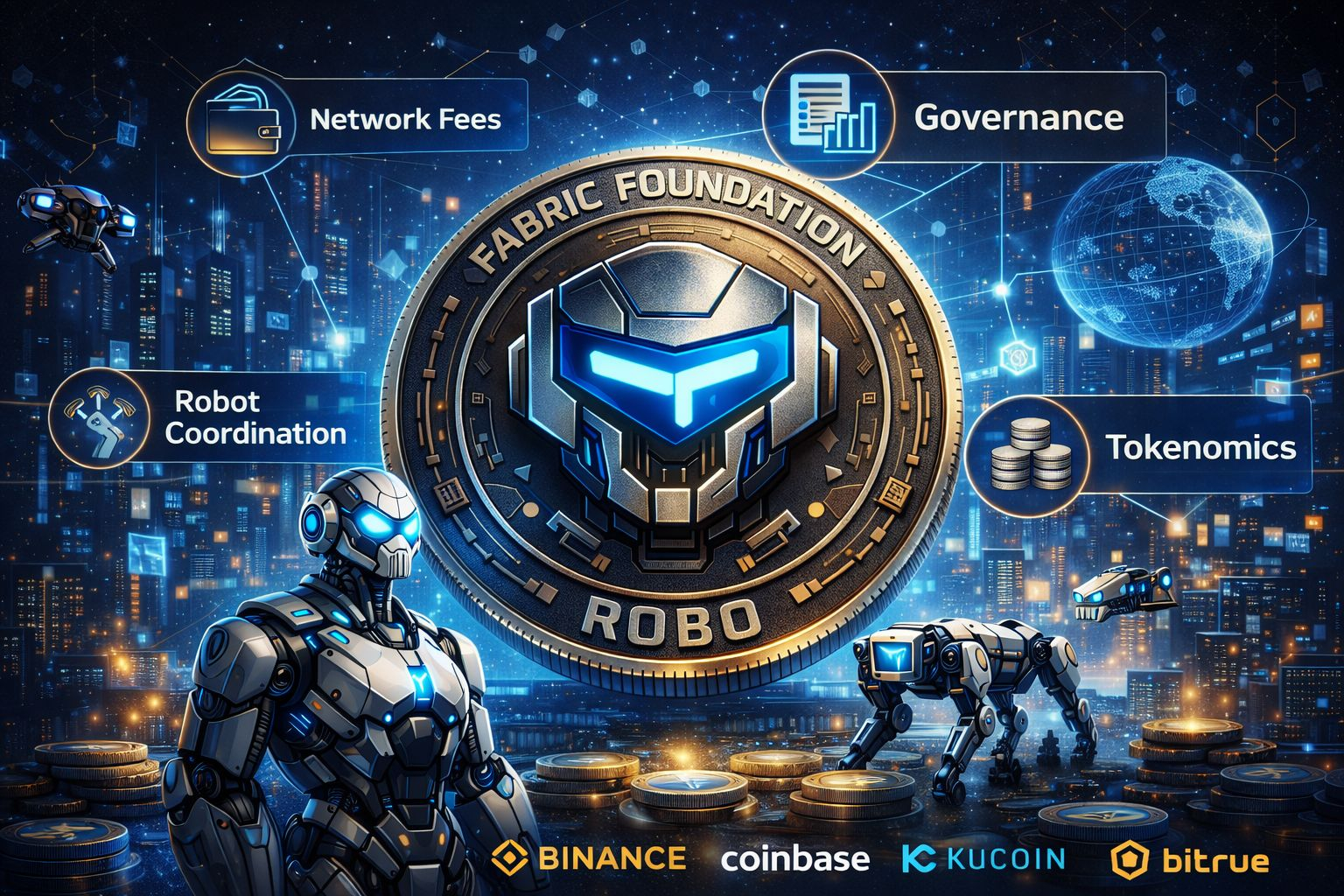
The $ROBO token is the native utility and governance asset of the Fabric Foundation’s decentralized robotics ecosystem. Fabric Foundation is a non-profit organization focused on creating the infrastructure that enables robots and intelligent machines to operate safely, autonomously, and interoperably in the real world. The core mission of the Foundation is to build open systems that ensure intelligent machines broaden human opportunity and remain aligned with human intent.
At its core, the ROBO token serves several critical functions within the Fabric network. First, it is used as the currency for network fees, covering payments, identity verification, task validation, and machine-to-machine transactions. In an ecosystem where autonomous robots and agents interact without traditional legal identities or bank accounts, on-chain wallets funded with $ROBO become essential for economic activity and digital identity resolution.
Second, ROBO is central to decentralized robot coordination. Participants in the Fabric network stake ROBO to access protocol functionality and receive priority weighting for initial task allocation. While staking does not confer ownership of physical robot hardware or direct revenue rights, it aligns participants with the success of robot deployment and incentivizes verified contributions such as skill development, task completion, compute provision, data validation, and other valuable work. A portion of protocol revenue is even used to buy $ROBO on the open market, designed to create persistent buy pressure as adoption grows.
Another major function of ROBO is governance. Token holders can participate in decisions that shape the evolution of the Fabric network, including setting fees, establishing operational policies, and guiding ecosystem direction. This governance layer is intended to balance decentralized decision-making with long-term stewardship by the Foundation itself, ensuring that as the network scales, control remains distributed among contributors and stakeholders.
The tokenomics of ROBO are structured to support sustainable growth and widespread participation. The total supply of the token is allocated across multiple categories, including investors (24.3%), team and advisors (20%), the Foundation reserve (18%), ecosystem and community incentives (29.7%), community airdrops (5%), liquidity provisioning (2.5%), and public sale (0.5%). Many of these allocations are subject to vesting schedules, with investor and team tokens locked for 12 months followed by linear vesting over 36 months. This vesting structure aims to reduce immediate supply shocks and align long-term interests with the network’s success.
As of late February 2026, the ROBO token has begun trading on multiple major cryptocurrency exchanges, including Binance, Coinbase, KuCoin, Crypto.com, BingX, Gate, and LBank, significantly expanding its liquidity and market access. Early trading activity has shown strong demand and volatility—a common characteristic for newly listed tokens in emerging tech sectors like AI and robotics.
The long-term success of ROBO and the broader Fabric ecosystem depends on real-world adoption of decentralized robotic coordination and the ability of the network to facilitate meaningful human-machine economic interactions. While the vision is ambitious—positioning blockchain as the economic backbone for autonomous robots—execution, regulatory developments, and technological maturation will be key determinants of its impact.maturation will be key determinants of its impact.human-machine economic interactions. While the vision is ambitious—positioning robo token