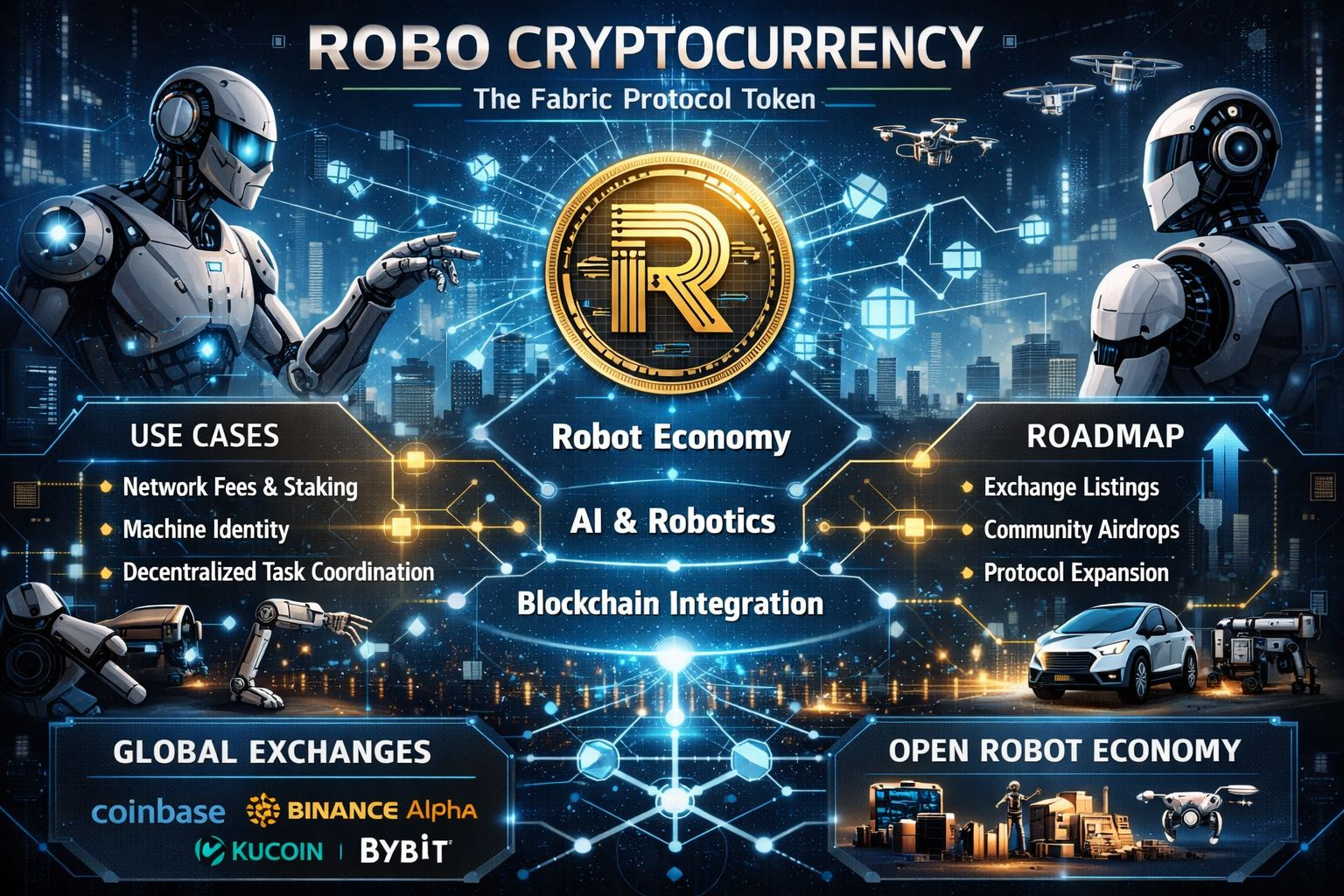
#robo $ROBO ROBO is the native utility and governance token of the Fabric Protocol, a blockchain-based infrastructure designed to support the coordination, governance, and economic integration of real-world robotics and autonomous AI systems. Unlike many crypto tokens that are speculative in nature, ROBO’s value proposition centers around enabling a decentralized robot economy — where robots, AI agents, and human developers interact transparently and securely on-chain.
In essence, the goal is to create a global, open protocol for robot identity, on-chain coordination of tasks, and machine-to-machine economic activity — something akin to a trust layer for physical automation systems integrated with blockchain.
🧠 Core Fundamentals
✅ Utility Beyond Trading
ROBO isn’t just a speculative ticker; it has real functional use cases within the Fabric ecosystem:
Network Fees: Used to pay for on-chain robot coordination and task execution.
Staking & Governance: Token holders can stake ROBO to participate in securing the protocol and vote on decisions.
Machine Identity & Coordination: ROBO tokens are required for registering robotic identities and automating decentralized task allocation.
This aligns ROBO more with utility and infrastructure tokens rather than a simple store of value.
📈 Exchange Listings & Market Exposure
In late February 2026, ROBO made significant strides in market accessibility:
It launched for spot trading on major exchanges, including Coinbase, Binance Alpha, Crypto.com, Bitrue, and others.
Recent expansion to KuCoin and Bybit helped boost liquidity and broaden access for global traders.
Such listings are often bullish signals — they increase liquidity, visibility, and institutional access — though they do not guarantee price performance.
👥 Community & Distribution
The Fabric Foundation has actively worked to decentralize ownership via community incentives:
A ROBO airdrop portal was launched to reward early participants and contributors to the OpenMind ecosystem.
Tokenomics often include vesting schedules for team and investors, ecosystem rewards, and a foundation reserve, which helps balance long-term growth with early distribution.
These allocation strategies can help align incentives but also introduce careful monitoring of unlock events and associated pressure on price stability.
🛠️ Roadmap & Development Highlights
While the Fabric Protocol’s long-term roadmap isn’t as formally published as some other projects, recent developments and emerging milestones illustrate a clear growth trajectory:
🚀 2025–2026 Key Milestones
Protocol Launch: Official Token Generation Event (TGE) and launch on major exchanges in early 2026.
Airdrop & Ecosystem Bootstrapping: Community distribution events to grow the user base and on-chain activity.
Infrastructure Expansion: Continued rollout of support for identity registration, decentralized task coordination, and staking/governance utilities.
Multi-Exchange Liquidity: Listings on KuCoin, Bybit, and other venues to increase liquidity and network participation.
🧭 Future Vision (Mid-to-Long Term)
Fabric’s broader vision is to establish a foundational layer for an open robot economy — where robots can interact economically, hold verifiable identities, and autonomously coordinate tasks without centralized control.
If successfully executed, this could support real-world applications such as supply chain automation, intelligent manufacturing, and autonomous coordination systems — particularly important as AI and robotics increasingly interact with everyday infrastructure.
⚠️ Risks & Considerations
While ROBO’s narrative and tech aspirations are promising, several risks remain:
Volatility: As a newly listed token, prices can swing dramatically with market sentiment.
Execution Risk: The decentralized robot economy concept is ambitious and depends on broad adoption and integration with physical systems.
Regulatory Factors: Cryptocurrencies remain subject to regulatory scrutiny worldwide, especially as they link to real-world infrastructure.
📌 Summary
ROBO isn’t just another meme token — it is part of an infrastructure project integrating AI, robotics, and blockchain technology. Its fundamentals are tied to real-world utility, governance, and coordination mechanisms for autonomous systems. Strategic exchange listings, airdrop incentives, and a growing ecosystem signal developer activity and community growth. However, its ambitious vision carries execution and market risks typical of infrastructure-oriented blockchain projects.