
The first time I saw someone call Mira Network the "Chainlink of AI," I’ll admit I rolled my eyes. In this industry, we’re prone to slapping legendary labels on any project that has a decent whitepaper and a working API. But as someone who has watched Chainlink evolve from a "niche data feeder" into the global standard for financial truth, I’ve started to realize that the comparison isn’t just hype, it’s an architectural prophecy. If Chainlink solved the "Oracle Problem" for DeFi, Mira is solving the "Reliability Problem" for the age of intelligence.
When I look at the landscape of 2026, the biggest bottleneck isn't the speed of AI, but our ability to trust it. We’ve all seen LLMs hallucinate with the confidence of a seasoned politician, and in high-stakes fields like medicine or finance, "close enough" is a recipe for disaster. Mira’s approach of creating a decentralized trust layer mirrors exactly what Sergey Nazarov did for smart contracts. As David Watt recently noted on Binance Square, "In a digital world drowning in synthetic content, trust must be engineered, not assumed." That is the exact mission Mira has embarked.
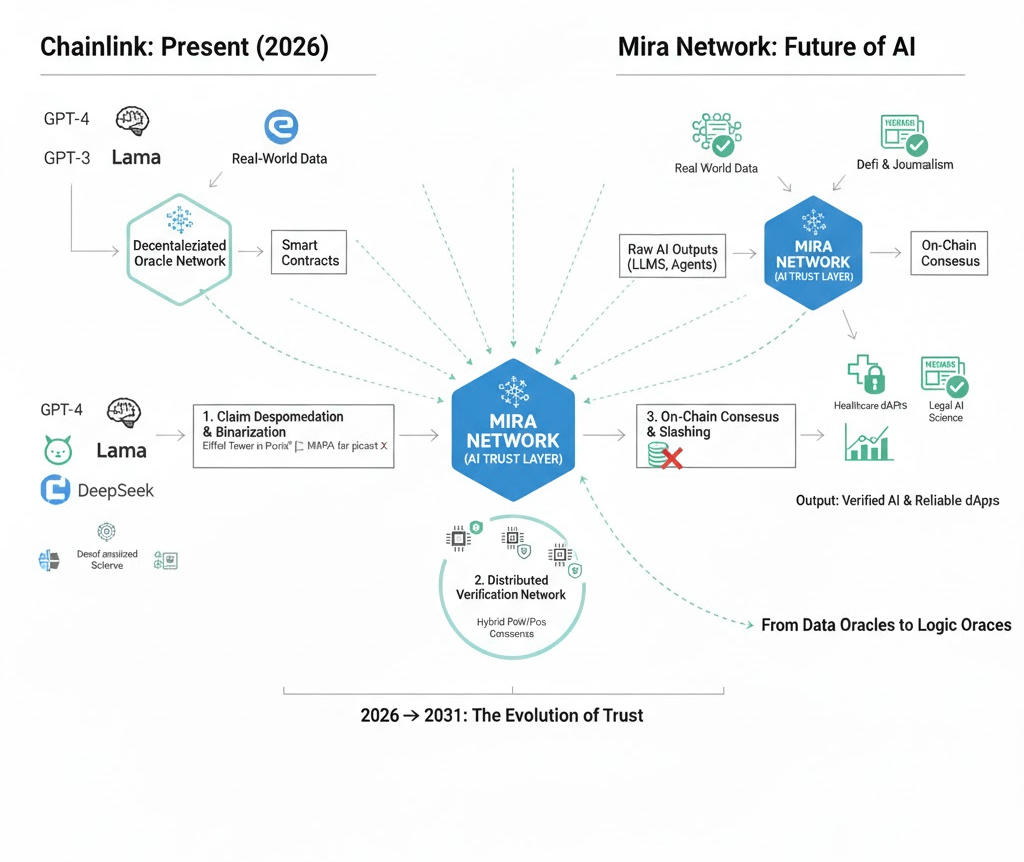
The Architect of Truth: Why the Middleware Model Wins
The brilliance of Mira lies in its position as a "middleware" protocol. It doesn't try to build a better GPT-5 or a faster Llama model; instead, it builds the plumbing that verifies them. This reminds me so much of the early days of Chainlink. While other projects were trying to build "Ethereum killers," Chainlink focused on being the essential bridge. Mira is doing the same for AI by breaking down complex outputs into verifiable "atomic claims." It’s like a digital judge that cross-references a thousand witnesses before delivering a verdict.
This decentralized consensus is the only way to scale AI safely. Co-founder Karan Sirdesai once said, "Mira allows AI contributors to maintain sovereign ownership of their models while being able to monetize them via our marketplace."
This creates a "network effect" where the more models and nodes that join, the stronger the verification becomes. By using a hybrid system of Proof-of-Work and Proof-of-Stake, they ensure that every piece of data has "skin in the game," a concept that has been the backbone of every successful decentralized infrastructure project since the inception of Bitcoin.
From Data Feeds to Logic Feeds: The Next 5 Years
In five years, I believe we won’t even think about "verifying" AI—it will happen automatically in the background, just as we don't think about where a DeFi price feed comes from today. The transition from "Data Oracles" to "Logic Oracles" is the natural evolution of the internet. If $MIRA continues its current trajectory, it will be the referee for every autonomous agent trading our capital or managing our healthcare. It’s moving from isolated intelligence to a collective, cryptographically-proven truth.
The comparison with Chainlink holds weight because both projects understand that reliability is the ultimate product. As we move further into this decade, the value of a token like $$MIRA on't just come from speculation, but from its utility as the "gas" for truth. Looking at the growth of the Klok app and the rapid adoption of the Mira SDK by Web3 developers, the foundation is already set. We are witnessing the birth of a standard that ensures AI serves us with facts, not just well-formatted fiction.
As I watch the Binance CreatorPad campaign heat up, it’s clear that the community is beginning to see the "Trust Layer" as a necessity rather than a luxury. The move toward on-chain accountability for AI is inevitable. By focusing on the infrastructure of verification, Mira is positioning itself to be the invisible, essential layer that makes the entire AI economy possible. This isn't just about another AI token; it's about building the prefrontal cortex of the decentralized web.