
For years, crypto has been seen mainly as a financial tool — trading, payments, and speculation. Fabric Protocol presents a different idea: crypto as a coordination layer, not just money.
The Real Problem
Machines and AI systems are becoming more autonomous. Robots, AI agents, and smart devices can perform tasks, make decisions, and interact with digital systems. But they still rely on centralized platforms for identity, payments, and governance.
They can operate — but they can’t truly participate in an open economy.
There’s no universal system where machines have:
Verifiable digital identity
Open trust infrastructure
Shared governance
Borderless value exchange
That’s the gap Fabric Protocol aims to address.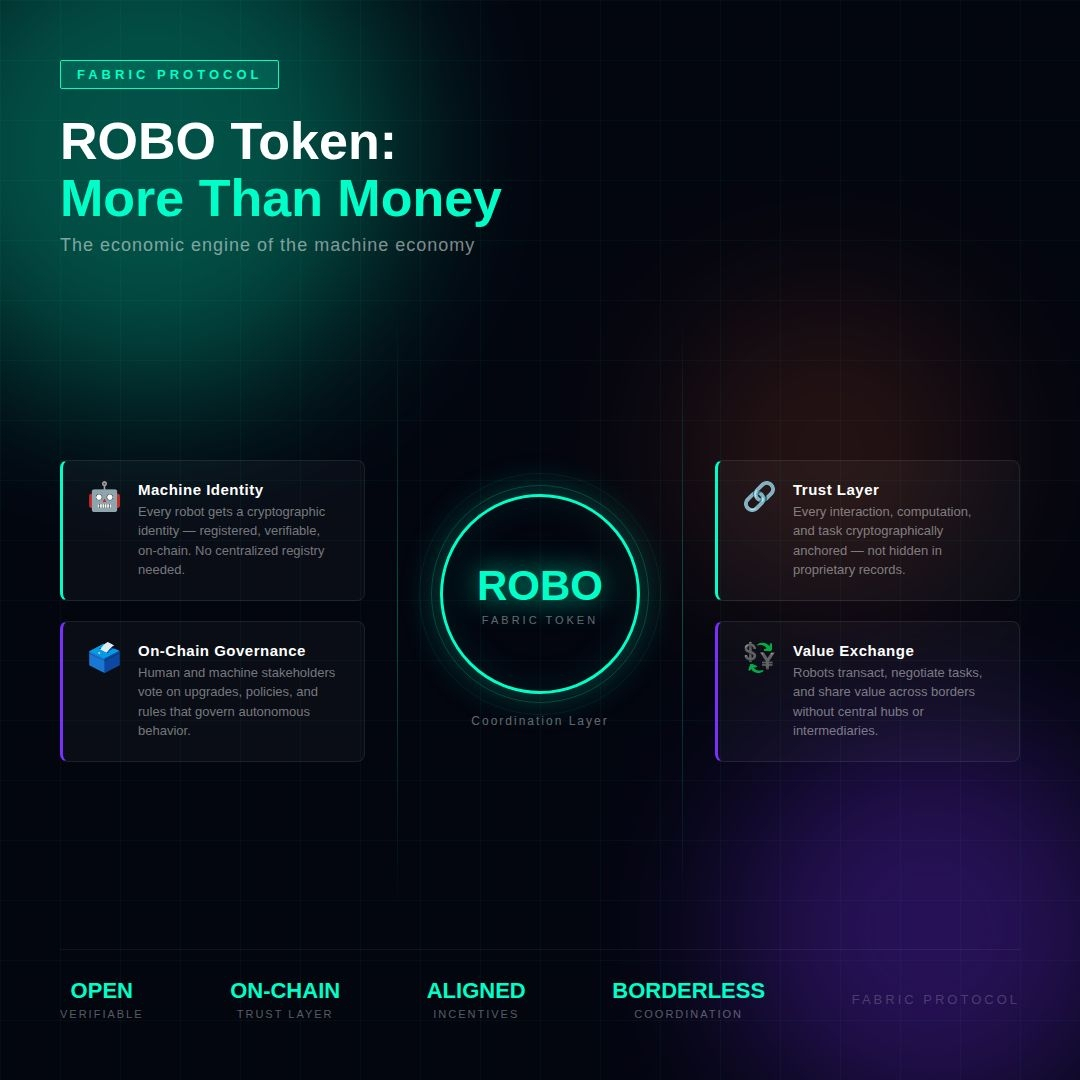
Fabric Protocol & ROBO
Fabric Protocol proposes a decentralized machine economy where every machine has a cryptographic identity and interactions are recorded on-chain. Governance is shared, and incentives are aligned through its native token, ROBO.
ROBO is positioned not just as currency, but as a coordination token — aligning humans, machines, and network participants within one ecosystem.
The Unproven Part
The vision is ambitious, but still early. Big questions remain about adoption, real-world demand, and whether industries will move away from centralized control.
Fabric Protocol highlights a real emerging challenge: giving machines an economic identity.
Whether ROBO becomes essential infrastructure — or just another token — will depend entirely on execution and real adoption.