
For a long time, I kept hearing people talk about artificial intelligence as if it had already solved the mystery of crypto trading. Everywhere I looked there were claims about bots making profits automatically while their owners slept. At first I was skeptical. Markets are chaotic, unpredictable, and often irrational. The idea that a machine could consistently understand something that millions of human traders struggle with every day sounded almost unrealistic. But curiosity pushed me to look deeper. I spent months researching the topic, observing different tools, and watching how AI systems interact with the crypto market.
The more time I spent studying this space, the more I realized that AI trading is not some futuristic fantasy. It is already happening quietly in the background of the market. What surprised me most was how different it is from the older forms of automated trading. Traditional trading algorithms are simple in nature. Someone writes a rule and the system follows it exactly as written. If a trader programs a bot to buy when the price drops below a certain level, the bot will execute that order every single time the condition appears. It does not question the rule and it does not learn anything from past results.
Artificial intelligence changes that dynamic. While researching these systems, I began to understand that AI models are designed to learn from data rather than blindly follow instructions. Instead of relying on one rule, the system analyzes patterns from historical prices, trading volume, and many other signals. It searches for relationships hidden inside large amounts of information. Watching this process unfold was fascinating. It felt less like programming a robot and more like teaching a system how to observe the market.
One of the things that caught my attention during my research was how AI can process information at a scale that humans simply cannot handle. The crypto market moves twenty-four hours a day, and news spreads instantly across the internet. Traders react to headlines, social media discussions, and community sentiment. I realized that while I might read a few updates during the day, an AI model can scan thousands of posts, articles, and conversations within seconds. It tries to measure the mood of the market and detect whether the overall sentiment is turning positive or negative.
I also spent time watching how automated trading bots operate when they are enhanced with AI tools. These systems connect directly to trading platforms and execute strategies without needing constant supervision. Some of them look for small price differences between exchanges. Others place orders across multiple price levels to capture movement as the market fluctuates. A few are designed to detect trends and ride momentum when the market begins moving strongly in one direction. Seeing these systems operate continuously made me realize how powerful automation can be in a market that never sleeps.
During my research I also experimented with using AI as a research assistant rather than a fully autonomous trader. I found that these tools can help explain complicated crypto projects, summarize long whitepapers, and even generate code for chart indicators. Watching AI write small scripts for trading charts felt like having a technical partner sitting next to me. It did not replace the thinking process, but it made exploration much faster.
Another part of the journey involved testing strategies using historical data. I spent hours watching simulations replay years of market activity to see how certain ideas would have performed. This process helped me understand how traders use AI to test their theories before risking real capital. It also showed me something important about the limitations of machine learning. Sometimes a system can study the past so intensely that it becomes too specialized for patterns that may never appear again.
The deeper I went into this research, the more I realized that AI trading also comes with serious risks. Technology can fail. Internet connections can break. Exchanges can go offline at the worst possible moment. And perhaps the biggest concern I discovered was the number of mysterious trading bots being sold online. Many of them promise guaranteed profits while hiding the logic behind their strategies. After spending so much time observing the market, I learned to be cautious of anything that refuses to explain how it works.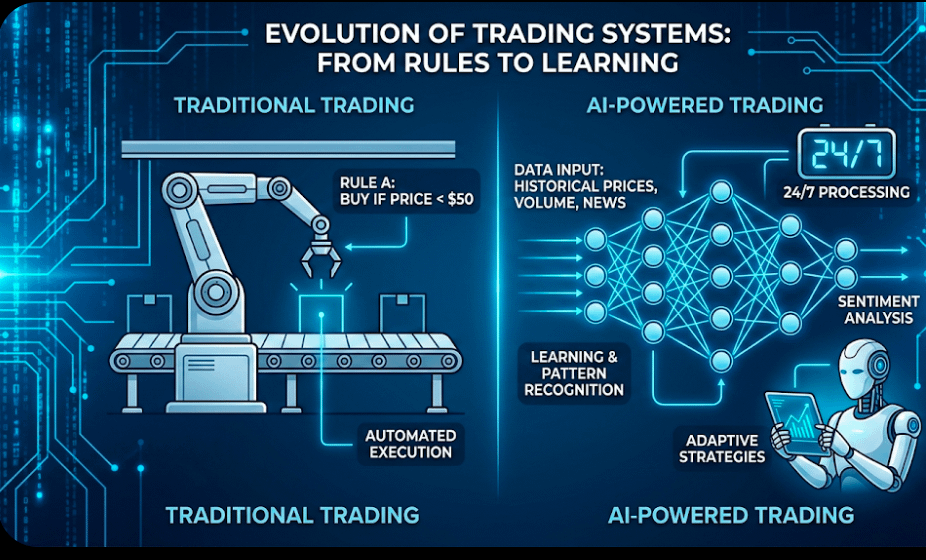
Despite these concerns, my overall perspective on AI in crypto trading has become more balanced. I no longer see it as a magical solution that removes all difficulty from trading. Instead, I see it as a powerful set of tools that can help traders analyze information faster and operate more efficiently. The machines are incredibly good at processing data and reacting quickly, but they still depend on the judgment of the person using them.
After all the time I spent researching, watching charts, and experimenting with these systems, one idea became very clear to me. Artificial intelligence works best when it is treated as a partner rather than a replacement for human thinking. The market is still driven by uncertainty, emotion, and unexpected events. AI can help interpret the noise, but understanding risk and making responsible decisions will always remain a human responsibility.