
When I look at the rapid rise of robotics and artificial intelligence, I don’t just see smarter machines or faster automation, I see the beginning of a structural shift in how value is created in society, because robots are slowly moving from being tools operated by humans to becoming semi-autonomous agents that can make decisions, execute tasks, and even coordinate with other machines without constant human supervision, and the real question is no longer how intelligent they can become but whether our economic systems are prepared for their participation as productive actors. Most conversations today still revolve around hardware improvements, AI model performance, and labor displacement fears, yet very few people are asking a deeper question that the Fabric white paper places at the center of its thesis: if robots are going to generate economic value at scale, where is the decentralized economic infrastructure that allows them to operate independently, get compensated autonomously, and scale globally without relying on centralized platforms that ultimately control access, pricing, and distribution.
The team supported by the approaches this challenge from a fundamentally different angle compared to most blockchain projects, because instead of beginning with token supply schedules, marketing narratives, or speculative incentives, they begin with the structural mismatch between autonomous production and centralized coordination systems, and they argue that while robots are increasingly capable of performing tasks in logistics, manufacturing, inspection, and service industries, the economic rails that would allow them to transact machine-to-machine in a trust-minimized way are still missing, which means that even highly advanced robots remain economically dependent on corporations, APIs, and centralized payment gateways that ultimately determine who gets paid and how value is distributed.
What makes this argument powerful is that it reframes the so-called “robot problem” as an economic design failure rather than a technological limitation, because from their perspective robots can already create measurable value in the real world, yet there is no native decentralized mechanism to measure that value objectively, verify it across a distributed network, and convert it into an economic unit that reflects productive output rather than speculative expectation, and without such a mechanism any token linked to robotics risks becoming disconnected from real work, turning into another asset driven primarily by hype cycles rather than underlying productivity.
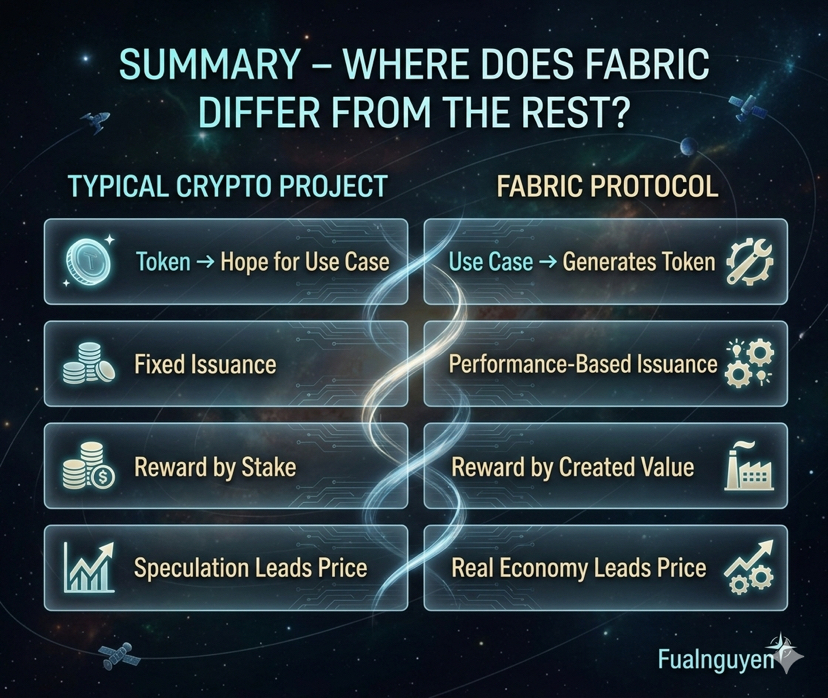 The white paper openly critiques traditional crypto-economic models by explaining that time-based emissions reward patience rather than performance, stake-based rewards prioritize capital over contribution, and revenue-based success metrics can be manipulated in machine-dominated markets where bots may transact with each other in circular loops that artificially inflate numbers without creating net societal value, and because of these structural flaws most tokens end up behaving like speculative instruments that are only loosely tied to the real economy, which makes them unstable foundations for something as serious as a long-term robotic labor market.
Instead of adjusting these familiar frameworks, Fabric proposes rebuilding the architecture from first principles by treating robots as independent economic agents that must prove their productivity before any economic issuance occurs, which means that in this model the token is not the starting point but the outcome of verified economic activity, and issuance only happens when robots deliver measurable services that are validated by the network through a combination of cryptographic proofs, economic bonding, and multi-layer verification mechanisms, so if there is no real economic output there is no new supply entering circulation, effectively transforming the token into an economic receipt that directly mirrors productive contribution rather than speculative anticipation. 
To address the risk of inflation or supply distortion, the protocol introduces an adaptive issuance framework that responds dynamically to network conditions, so when demand for robotic services increases and efficiency improves the system can expand issuance to support growth, and when productivity slows or supply exceeds demand issuance contracts naturally without requiring artificial burns or centralized intervention, which creates a feedback loop between real-world performance and token supply that is closer to an economic thermostat than a fixed emission schedule.
At the same time, intrinsic demand is embedded directly into the protocol because the token is required as operational fuel for accessing robotic services, bonding hardware into the network, participating in validation, and engaging in governance decisions, and as more robots join and more services are consumed the amount of tokens locked or utilized within the system grows organically, reducing reliance on narrative-driven mechanisms like buybacks or symbolic burns and instead tying demand directly to network usage, which strengthens the connection between utility and valuation.
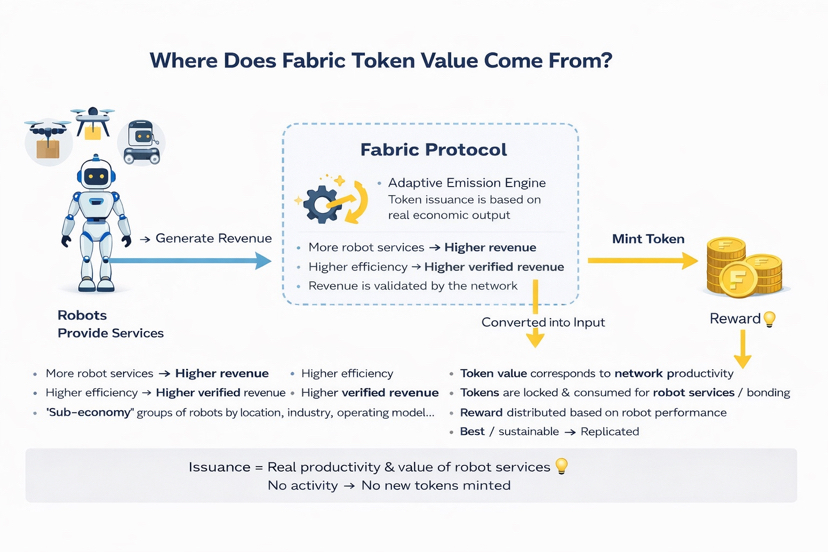 One of the most interesting elements of the new update in the white paper is the evolutionary reward layer, which organizes robots and AI models into different sub-economies based on geography, task specialization, and operational context, and rather than allocating rewards purely by voting or static rules the system evaluates performance across these sub-economies and gradually increases rewards for models that demonstrate sustainable productivity while phasing out inefficient configurations, creating a process that resembles natural selection within an economic environment rather than political governance through majority opinion.
The paper also recognizes that no single metric can remain immune to manipulation in an environment where autonomous agents can coordinate strategically, so instead of trusting revenue alone the system evaluates value through patterns of repeated transactions, long-term integration into workflows, cross-verification among independent validators, and the depth of economic relationships formed within the ecosystem, which means that token reflection becomes an emergent property of overall network health rather than a direct function of one easily gamed indicator.
From an investment perspective this design makes Fabric fundamentally different from projects optimized for short-term volatility cycles, because the model requires gradual onboarding of real robotic infrastructure, sustained service demand, and measurable productivity before significant economic expansion occurs, which implies slower early growth but potentially greater structural resilience if robotics truly becomes a core productive force in global markets, and this long-horizon orientation may limit immediate speculative appeal while strengthening alignment with long-term economic fundamentals.
When I think about whether Fabric can truly solve the real economic problem of robots, I see that its ambition is not to predict token appreciation or to promise exponential returns but to create a system in which if robots generate verifiable economic value that value must be reflected in the economic layer coordinating them, and that distinction is important because it shifts responsibility from marketing narratives to measurable productivity, from capital dominance to contribution-based issuance, and from centralized gatekeeping to distributed validation.
In that sense, the experiment supported by the is less about launching another digital asset and more about testing whether autonomous machines can participate in a decentralized market structure where incentives, measurement, and coordination are aligned from the ground up, and if robots do become a defining productive class of the coming decades then the real breakthrough may not be a new hardware platform or a more advanced neural network but an economic architecture capable of pricing, verifying, and scaling their contribution without collapsing into speculation or central control.