
@Fabric Foundation I was half-awake at 7:18 a.m. when my neighbor’s drill started chewing into the shared wall. My coffee cooled while a wheeled robot prototype on my desk flashed an error code. I’d just read about Fabric Protocol’s “collaborative evolution” and I felt a mix of interest and unease. Does this scale cleanly?
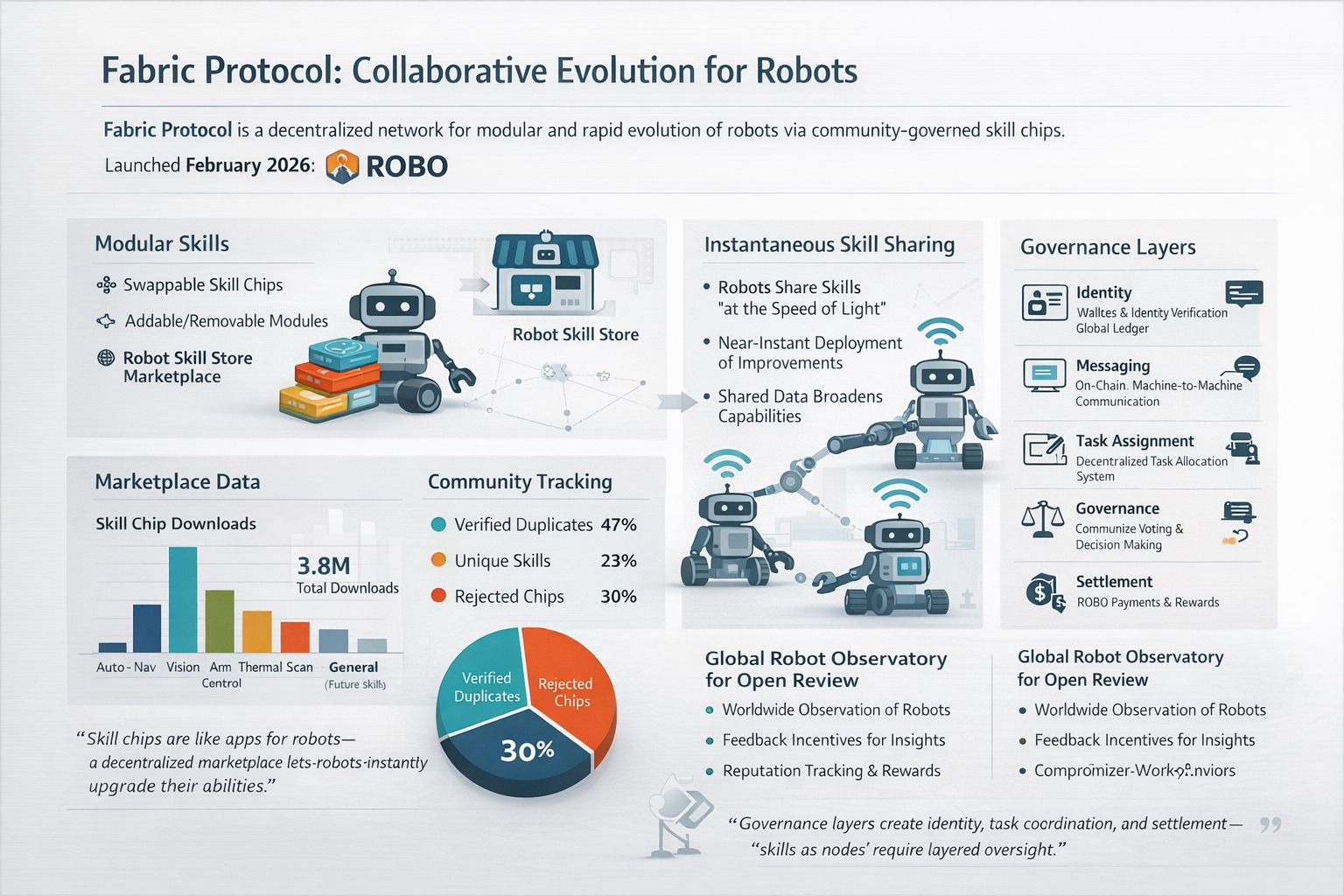
Fabric Protocol is trending right now for a simple reason. It recently stepped into public view. The Fabric Foundation published “Introducing $ROBO” on February 24 2026 and described the token as the utility and governance asset for its robotics network while tying it to fees for payments identity and verification. Within days exchanges began listing ROBO for spot trading which widened the audience beyond robotics specialists. Listings are not proof of substance but they force scrutiny.
What I find worth examining is the phrase Fabric uses for its ambition. It wants to build govern and evolve general-purpose robots as a shared project. In its whitepaper Fabric is framed as a global open network that coordinates data computation and oversight through public ledgers so people can contribute and be rewarded. Collaborative evolution in that sense is as much about incentives and accountability as it is about code.
The clearest picture of collaborative evolution comes through Fabric’s idea of modular “skill chips.” The whitepaper describes skills as addable and removable modules that are compared to apps and it sketches a “Robot Skill App Store” where skill chips can be shared and removed when they are no longer needed. I read that as a bet on portability where improvements can travel while mistakes can be isolated before they spread.
Fabric leans on an asymmetry between humans and machines because robots can share skills almost instantly. The whitepaper calls this “instantaneous skill sharing” and describes machines sharing skills “at the speed of light” which lands for me because robot progress is increasingly shaped by software and distribution. The same document argues that modern language models can control robots through open-source code and that makes a networked approach feel less far-fetched than it might have a few years ago. The Foundation’s broader framing is blunt since AI is entering “the world of atoms” where safety and real-time constraints bite.
A network that “evolves” robots needs identity communication task coordination and a way to settle who did what. One explainer breaks the concept into layers like identity messaging task assignment governance and settlement so machines can authenticate coordinate and trigger rewards when work is verified. I am less interested in the labels and more interested in the implication that robots become nodes with histories instead of devices with serial numbers.
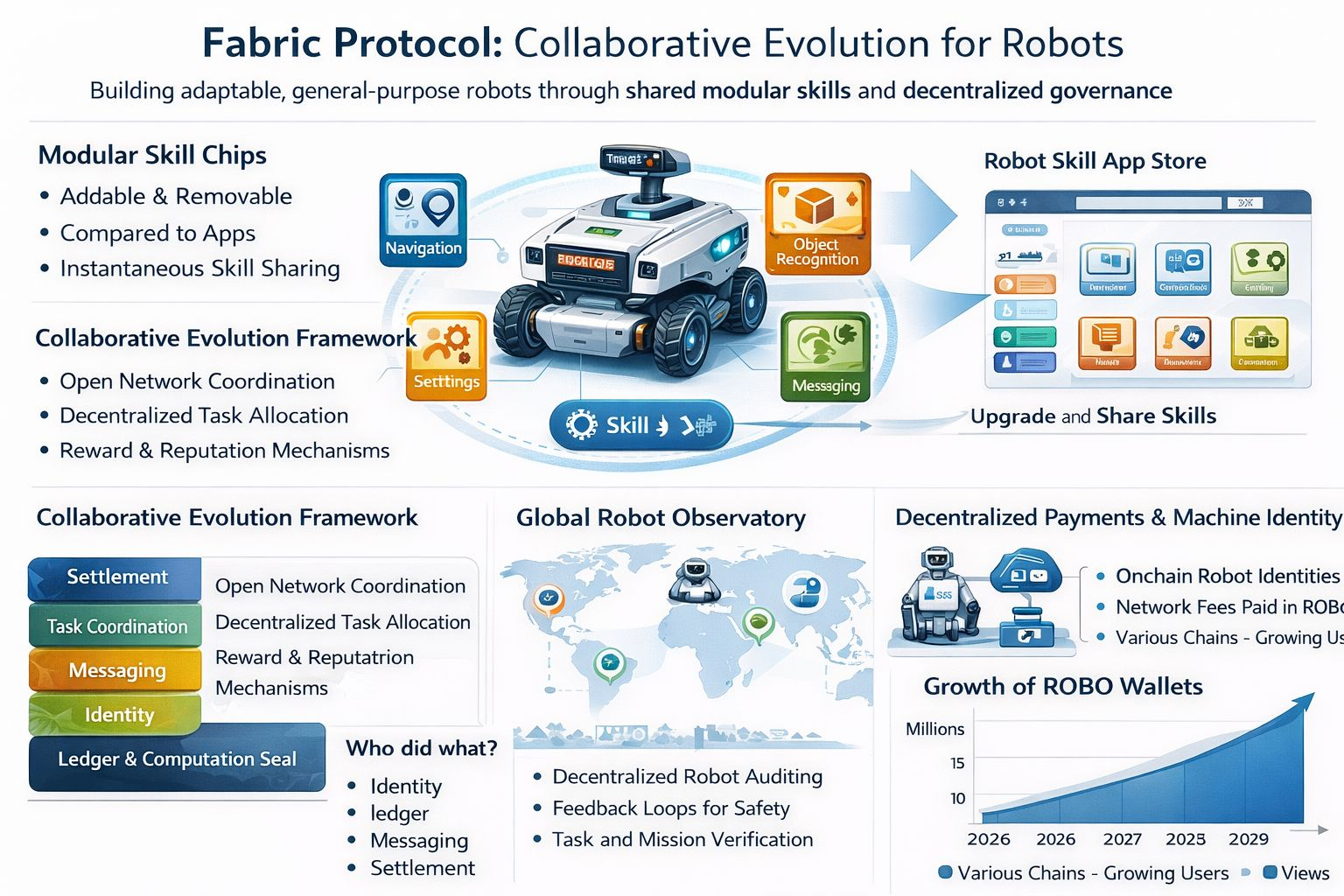
I also notice how Fabric drifts into money and identity where robotics conversations often get hand-wavy. The Foundation argues that robots cannot open bank accounts or hold passports so they will need wallets and onchain identities to track payments with network fees paid in ROBO. It also says the network will begin on an existing blockchain environment and later move to its own chain as adoption grows. I read that less as theater and more as an attempt to answer a hard question that keeps coming up for me. If a machine does work how does it get paid audited and safely stopped when it misbehaves?
That history connects to a risk Fabric explicitly worries about which is concentration of power. The Fabric Foundation argues that existing institutions and economic rails were not built for machine participation and it warns that without new governance frameworks there is a risk of misalignment and unequal access. Collaborative evolution is pitched as an antidote yet it also creates new failure modes because bad incentives can spread brittle behavior fast.
The most human-facing piece in the whitepaper is the “Global Robot Observatory” which is an idea of incentivizing people to observe and critique machine actions with feedback loops compared to systems used in large-scale AI and autonomy programs. I like the humility in that idea and I also see the burden because review work is hard uneven and easy to game.
I keep circling back to verification because a ledger can record that a task was claimed and paid while real-world quality stays messy. That is why I notice the Foundation’s focus on infrastructure like decentralized task allocation machine-to-machine communication and “location-gated and human-gated payments” since those controls are designed for the physical world where place and permission matter.
When I look again at the flashing error code on my desk Fabric’s promise feels both practical and unfinished. Collaborative evolution could make robot progress more open and auditable and less captive to one vendor while also spreading responsibility so widely that nobody feels accountable when something goes wrong. I can live with that tension only if the people closest to the robots get a real seat at the table and not just a voting token.