

We are currently obsessed with the "brain" of the machine. We argue about whether AI is conscious, whether it can write a poem, or whether it will eventually decide humans are a suboptimal use of carbon. But while we’re staring at the flickering lights of the neural networks, a much more practical—and arguably more dangerous—transformation is happening under our feet.
It’s the shift from machines that obey us to machines that act around us.
I’ve been thinking a lot about Fabric lately. Not as a brand or a buzzword, but as a potential solution to the "clutter" of autonomy. When I watch a robot vacuum get hopelessly wedged under a mid-century modern chair, I don’t see a failure of AI; I see a breakdown in legibility. The robot is doing something "correct" by its own internal map, but to the human standing there with a cup of coffee, it’s just a plastic puck making a nuisance of itself.
If we are going to live in a world populated by millions of moving parts—delivery bots, autonomous chargers, maintenance drones—we have to solve the "boring" problems: charging, repairs, and receipts. Because if we don’t, the future won’t be a sleek utopia; it’ll just be a mess of blind automation that nobody knows how to fix.
The Wallet as an Anchor
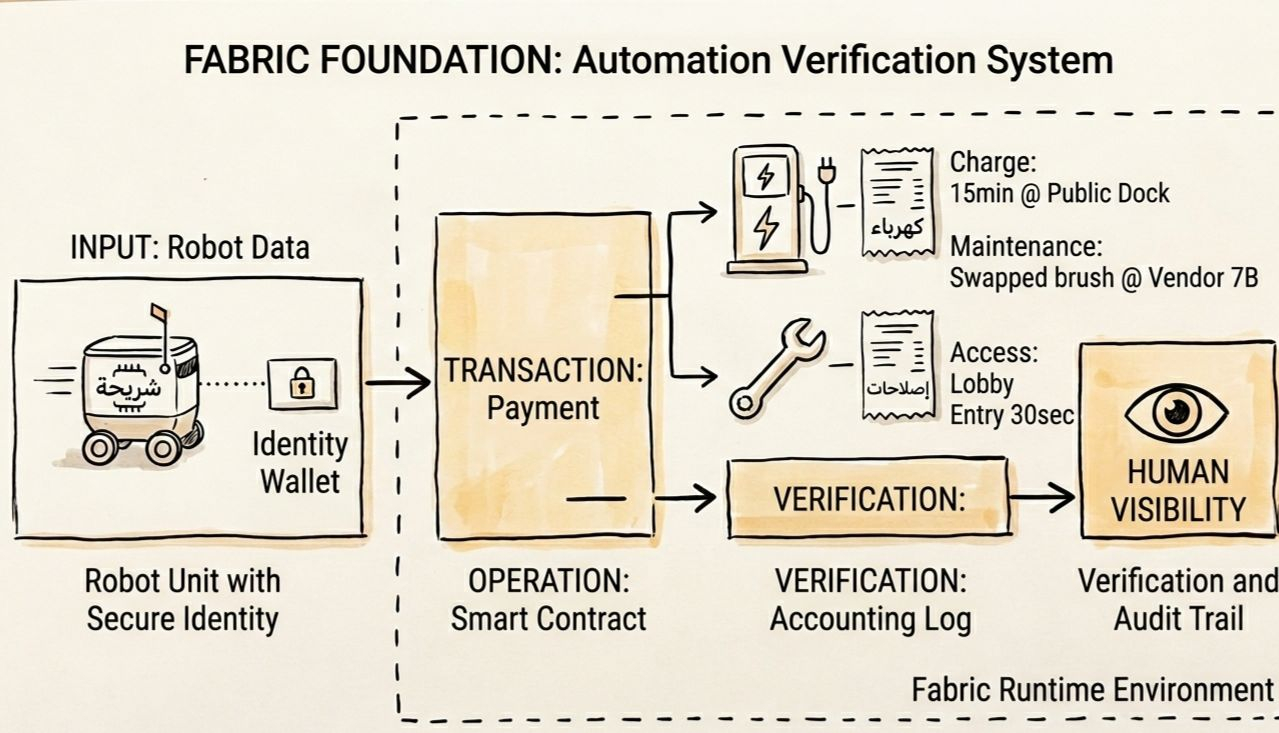
In the world Fabric is trying to build, a "wallet" isn’t just a place to keep digital coins. It’s an identity. It’s a private secret—a cryptographic handshake—that proves a machine has the authority to be where it is and do what it’s doing.
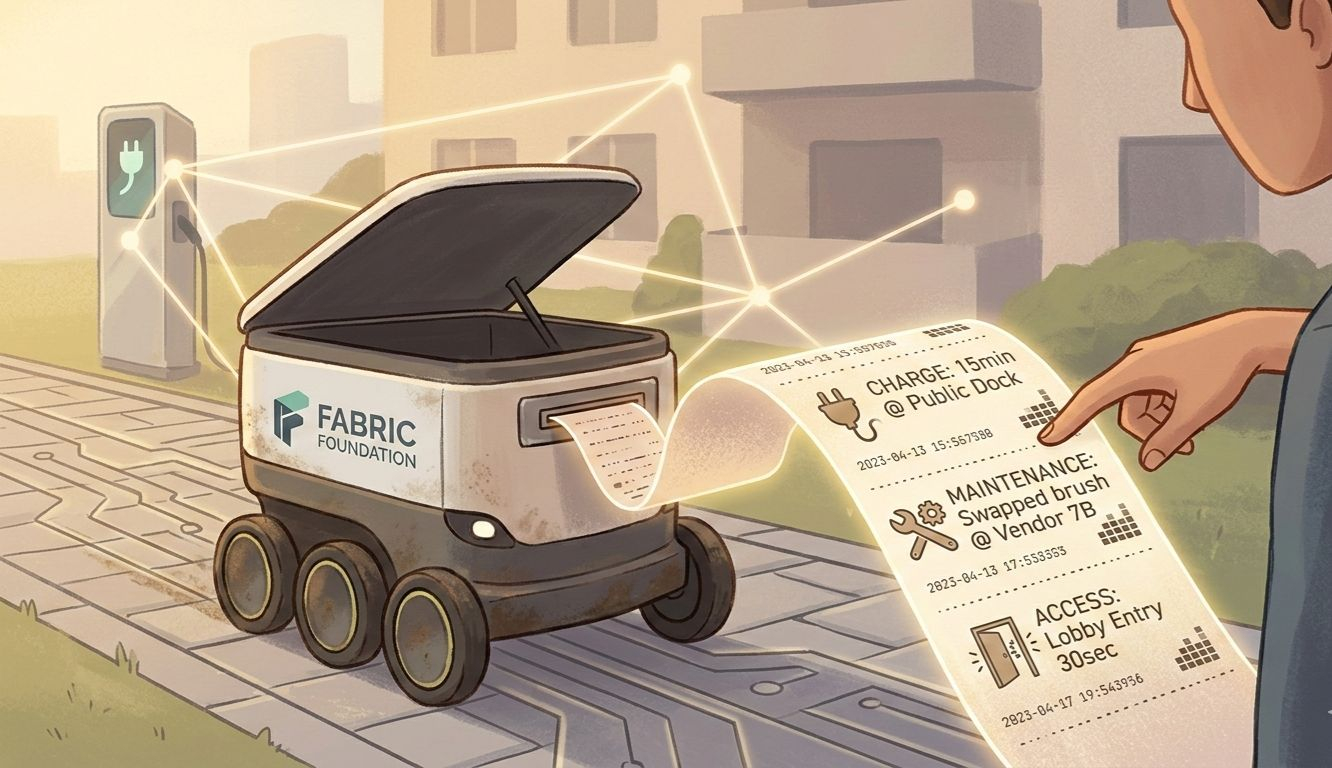
Think about the friction of your daily life. When a delivery robot reaches a locked apartment lobby, it shouldn’t need a human to wake up and press a buzzer. It needs to be able to negotiate. It should be able to say, "I am Robot #402, I have a verified package for 4B, and I am willing to pay a 5-cent access fee for a 30-second entry window." That sounds like a financial transaction, but it’s actually a safety feature. By attaching a cost and a digital signature to that action, we create a verifiable trail. The building knows exactly who entered and why. The robot’s owner knows why the battery drained faster than usual. The "wallet" becomes the machine’s passport and its reputation all at once.
The Double-Edged Sword of the "Smart" Contract
We use the term "Smart Contracts" as if they’re magic spells, but they’re really just automated "If/Then" statements. If the repair is confirmed, then release the payment.
On paper, this is beautiful. It eliminates the "who goes first?" game that stalls human commerce. But as anyone who has ever dealt with a software bug knows, code is only as "smart" as the person who wrote it. If the rules are wrong, the mistake doesn't just happen—it happens at scale, at the speed of light, on autopilot.
This is why the public ledger aspect of Fabric matters so much. We don't need a ledger because we want to spy on every robot; we need it because we’ve all experienced the gaslighting of a system that says "Computer says no" without an explanation. A ledger provides a way to look back and say, "Show me the receipts." It prevents the "system did it" excuse from becoming the default answer for every glitch in the neighborhood.
The Friction of Reality
Let’s look at the risks, because that’s where the optimism gets tested:
The Key Problem: If a machine’s identity is tied to a private secret, losing that secret is catastrophic. It’s not like losing a credit card that you can cancel with a phone call; it’s like losing the keys to your house to a thief who can teleport. A stolen "wallet" could allow a malicious actor to drain resources in tiny, imperceptible bites across a thousand machines.
The Accountability Gap: If a robot pays for a repair that wasn't actually performed, who is at fault? Is it the developer who wrote the contract? The manufacturer? The network? If we can’t point a finger, we can’t build trust.
The Paywalled World: There is a dark version of this where everything becomes a micro-transaction. A world where a robot (and eventually a person) can’t move through a hallway or sit in a park without a "tiny access fee" being deducted from a digital shadow.
Why "Open" is the Only Way Forward
This is why I find myself leaning toward the idea of an open, foundation-backed network. "Open" isn't a magic wand that fixes human greed, but it is a spotlight. It allows us to inspect the guts of the system.
The real test of Fabric—or any system like it—isn't whether the machines can pay each other. They’ve been able to do that for years in high-frequency trading labs. The real test is whether humans stay in charge of the boundaries. We need machines to be predictable. We need them to operate inside fences that we, as a community, can verify and update. Governance might be the most boring word in the English language, but it is the only thing that keeps progress from turning into a nightmare of "convenient" surveillance.
The Bottom Line
Trust doesn’t grow from automation. You can’t "automate" a relationship. Trust grows when we write the rules carefully, keep them visible to everyone, and take actual responsibility when things break.
I don't want a world where I have to think about my robot's repair schedule or its charging receipts. I want those things to happen quietly in the background. But I do want to know that if I ever need to look, the truth is there, written in a language that humans can still understand.
#robo #Robo @Fabric Foundation
