


I used to think the biggest hurdle for robotics was the hardware—getting mechanical fingers to move like humans or figuring out how to make a battery last forty-eight hours under load. I was wrong. After spending enough time looking at how automation actually scales, it is clear that the real wall isn't mechanical. The real wall is the fact that every smart machine today is a digital prisoner of its manufacturer.
We are entering an era where intelligence is becoming "embodied," moving from chat boxes into physical atoms. But as we do, we are sleepwalking into a fragmented reality where your delivery drone can’t talk to your smart warehouse, and your autonomous mower can’t negotiate for a charge from a third-party station without five different corporate APIs and a dozen middle-men.
The Coordination Bottleneck
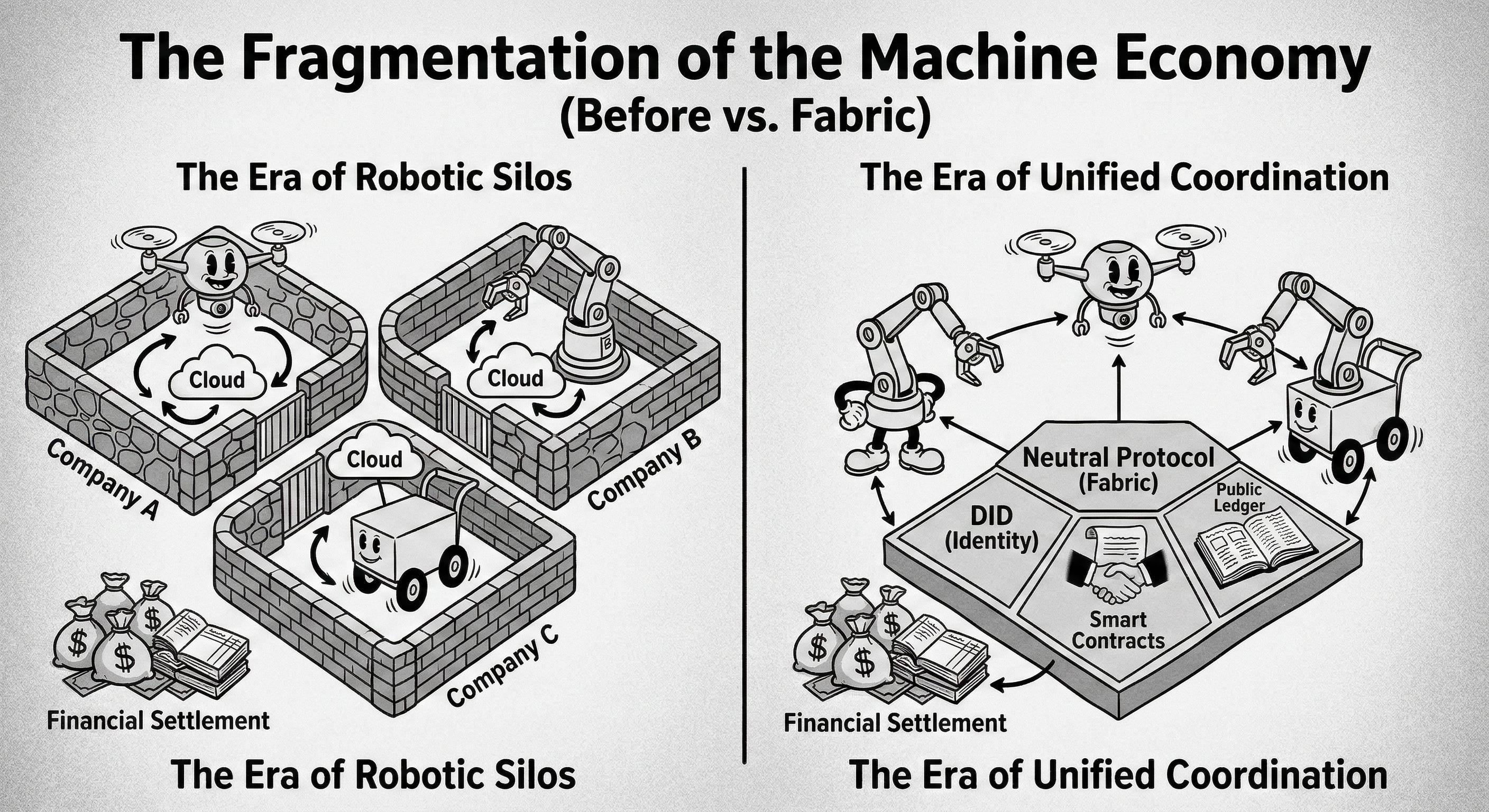
The structural problem in the robotics industry isn't a lack of "smart" models; it’s a failure of coordination. Right now, robotics is a collection of closed gardens. If you buy a robot from Company A, it lives in Company A’s cloud, uses Company A’s proprietary identity system, and can only perform tasks allowed by Company A’s terms of service. This creates a massive trust bottleneck.
For a true "machine economy" to exist, robots need to be first-class economic citizens. They need to own their own identity, hold their own keys, and settle their own transactions. Without a neutral infrastructure layer, we aren't building an autonomous future—we’re just building a more expensive version of the current gig economy where the "workers" happen to be made of steel and silicon.
Current "solutions" usually involve a centralized platform trying to become the "Amazon of Robots." They want to be the gatekeeper. But centralized platforms break structurally when they try to scale across competing manufacturers. No company wants to hand over their proprietary data or fleet control to a direct competitor's cloud. This incentive misalignment is why we haven't seen a universal "Android for Robotics" yet. The trust isn't there, and the architectural foundation is too brittle to support it.
The Fabric Foundation Design Philosophy
This is where @Fabric Foundation catches my attention. They aren't trying to build the "best" robot; they are building the connective tissue that allows any robot to function as an autonomous economic actor.
The design philosophy here moves away from the "tool" metaphor and toward the "agent" metaphor. By utilizing a hardware-agnostic operating system like OM1 and pairing it with a decentralized protocol, Fabric is creating a social network for machines. It’s an infrastructure-first strategy. Instead of focusing on flashy hardware demos, the focus is on on-chain identity (DID) and verifiable task allocation.
What stands out to me is how the $ROBO token isn’t just a speculative asset—it’s a coordination tool. In the Fabric ecosystem, the token functions as the "participation bond." If you want a robot to join the network and perform tasks, it needs a verifiable identity and a stake in the system. This creates a Proof of Robotic Work (PoRW) mechanism. It ensures that the machine isn’t just spinning its wheels in a simulation but is performing measurable, auditable labor in the physical world.
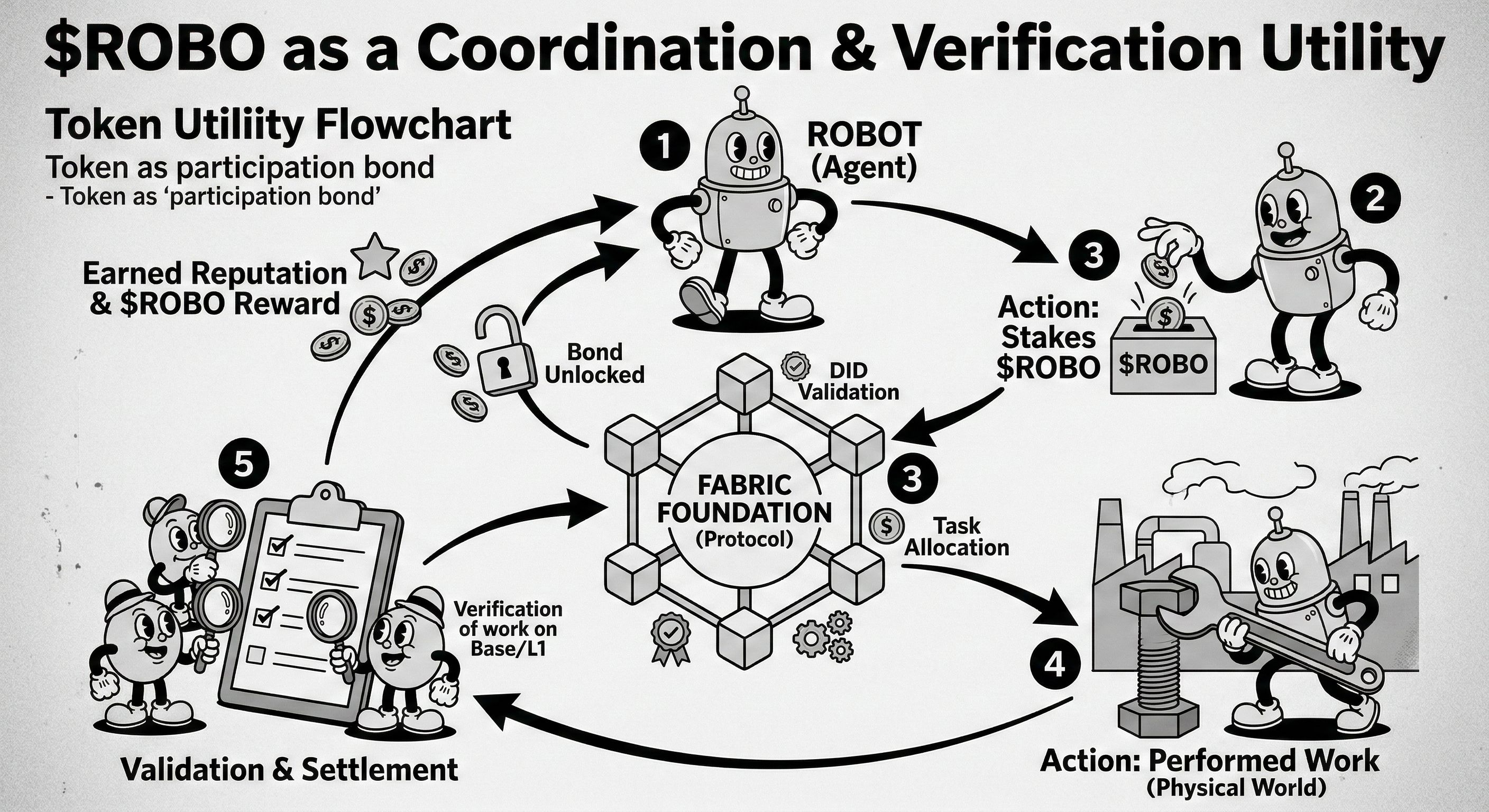
The architecture decisions, moving from an initial deployment on Base toward a dedicated Layer 1, suggest the team understands that high-frequency machine-to-machine transactions will eventually choke a general-purpose chain. They are building for a future where a robot might make a thousand micro-decisions a minute, each requiring a layer of cryptographic verification.
The Insight Most People Miss
There is a second-order consequence to this that most observers haven't fully processed yet. We often talk about AI "replacing" human labor, which frames the machine as a competitor. But by giving robots their own wallets and identities through a decentralized protocol, we actually enable a shift from "labor" to "ownership."
In the current model, if a robot works, the manufacturer gets paid. In the Fabric model, it becomes possible for a community, a DAO, or even an individual to co-own a "fleet" of autonomous agents that operate on a neutral protocol. The robot becomes a piece of public infrastructure rather than a corporate asset.
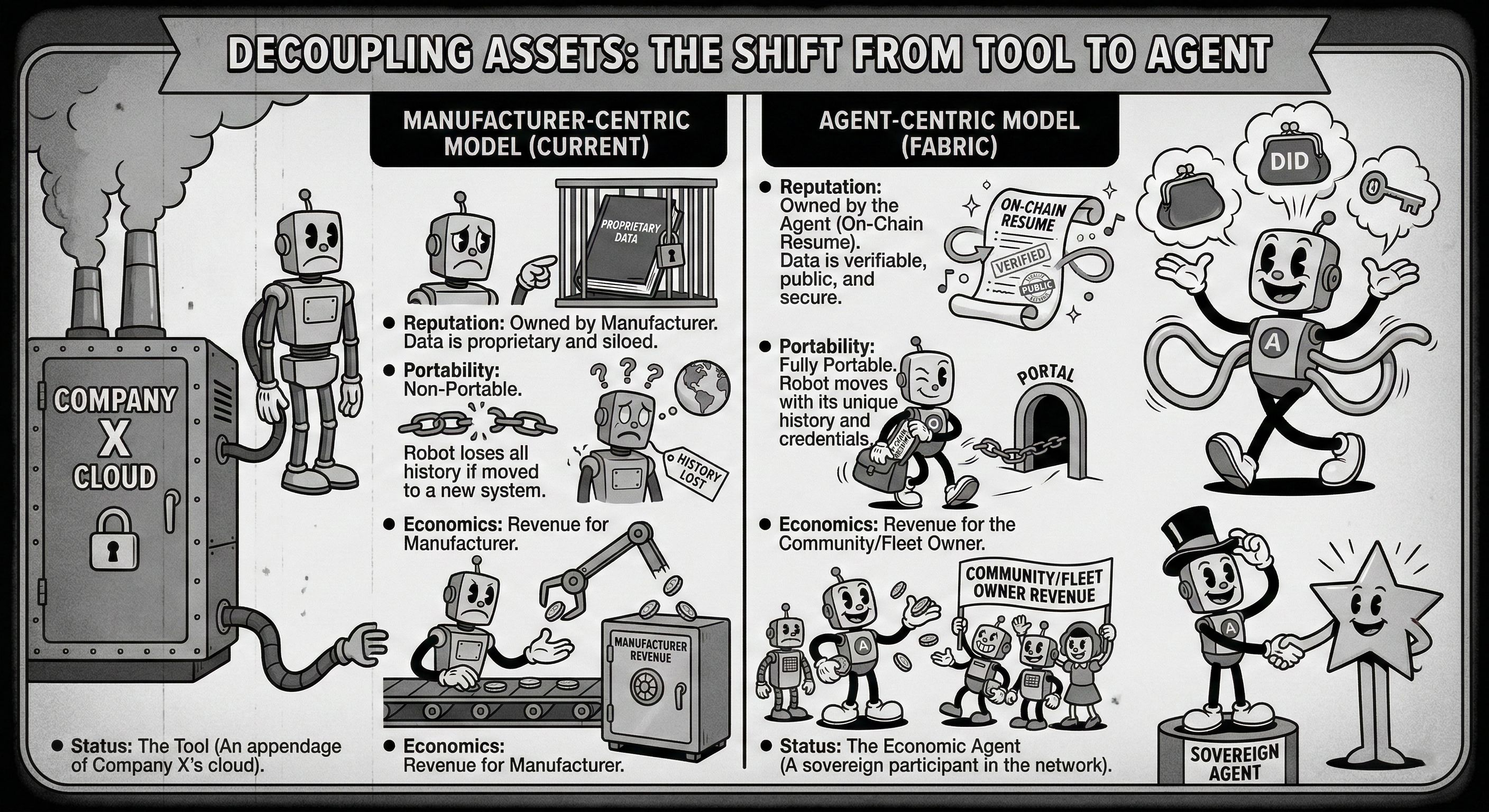
I’ve started to notice that we are moving toward a world where the most valuable "real estate" isn't land, but the slots in a decentralized coordination ledger. If a robot’s reputation, its skill history, and its payment rails are all on-chain, it becomes portable. It can move between different service providers without losing its "resume." That kind of portability is the death knell for corporate monopolies in automation.
It also changes the nature of safety. When a machine’s actions are logged on a public, verifiable ledger, the cost of "bad behavior" becomes economically transparent. You can’t just "reset" a bad actor machine if its identity is tied to a slashed stake on the Fabric network. We are essentially using tokenomics to enforce machine ethics.
A Measured Outlook
The listing of $ROBO on major platforms marks a transition point, but the real test isn't the price action of the next week. The real test is the "integration rate"—how many manufacturers and developers actually start anchoring their agents to this protocol.
We are at the very beginning of the machine economy. Most of what we see today is just noise and narrative. But beneath the surface, the transition from siloed tools to a unified, programmable machine layer is inevitable. Whether or not Fabric Foundation becomes the definitive standard remains to be seen, but their approach to solving the coordination failure is the most intellectually honest one I’ve seen in the space so far.
The goal isn't just to make robots smarter. The goal is to make them coordinate without us having to trust a single entity to hold the leash. In the long run, the systems that win aren't the ones with the most marketing; they are the ones that provide the most neutral ground for everyone else to build on.