
For most of history, machines have lived quiet, solitary lives.
A robot on a factory floor welds metal all day but never speaks to the agricultural robot harvesting crops thousands of miles away. A drone mapping farmland learns about wind patterns and terrain, yet that knowledge rarely reaches the delivery robot navigating crowded city streets. Each machine gathers experience, but the lessons remain trapped inside its own small world.
If you step back and look at it, the modern robotics landscape feels strangely similar to the early days of computing. In the 1960s and 70s, computers were powerful but isolated islands. Then the internet arrived and connected those islands, transforming scattered machines into a living global network.
Fabric Protocol begins with a simple but ambitious question: What if robots could connect in the same way?
Instead of operating as disconnected tools, machines could become part of a shared digital ecosystem where knowledge, computation, and decision-making flow across a global network. Supported by the non-profit Fabric Foundation, Fabric Protocol imagines infrastructure that allows robots, AI agents, developers, and institutions to collaborate through verifiable systems rather than closed platforms.
The idea sounds futuristic, but it grows out of a very real problem.
Robotics today is advancing rapidly. Autonomous vehicles are becoming more capable. Warehouse robots coordinate entire logistics operations. Surgical machines assist doctors with microscopic precision. Humanoid robots are slowly learning to walk, balance, and interact with their environment.
Yet beneath this progress lies a quiet inefficiency. Every robotic system is learning alone.
A navigation robot in Tokyo learns how to avoid pedestrians in crowded subway stations. A warehouse robot in Chicago learns to move efficiently through inventory aisles. A drone in rural Brazil learns how wind patterns affect flight stability. But these lessons rarely travel beyond the companies or research labs that built the machines.
In other words, robots are gaining experience, but they are not building collective memory.
Fabric Protocol attempts to change that by creating a shared infrastructure where robotic data, computation, and coordination can exist openly and securely. The protocol acts almost like connective tissue between machines, allowing them to interact through a decentralized network instead of isolated systems.
One of the most interesting pieces of this vision revolves around something called verifiable computing.
Today, many AI systems operate like black boxes. A machine observes data, runs complex models, and produces an answer. Often we trust that answer simply because the system has performed well in the past. But when machines begin making decisions in real-world environments—driving vehicles, managing infrastructure, assisting in healthcare—that kind of blind trust becomes uncomfortable.
Fabric introduces ways for machines to prove that their computations followed certain rules.
Imagine a delivery robot navigating a busy street. Instead of simply reporting that it followed safety protocols, it could mathematically verify that its decision-making process complied with predefined standards. A drone could demonstrate that its flight path respected restricted zones. A robotic manufacturing system could confirm that it operated within safety parameters.
These proofs don’t just improve trust between humans and machines. They also allow machines to trust each other.
As robots and AI agents begin interacting autonomously, verification becomes the language through which they coordinate.
Another idea embedded within Fabric Protocol is something called agent-native infrastructure. Most of the internet was built for humans clicking on screens. Websites, apps, and databases assume that people are the ones interacting with them.
But the digital world is slowly filling with non-human participants.
AI agents now schedule meetings, analyze markets, write code, and manage workflows. Robots navigate warehouses, scan farmland, inspect infrastructure, and deliver packages. These systems increasingly need to communicate with one another without waiting for human instructions.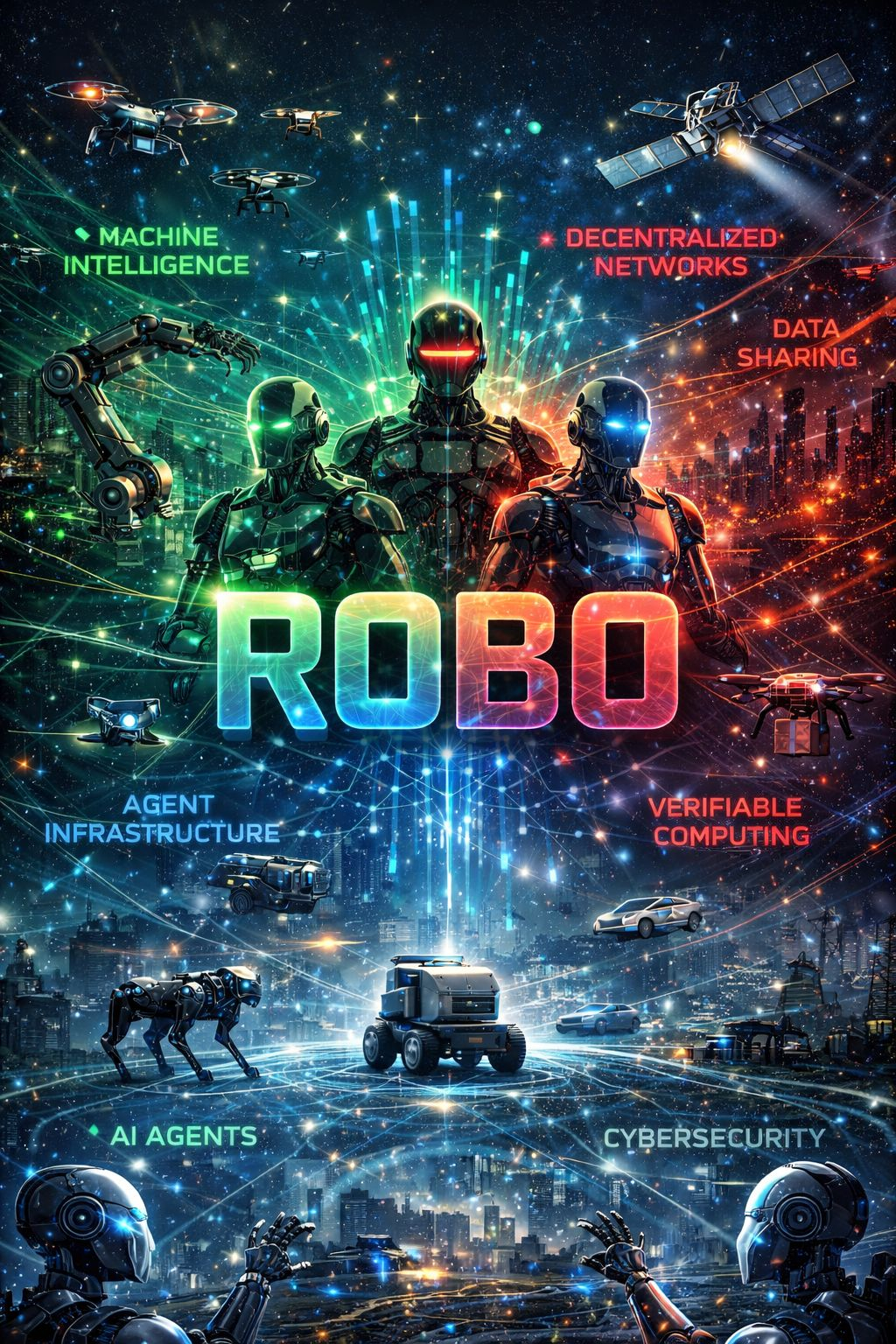
Fabric imagines an internet where these autonomous systems are not awkward guests but natural participants.
A robot could request computational resources to train a navigation model. A drone could access shared environmental data to improve its flight path. AI agents could coordinate logistics across fleets of machines scattered around the world. These interactions are recorded on a decentralized ledger, creating a transparent layer where machines exchange information and coordinate tasks.
It is helpful to think of Fabric not as a single piece of software but as a layered environment where several systems work together.
At the base sits the data layer. Robots generate enormous amounts of information every second—camera feeds, sensor readings, maps of physical spaces, and logs of how they interact with the world. Fabric allows this data to be stored and shared in decentralized systems where ownership and privacy remain protected. The goal is not to force companies to give away proprietary information but to create a framework where useful knowledge can circulate.
Above that layer sits distributed computing. Training robotic AI models requires vast amounts of processing power. Instead of relying entirely on centralized cloud providers, Fabric coordinates a network of computing nodes where participants contribute resources and receive incentives. This turns computation into something closer to a shared utility.
Then there is governance, which may be the most unusual element of the system.
As robots begin operating in public spaces and critical industries, questions about rules and responsibility inevitably arise. Who defines safety standards? How are software updates approved? What happens when autonomous systems make mistakes?
Fabric proposes a collaborative governance model where developers, institutions, and community participants help shape protocol decisions. The Fabric Foundation plays a stewardship role, guiding development while ensuring that the network remains open and transparent rather than controlled by a single corporation.
The idea echoes the early institutions that guided the development of the internet itself.
Another fascinating dimension of Fabric’s vision is the possibility of machine-driven economic activity.
Right now robots create value, but they don’t directly participate in economic systems. A warehouse robot moves products but doesn’t pay for the software updates that improve its performance. A drone collects environmental data but cannot exchange that data in a marketplace.
Fabric introduces the possibility that machines might eventually operate as economic actors.
A robot could purchase high-quality navigation data from another network. A drone could sell mapping information gathered during environmental monitoring. Computing nodes that help train robotic models could receive rewards for their contribution.
At first this sounds like science fiction, but small pieces of this future are already emerging in decentralized computing networks and AI agent ecosystems.
If machines can coordinate work and exchange resources autonomously, entirely new economic patterns could appear.
Despite the excitement surrounding such ideas, the road toward them will not be easy. Connecting physical machines to decentralized networks introduces complex security concerns. A vulnerability in digital infrastructure could potentially affect real-world systems. Ensuring that such networks remain safe and reliable will require careful engineering and oversight.
Regulation presents another challenge. Governments around the world are still trying to understand how to regulate artificial intelligence and robotics. Decentralized governance models add another layer of complexity that policymakers must navigate.
Perhaps the biggest hurdle, however, is adoption.
Protocols only become powerful when communities build around them. Developers must see value in contributing to the ecosystem. Robotics companies must feel comfortable integrating open infrastructure into their products. Researchers and institutions must find meaningful ways to collaborate within the system.
But if these pieces come together, Fabric Protocol could represent something larger than a single technology project.
It could become the connective layer that allows robots and AI systems to learn from each other at planetary scale.
Imagine fleets of delivery robots sharing real-time navigation knowledge across cities. Agricultural machines exchanging soil and climate data across continents. Environmental drones collectively mapping ecosystems and detecting climate changes faster than any single organization could manage.
Instead of machines evolving in isolation, intelligence would accumulate across a global network.
In many ways, Fabric Protocol is an attempt to weave a new kind of infrastructure—one designed not just for humans but for a world increasingly populated by intelligent machines. The name itself feels appropriate. A fabric is made from countless threads woven together, each contributing strength to the whole.
Robots today are those threads: independent, capable, but separate.
Fabric Protocol asks whether they might one day be woven into something much larger—a living network where machines, humans, and intelligence itself move together across the same digital fabric.