
I have spent the last seventy-two hours staring at two different browser tabs that represent the split soul of our current market. One shows the complex subnet performance of Bittensor while the other tracks the live registration of bipedal robots on the Fabric Foundation’s OM1 operating system. It is March 8, 2026, and as I sit here in my home office watching ROBO consolidate near the $0.0416 level after its explosive graduation to the Binance Spot market, I find myself conducting a quiet experiment on the nature of value itself. Hmmm... yes, the retail crowd is currently obsessed with the 24-hour trading volume of over $121 million, but the real research question I’m digging into is far deeper. Are we betting on the brain of the machine, or are we betting on its hands? This distinction between Bittensor’s decentralized intelligence and the Fabric Foundation’s focus on physical labor isn’t just a technical debate. It is the most important strategic crossroads for any investor in the AI and DePIN sector this year.
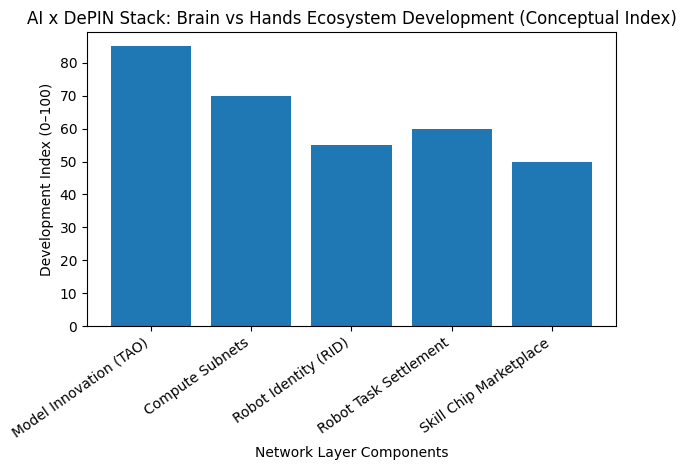
When we look at Bittensor, we are essentially looking at a global marketplace for the world of bits a system where TAO rewards the most efficient machine learning models and intellectual outputs. It is a brilliant architecture of the mind, and I’ve watched it mature since its early days. But during my research into the Fabric whitepaper published in December 2025, I realized that intelligence without a physical vessel is economically incomplete. No, robots cannot open bank accounts, and an AI model sitting on a server cannot deliver a package or weld a car frame. Fabric Foundation addresses this "original sin" of the digital age by building the economic rails for the world of atoms. While Bittensor focuses on what the machine thinks, Fabric focuses on what the machine does. This is the core of their Proof of Robotic Work or PoRW mechanism, which is fundamentally different from the consensus models we see in the "brain-only" AI protocols.I’ve been tracking the Robot Identity or RID registrations on the Fabric Protocol all morning, and the data suggests a shift in institutional sentiment. While TAO remains the king of decentralized compute narratives, ROBO is quickly becoming the settlement layer for the agentic economy where machines act as sovereign economic actors. Hmmm... consider this scenario. An AI model trained on a Bittensor subnet discovers a more efficient path for warehouse logistics. In the old world, that’s just data. In the 2026 Fabric economy, that data is instantly converted into a "Skill Chip" and purchased autonomously by a fleet of humanoid robots from manufacturers like UBTech or Fourier. The robots pay for this skill using $ROBO tokens stored in their native on-chain wallets, and the transaction settles in milliseconds on the protocol’s high-speed rails. This isn't science fiction anymore. It is the infrastructure we are currently stress-testing.From a trading perspective, the differences in tokenomics are striking. Bittensor uses a continuous emission model to reward model contributions, which has created a massive market cap but also persistent inflation concerns. Fabric, on the other hand, utilizes an Adaptive Emission Engine that I’ve been analyzing since the Token Generation Event on February 27th. According to the whitepaper, this engine is a discrete-time feedback controller that adjusts the supply of ROBO based on actual network utilization and service quality. If the robots aren't working efficiently falling below the 95 percent quality thresholdbthe supply issuance literally contracts. Yes, you heard that right. It is a performance-based monetary policy. As an analyst, I find this far more trustworthy than a fixed schedule because it ensures that every token is backed by a verifiable unit of mechanical labor.However, we must talk about the risks, and hmmm... they are significant. Bittensor has the advantage of a three-year head start and a deep ecosystem of subnets. Fabric is still in its "graduation" phase on Binance with a Seed Tag, meaning the volatility is higher and the circulating supply of 2.23 billion is only about 22 percent of the 10 billion total cap. My research indicates a "supply vacuum" until February 2027, when the 12-month cliff for the Pantera Capital-led investors and the core team finally ends. This creates a temporary window of artificial scarcity, but if the "Robot Economy" measured by actual task settlement volume doesn't scale fast enough to meet those future unlocks, the price action could face a reckoning. We are betting on the speed of physical adoption versus the speed of token releases. I believe we are transitioning from an era of "social trust" to an era of "temporal performance." In 2026, I don't care what a project's CEO says in a livestream; I care what the Proof of Robotic Work records on the public ledger. Bittensor has proven that machines can think together, but Fabric Foundation is now proving that machines can work together without a human master. The battle between TAO and ROBO isn't a zero-sum game; it is the assembly of a new civilization. Intelligence provides the plan, but labor builds the wall. As an investor, I’ve decided to stop looking for the "next AI coin" and start looking for the "first machine currency." Trust the math, respect the cliff, and watch the machines. In the end, the brain might conceive the future, but it is the hands that will own it. Hmmm... yes, the ledger is finally getting fingers, and those fingers are holding our future. Stay original, keep your eyes on the utilization targets, and remember that in the world of atoms, scarcity must be earned through sweat, even if that sweat is hydraulic.
@Fabric Foundation #ROBO $ROBO
