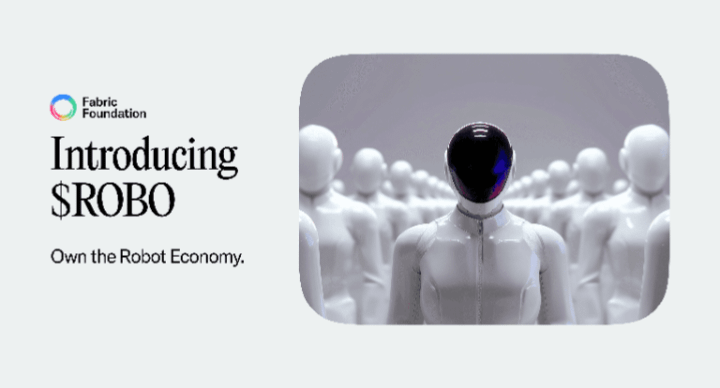
@Fabric Foundation Fabric Foundation is an emerging AI + robotics + blockchain project aiming to build infrastructure for what it calls the “Robot Economy.” Instead of focusing only on digital assets or DeFi, Fabric is trying to create a decentralized network where robots and autonomous machines can operate as economic participants—earning, paying, and coordinating work through blockchain systems.
Fabric Foundation +1
The project introduces $ROBO, the native token of the Fabric ecosystem, which functions as both a utility token and governance asset used for payments, identity verification, and network participation.
Fabric Foundation +1
This concept places Fabric in a unique narrative category within crypto: AI infrastructure + robotics automation + Web3 coordination.
Core Technology & Use Case
1. Building the “Robot Economy”
Fabric’s main thesis is that robots will soon perform large amounts of labor across industries such as logistics, healthcare, manufacturing, and services. However, current systems lack the infrastructure needed for machines to function independently in economic systems.
Fabric Foundation
Fabric attempts to solve this by providing:
On-chain machine identity for robots
Crypto wallets for robots to receive payments
Decentralized task allocation between humans and machines
Transparent tracking of robot performance
Through this model, robots could theoretically accept tasks, complete them, and receive payment automatically through smart contracts.
Bitget
Tokenomics ($ROBO)
Token: ROBO
Total Supply: 10 billion tokens
Supply Model: Fixed supply (no inflation)
Network: Initially deployed on Base (Ethereum Layer-2)
Bitget
Token Utility
$ROBO powers the Fabric ecosystem by enabling:
Network fees for identity verification and transactions
Governance voting on protocol upgrades
Payment settlement for robot labor services
Staking and network participation incentives
Fabric Foundation +1
Key Developments
1. Token Launch (2026)
The project launched its token generation event in February 2026, marking the public debut of $ROBO in the crypto market.
Bitget
Shortly after, the token began trading on several crypto exchanges, representing the project’s transition from development phase to market discovery.
HOKANEWS.COM
2. Robotics Infrastructure Vision
Fabric’s long-term plan involves building a global coordination network for robotic labor.
Instead of centralized robotics companies owning fleets, Fabric proposes a community-owned coordination layer where participants can help fund, deploy, and operate robot fleets while sharing the benefits of automation.
Fabric Foundation
3. AI-Driven Robotics Stack
According to its whitepaper, Fabric is developing a modular robotics intelligence system, where robotic skills can be added as “skill chips,” similar to installing apps.
Fabric Foundation
This architecture could allow developers worldwide to contribute new capabilities to robots, expanding the ecosystem over time.
Roadmap (Key Direction)
While the project is still early, its roadmap focuses on several major milestones:
Phase 1 – Network Launch
Token generation event (TGE)
Deployment on Base blockchain
Initial ecosystem incentives
Phase 2 – Infrastructure Development
On-chain robot identity registry
Decentralized robotics task marketplace
Machine payment infrastructure
Phase 3 – Ecosystem Expansion
Partnerships with robotics operators
Real-world robotic deployments
Development tools for robotic applications
Phase 4 – Dedicated Blockchain
Fabric plans to eventually transition into a custom Layer-1 blockchain optimized for high-frequency machine transactions.
Bitget
Fundamental Strengths
1. Unique Narrative (AI + Robotics + Crypto)
Fabric sits at the intersection of three major technology trends:
AI
Robotics automation
Blockchain coordination
If these industries converge, Fabric could benefit from a powerful long-term narrative.
2. Real-World Infrastructure Focus
Unlike many speculative crypto projects, Fabric targets real-world machine economies, not just digital finance.
3. Early Positioning
The robotics economy is still in its infancy, which means Fabric is positioning itself early in a potentially massive future industry.
Risks & Challenges
1. Extremely Early Stage
Most of the project’s vision depends on future robotics adoption, which could take years.
2. Execution Complexity
Combining robotics, AI, blockchain, and economic coordination is technically difficult.
3. Adoption Dependency
The success of the network depends on:
robotics companies integrating with it
real-world deployments
Without these, the token may remain speculative.
Overall Fundamental Outlook
Fabric Foundation represents a high-risk, high-potential crypto project focused on enabling machines to become participants in a decentralized economy.
If the robot economy narrative grows alongside AI automation, Fabric could become an interesting infrastructure layer in that ecosystem. However, it remains early-stage and speculative, with many technological and adoption hurdles ahead.
✅ Short Summary
Bullish factors
AI + robotics + blockchain narrative
Unique real-world use case
Early infrastructure for machine economies
Bearish factors
Very early development stage
Heavy reliance on robotics industry growth
Uncertain real-world adoption
#Crypto #Cryptocurrency #CryptoNews #CryptoAnalysis