
When people imagine the future of robotics, they usually focus on intelligence.
- Smarter AI.
- Better sensors.
- More capable machines.
But the real obstacle to a global robot economy might not be intelligence at all.
It might be infrastructure.
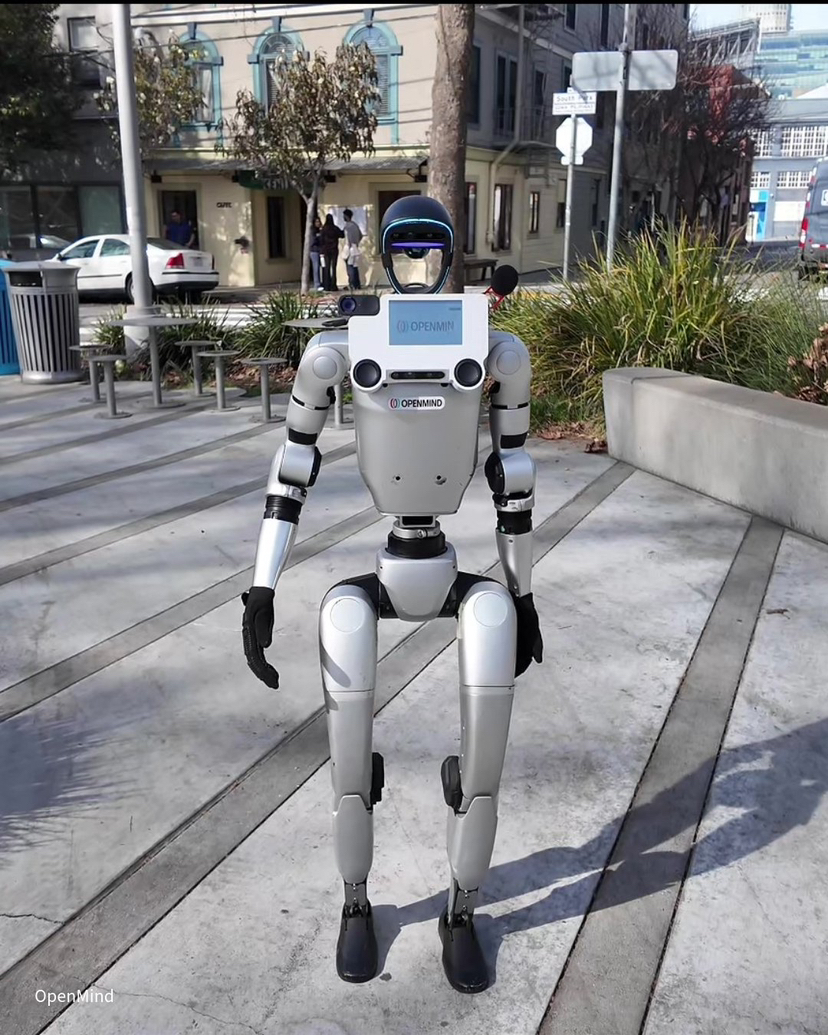
Today, robots already work in warehouses, hospitals, factories, and logistics centers. They sort packages, transport goods, assist workers, and perform repetitive tasks. Yet despite this progress, robots still operate mostly as isolated systems.
A typical robotic deployment looks something like this.
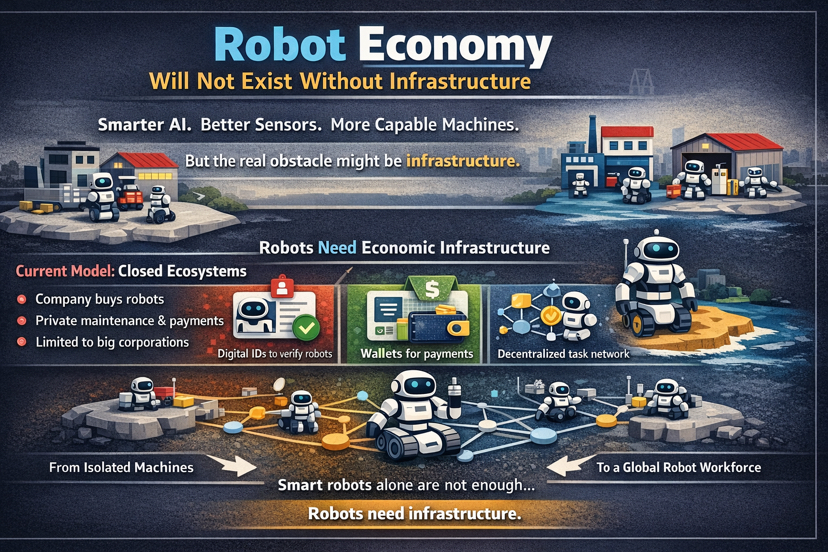
- A company purchases a fleet of robots.
- The robots operate inside that company’s internal system.
- Maintenance, charging, scheduling, and payments are all managed privately.
Every deployment becomes its own closed ecosystem.
This model works at small scale, but it prevents robotics from becoming a true global workforce. Access to automation remains limited to organizations that can afford the capital and infrastructure needed to deploy robots themselves.
If robots are going to scale across industries and cities, something very different is needed.
They need economic infrastructure.
Humans already operate inside complex economic systems. We have identity documents, bank accounts, contracts, and payment networks. These structures allow millions of people who have never met to coordinate work and exchange value every day.
Robots have none of these things.
- A robot cannot open a bank account.
- It cannot sign a contract.
- It cannot prove its identity across organizations.
Without these capabilities, robots remain tools controlled by centralized operators rather than independent participants in an economy.
This is the problem projects like Fabric Protocol are trying to solve $ROBO
1. The first requirement is identity.
If robots operate across warehouses, cities, and supply chains, the network needs a way to verify what each robot is, who operates it, and what tasks it has completed in the past. A persistent digital identity allows machines to be recognized and trusted across different environments.
2. The second requirement is financial capability.
For robots to participate in an economy, they need wallets. They must be able to receive payments for completing tasks and pay for services such as computation, maintenance, or energy. Blockchain-based accounts allow machines to hold cryptographic keys and execute transactions automatically.
3. The third requirement is coordination.
If thousands or millions of robots are operating simultaneously, tasks must be assigned, verified, and rewarded in a transparent system. Decentralized networks make it possible to coordinate this activity without relying on a single centralized operator.
In this model, robots are no longer isolated machines.
They become nodes in a shared economic network.
- Tasks can be published openly.
- Robots can accept work based on their capabilities.
- Proof of completion can be verified.
- And payments can be settled automatically.
This changes how robotics fits into the economy.
Instead of companies owning small, closed robotic fleets, machines could participate in open networks where developers, operators, and users collaborate to deploy automation at global scale.
The robot economy will not emerge simply because machines become smarter.
It will emerge when the systems exist that allow robots to identify themselves, coordinate work, and exchange value.
In other words, intelligence alone is not enough.
$ROBO Robots need infrastructure.