

I've spent the last four years covering blockchain technology—attending developer conferences, reading whitepapers that put me to sleep, and watching countless projects promise the moon only to disappear when the market turns. Through all of that, I've developed a healthy skepticism for anything that sounds too good to be true.
So when I first heard about Midnight Network, I did what I always do: I ignored the hype and started digging into the technical documentation. What I found surprised me enough to spend the next few weeks talking to developers, reading through their code repositories, and trying to understand what they're actually building.
This is what I learned.
The Privacy Problem That Nobody Solved
Let me start with a story.
A few months ago, I was talking to a friend who runs a medium-sized import business. He's been in crypto since 2017, holds Bitcoin and Ethereum, and genuinely believes in the technology. But when I asked him why he doesn't use blockchain for his actual business operations—tracking shipments, managing payments to overseas suppliers—he laughed.
"You want me to put my entire supply chain on a public ledger?" he said. "So my competitors can see exactly who I'm buying from, how much I'm paying, and when my shipments arrive?"
He had a point.
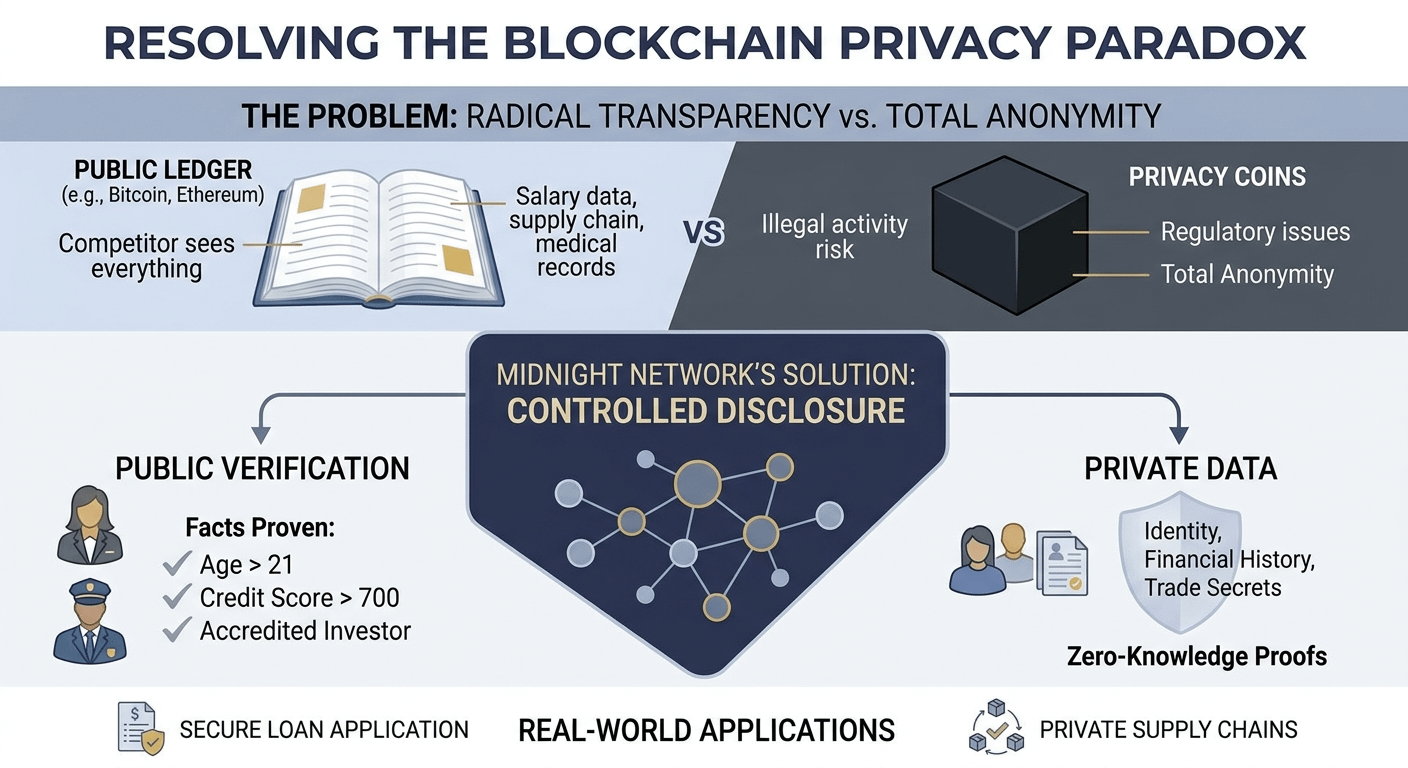
This is the paradox that blockchain has never quite solved. The technology promises transparency and trust, but the real world runs on secrets. Companies protect their supplier relationships. Individuals don't want their salaries public. Hospitals can't share patient data on an open network.
Bitcoin and Ethereum give us radical transparency. Privacy coins give us radical anonymity. But what the actual economy needs is something in between—a way to verify information without revealing it.
This is the problem Midnight Network is trying to solve.
What Actually Makes Midnight Different
I'll be honest: when I first started reading about Midnight, I assumed it was another privacy coin trying to rebrand itself for the 2020s. The crypto space is full of projects that claim to protect your data while doing very little differently.
But as I dug deeper, I realized Midnight takes a fundamentally different approach.
Most privacy-focused blockchains start with a simple goal: hide everything. Transactions, balances, smart contract interactions—all of it goes into an encrypted black box. This works for users who want complete anonymity, but it creates two serious problems.
First, regulators hate it. When financial institutions can't see what's happening on a network, they can't use it. Second, many real-world use cases don't actually need total secrecy. They need selective disclosure.
Midnight's architecture is built around something its developers call "controlled disclosure." The idea is simple but powerful: give users and businesses the ability to prove specific facts about their data without revealing the data itself.
Here's a concrete example. Imagine you're applying for a loan. Today, you'd probably hand over bank statements, tax returns, and a complete picture of your financial history. The lender sees everything, even information that has nothing to do with whether you can repay the loan.
On Midnight, you could prove that your income exceeds a certain threshold, that you have sufficient collateral, and that you've never defaulted on a loan before—all without revealing your exact income, your total net worth, or any transaction history. The lender gets exactly the information they need to make a decision, and nothing more.
This isn't just a theoretical feature. It's built into the network at the protocol level through zero-knowledge proofs, a cryptographic technique that lets one party prove to another that a statement is true without revealing any additional information.
The Machine Economy Changes Everything
Here's something I've been thinking about a lot lately.
We're entering a period where more and more economic activity won't involve humans at all. AI agents will negotiate with each other. Autonomous robots will order replacement parts when they break down. Sensors will sell data to other sensors.
This isn't science fiction. It's already happening in limited ways, and it's going to accelerate.
But here's the problem nobody's talking about: how do these machines establish trust?
When a robot from one factory needs to order parts from a robot in another factory, they need to verify each other's credentials. The purchasing robot needs to prove it has the authority to buy and the funds to pay. The selling robot needs to prove it can deliver quality parts on time.

On a public blockchain, every interaction would be visible to competitors. Factory A doesn't want Factory B to know how often their robots break down. Factory B doesn't want competitors to see their pricing or delivery volumes.
This is where Midnight's architecture becomes interesting. The network is designed specifically for machine-to-machine transactions, with privacy features that let autonomous systems verify each other without exposing sensitive operational data.
I spent some time reading through Midnight's technical documentation on this, and what struck me was how seriously they've thought about the problem. Most blockchain projects talk about the machine economy as a marketing angle. Midnight has actually built infrastructure that addresses the specific trust and privacy requirements of autonomous systems.
The Dual Token Model: Boring but Brilliant
I need to talk about tokens for a moment, even though I usually find token economics incredibly dull.
Most blockchain projects design their token economics to maximize speculation. They want traders excited, influencers promoting, and prices pumping. This is understandable—rising prices attract attention and funding.
But it creates a real problem for anyone trying to actually use the network.
Think about Ethereum during the DeFi summer of 2020, or during any NFT mania. When transaction fees spike because of speculation, actual users get priced out. Businesses can't plan around costs that might multiply tenfold in a week.
Midnight has taken a different approach with what they call a dual token model, and honestly, it might be the smartest thing about the whole project.
The network has two tokens: NIGHT and DUST. NIGHT is what you might expect. It's the asset you buy if you believe in the project's long-term value. You can stake it to help secure the network, and you can use it to participate in governance decisions about how the protocol evolves. Think of it as ownership in the network.
DUST is where things get interesting.
You can't buy DUST on an exchange. You can't speculate on it. The only way to get DUST is to hold NIGHT, which automatically generates DUST over time. And DUST is the only thing you can use to pay for transactions on the network.
Here's why this matters.
When you separate the speculative asset from the utility asset, you create predictability. A business using Midnight can estimate their transaction costs based on the DUST they generate from their $NIGHT holdings, not based on whatever mania is happening in the markets that week.
There's another feature that caught my attention: DUST has a decay mechanism. If you hoard it without using it, it slowly disappears. This prevents large holders from accumulating all the DUST and driving up transaction fees. It keeps the economy flowing.
Is this model perfect? Probably not. But it shows that the people building Midnight are thinking about actual usage, not just speculation.
What the Kūkolu Mainnet Actually Means
Later this month, Midnight is launching what they call the Kūkolu Mainnet. In crypto, "mainnet launch" usually means "now you can trade our token." But with Kūkolu, something different is happening.
The node operators aren't just anonymous enthusiasts running servers from their bedrooms. They're some of the biggest infrastructure companies in the world.
Google Cloud is operating nodes. This isn't a marketing partnership where Google lets Midnight use their name—Google is actually running the infrastructure that keeps the network running.
Blockdaemon, which provides institutional-grade blockchain infrastructure to banks and enterprises, is also operating nodes.
Vodafone, through their Pairpoint initiative, is involved. This matters because Vodafone sits at the center of global telecommunications and IoT infrastructure. Their participation suggests Midnight is being designed to interact with billions of connected devices.
And then there's MoneyGram. This is the one that made me sit up and pay attention.
MoneyGram operates in over 200 countries. They process billions of dollars in remittances—money that migrant workers send home to their families. For years, crypto has promised to disrupt this industry by making cross-border payments faster and cheaper. It hasn't happened, largely because regulatory compliance is so complex.
MoneyGram running a Midnight node suggests they see a path to using this technology for actual remittance business, not just as a speculative sideshow.
When you see this caliber of companies committing infrastructure to a blockchain network, the conversation changes. We're not talking about whether the technology works anymore. We're talking about how quickly it scales.
The Regulatory Question Nobody Wants to Ask
I need to address something uncomfortable.
Privacy-focused cryptocurrencies have a complicated history with regulators. Monero and Zcash have faced delistings from exchanges. Privacy features have been used by bad actors to launder money. When a new privacy project emerges, the immediate question from regulators is: "How will this be used for illegal activity?"
Midnight's team seems to have thought about this carefully.
The controlled disclosure model isn't just about giving users flexibility. It's also about creating a framework where regulated institutions can participate. A bank using Midnight can prove to regulators that they're complying with anti-money laundering rules without revealing every transaction to the public.
This is a fundamentally different approach from "privacy at all costs." It's privacy within boundaries, privacy that acknowledges the legitimate needs of law enforcement and regulators while still protecting users from unnecessary surveillance.
Will this satisfy regulators? I honestly don't know. But it's a more sophisticated approach than simply saying "privacy is a human right and we don't care what governments think."
What I Still Don't Know
After weeks of research, there are things about Midnight I still can't figure out.
The user experience, for one. Zero-knowledge proofs are computationally intensive. Even with all the optimizations in the world, will using Midnight feel slow and clunky compared to networks that don't prioritize privacy? The documentation suggests they've made major progress on this, but I haven't used the mainnet myself yet.
Developer adoption is another question mark. A blockchain is only as valuable as the applications built on top of it. Midnight has some interesting partnerships, but will developers actually build on it? Or will they stick to Ethereum and other established networks where users and liquidity already exist?
And then there's the competition. Other projects are working on similar problems. Some are further along. Some have more developer mindshare. Midnight has a thoughtful approach, but thoughtful approaches don't always win.
The Bigger Picture
Here's where I've landed.
For the last few years, blockchain has been stuck in a cycle. New projects launch with big promises. Speculators pile in. Prices go up. Prices go down. And through it all, actual adoption—real businesses using the technology for real purposes—moves at a glacial pace.
The reason, I've come to believe, is that the technology hasn't matched what the economy actually needs. Businesses need transparency for trust, but privacy for competition. Individuals need to prove things about themselves without exposing everything. Regulators need visibility without compromising user rights.
Midnight is the first project I've seen that seems to understand this tension and has built something to address it.
I don't know if they'll succeed. The crypto space is littered with well-designed projects that never gained traction. But for the first time in a while, I'm watching a mainnet launch not because I'm curious about the token price, but because I'm curious about whether the technology actually works.
The Kūkolu Mainnet launches this month. After that, we'll start getting answers.
$NIGHT @MidnightNetwork #night #NIGHT
#marouan47
