

When you first hear about Fabric Protocol, it doesn’t sound flashy. No promises of “the metaverse of robots” or “decentralized Tesla fleets.” It’s just a calm, almost under‑the‑radar idea: that instead of treating every robot as a separate silo, we could build a shared, open network where robots and AI agents can actually coordinate, learn, and evolve together—while still being accountable and transparent. From a Binance Square Creator Pad lens, what’s interesting isn’t the noise around it; it’s the way Fabric reframes problems that everyone else has been avoiding.
Most robotics projects today still feel like they’re built for one owner, one fleet, one closed ecosystem. Data lives in private servers, APIs are custom, and there’s no easy way for humans, regulators, or even other robots to understand what’s really happening behind the scenes. Fabric’s approach is quieter and more structural: instead of racing to build the fanciest robot, it’s trying to build the missing layer that lets robots and agents talk to each other in a shared language. It’s less about the robot itself and more about the rules of interaction, identity, and accountability that sit beneath it.
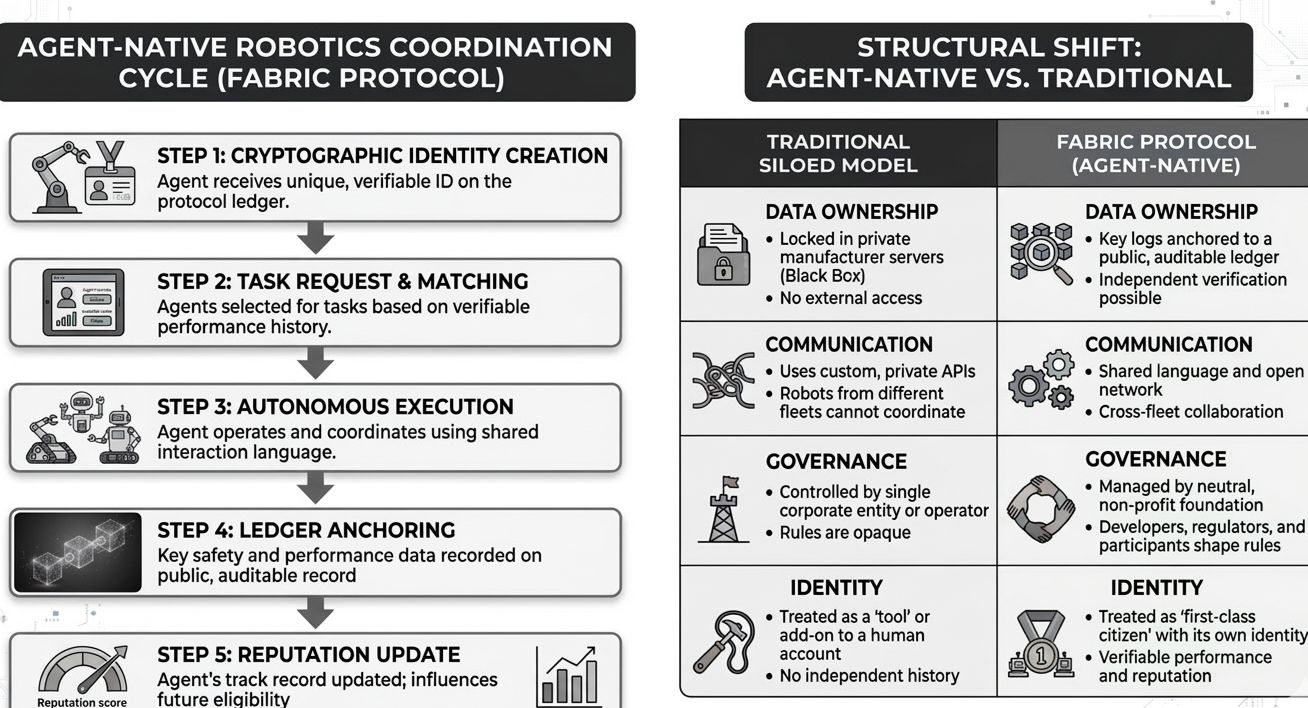
What makes Fabric stand out is how it treats agents and robots as first‑class citizens in the system, not as add‑ons. Many platforms today are still human‑first: the user logs in, gives instructions, and the robot or AI follows. With Fabric, the architecture is “agent‑native,” which means the protocol is designed from the ground up with autonomous agents in mind. That quietly changes everything. Suddenly, a robot can maintain its own identity, a verifiable track record of performance, and even a kind of reputation that can be inspected by others. Over time, this could allow very different kinds of collaborations—multiple manufacturers, multiple operators, even multiple countries—working together on shared tasks without needing a single, centralized orchestrator holding all the keys.
A big part of that vision rests on verifiable computing and a public ledger. Instead of relying on opaque internal logs, Fabric anchors key decisions, behaviors, and interactions onto a shared, auditable record. This doesn’t mean every movement of every robot is broadcast to the world; it means that the parts that matter for safety, regulation, and trust can be independently verified. For regulators, that’s a way to make sure certain standards are being followed without relying solely on a company’s word. For developers and researchers, it opens the door to a new kind of experimentation: analyzing patterns across large fleets of robots, spotting systemic risks, and building tools that react to real‑world behavior instead of theoretical assumptions.
Unlike many crypto‑adjacent projects that either ignore governance or treat it as a token‑based game, Fabric is backed by a non‑profit foundation that aims to keep the protocol neutral and open. That’s not just a branding choice; it’s an attempt to handle the fact that robotics and AI sit at the intersection of technology, safety, and regulation. By designing governance as an integral part of the stack, Fabric makes it possible for developers, robot operators, researchers, and even policy‑aware participants to shape how the rules evolve over time. If new safety standards emerge, or if a region introduces updated requirements for AI‑driven robots, those can be reflected in the protocol’s governance structure, with the ledger helping to keep compliance visible and checkable.
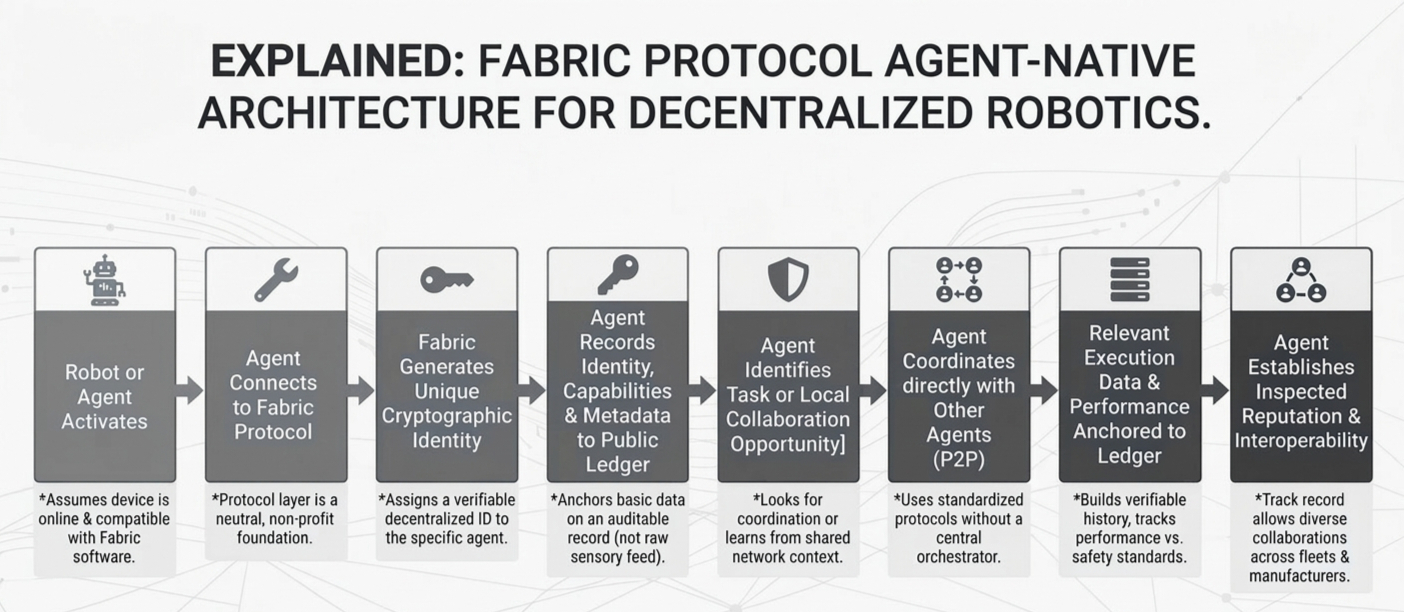
One of the most refreshing things about Fabric is how it quietly rejects the usual extremes of the AI‑robotics narrative. So much of the public conversation swings between utopian visions of “robots freeing us from all work” and dystopian fears of “machines taking over.” Fabric’s architecture leans toward a third, more grounded space: robots and AI as co‑pilots and collaborators that operate under shared rules, with human oversight still very much in the picture. By giving robots cryptographic identities and verifiable behavior histories, the protocol makes it possible to design workflows where humans and machines are coordinated around tasks, not just around ownership. Imagine a shared network of agricultural robots contributed by different farms, where each robot’s performance, safety record, and resource usage are visible and auditable. Farmers gain access to more capable machinery without needing to own it outright; manufacturers gain real‑world data and reputation signals; and regulators can ensure that safety standards are being followed—all without creating a single, monopolistic operator.
From a creator’s perspective on Binance Square, Fabric isn’t a vertical “play” in the sense of “how to flip this token” or “why this will 100x.” It’s more like a foundational layer that subtly reshapes how you think about integrating AI and robotics into Web3‑native applications. You can start designing applications where agents and robots are true participants, not just extras in the background. You can experiment with new kinds of data and reputation primitives—reputation‑like scores for robots, insurance‑style models based on performance, even machine‑to‑machine collaboration patterns that don’t currently exist in a standardized way. And as governments start paying closer attention to AI and robotics, having a protocol that can demonstrate verifiable compliance and transparent governance becomes a strategic advantage, not just a marketing line.
What’s most striking about Fabric is how quietly ambitious it feels. It isn’t trying to sell a utopia or scare you with dystopia. It’s asking a much harder question: what would it actually take to coordinate thousands, maybe even millions, of robots and AI agents in a way that’s safe, transparent, and collaborative? Instead of hand‑waving, it’s trying to build an architecture that can answer that question without oversimplifying the messiness of the real world. In a space that’s often dominated by hype, Fabric comes across as a rare kind of project—one that’s more interested in long‑term foundations than short‑term attention. Whether it becomes the dominant coordination layer for robotics or simply one of several experiments, its architecture feels like a small but meaningful step toward a future where robots aren’t just tools, but participants in an open, shared ecosystem—and where humans still hold both oversight and agency in that process.
@Fabric Foundation #ROBO $ROBO
