

I've always found myself drawn to creations that prioritize subtlety over spectacle, and Zcash exemplifies that in the sprawling universe of blockchains. It's not the loudest voice in crypto, but its quiet brilliance lies in solving one of the most fundamental paradoxes of decentralized ledgers: how can a system verify truth publicly while preserving the sanctity of personal data privately? Emerging in 2016 as a fork of Bitcoin, spearheaded by cryptographer Zooko Wilcox and the Electric Coin Company, Zcash introduced zk-SNARKs—zero-knowledge succinct non-interactive arguments of knowledge—to the mainstream. This allowed users to prove the validity of transactions without disclosing sender identities, recipient details, or even transaction amounts, unless explicitly chosen. To me, this feels like a philosophical upgrade to money itself, transforming a transparent ledger into a canvas of selective revelation, where utility flows freely without the chains of unwanted exposure.
The elegance of Zcash's architecture starts with its bifurcated address system, a design choice that resonates with real human variability. Transparent addresses, or t-addrs, function much like Bitcoin's UTXOs—fully auditable, legible to all, ideal for scenarios demanding accountability such as corporate treasuries or regulatory filings. In contrast, shielded addresses, known as z-addrs, envelop transactions in a cryptographic veil, leveraging zk-SNARKs to generate proofs that affirm balance conservation and no double-spends without revealing underlying data. This opt-in privacy model sidesteps the pitfalls of mandatory opacity seen in alternatives like Monero, where every transaction inherits suspicion. Instead, Zcash empowers choice: a freelancer might shield gig payments for discretion, while a DAO could use transparent notes for public treasury reports. It's this adaptability that makes Zcash feel organically human—mirroring how we navigate privacy in daily life, revealing just enough to proceed while guarding what matters most.
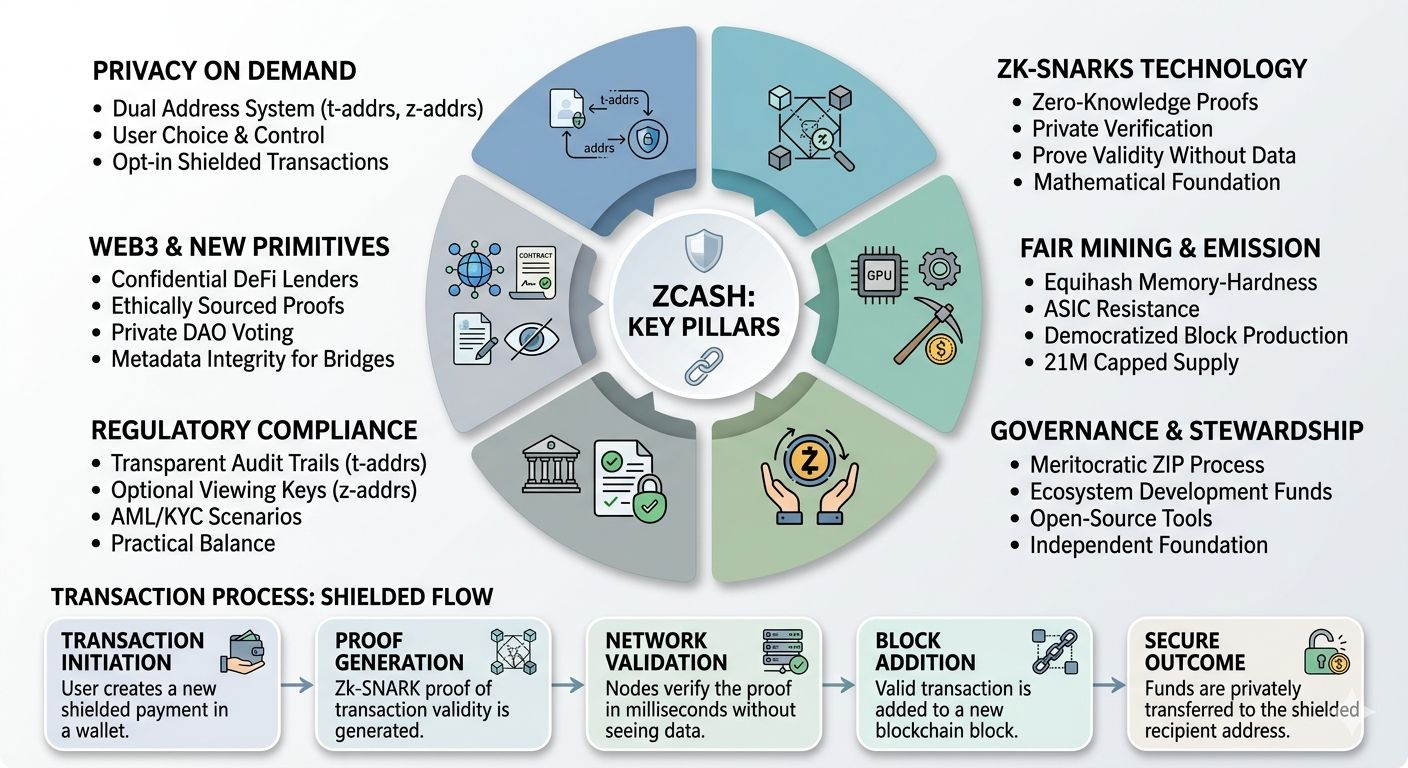
Delving into the cryptographic heart, zk-SNARKs represent a pinnacle of mathematical ingenuity that continues to captivate me. These proofs distill enormously complex computations—verifying entire transaction histories—into mere 256 bytes verifiable in under a millisecond on standard hardware. Early implementations required a "trusted setup" ceremony, where participants generated public parameters through a ritualistic multi-party computation to prevent forged proofs. Over time, innovations like the Powers-of-Tau protocol distributed this risk across hundreds of anonymous contributors, and later, the Halo 2 upgrade introduced the first trustless recursive proofs, eliminating setups entirely by bootstrapping verification from within the system itself. Network Upgrade 5 (NU5) in 2022 further refined this with Orchard, a new shielded payment pool that balances efficiency and auditability. What strikes me as profoundly positive is how these evolutions don't just patch vulnerabilities; they expand Zcash's applicability, turning proofs into portable tools that lightweight devices can wield without compromise.
Mining on Zcash reveals yet another facet of thoughtful engineering, designed to foster inclusivity amid decentralization pressures. The Equihash algorithm, chosen for its memory-hardness, pits miners against puzzles solvable primarily through GPU or CPU resources rather than specialized ASICs, which have come to dominate Bitcoin's landscape. This resistance has sustained a diverse miner base longer than many peers, with block times clocking in at a brisk 75 seconds and a total supply capped at 21 million coins, echoing Bitcoin's scarcity model. Post the 2020 halving, a 20% founder reward mechanism redirected block subsidies toward ecosystem development—funding everything from protocol research to developer grants via the Zcash Foundation. While mining pools inevitably concentrate hash power, the network's steady hash rate demonstrates resilience, ensuring blocks propagate reliably even as global energy dynamics shift. It's a system that rewards participation without pandering to industrial-scale operations, quietly democratizing access to block production.
One of the rarer angles I appreciate about Zcash is its potential as a privacy primitive for emerging paradigms beyond simple value transfer. Imagine confidential DeFi primitives where lenders verify borrower solvency via zero-knowledge attestations without exposing portfolio compositions, mitigating front-running or oracle manipulations. In supply chain finance, producers could prove ethical sourcing—fair labor certifications, origin traceability—without divulging competitive cost structures to rivals. Private voting mechanisms for DAOs become feasible, tallying quorums on sensitive proposals like treasury reallocations while shielding individual stances. Cross-chain bridges gain a layer of discretion, wrapping assets with proofs that preserve metadata integrity during hops between ecosystems like Ethereum or Solana. These aren't pie-in-the-sky visions; they're logical extensions of Zcash's tech stack, positioning it as the cryptographic plumbing for Web3 applications where data leakage could erode trust or invite exploitation. The positivity here is in its under-the-radar utility—enabling collaboration in a distrustful digital realm.
Governance in Zcash evolves with a stewardship ethos that's refreshingly devoid of the governance token frenzies plaguing other chains. The founder rewards, tapering off by 2024, seeded the ZIP process (Zcash Improvement Proposals), a meritocratic forum where developers, researchers, and community stewards debate upgrades like unified addresses—seamless z/t interoperability that hides complexity from users. The Zcash Foundation channels funds into bounties for audit tooling, such as flight simulators for proof generation and formal verification suites ensuring SNARK soundness. This focus on primitives over peripherals has ripple effects: Zcash's SNARK libraries now underpin Ethereum layer-2 solutions like Aztec or Polygon Nightfall, where privacy rollups borrow the tech wholesale. It's leadership through example—cultivating open-source tools that elevate the broader field without proprietary lock-in, fostering an ecosystem where Zcash thrives as an interoperable cornerstone.
Navigating the regulatory thicket, Zcash's hybrid model offers a pragmatic bulwark against overreach. Transparent addresses provide clear audit trails for KYC/AML compliance, allowing exchanges to monitor inflows without delisting the asset outright, unlike purer privacy coins facing bans in jurisdictions like Japan or South Korea. Shielded pools, meanwhile, safeguard retail users from metadata surveillance, with tools like the Orchard suite introducing optional viewing keys for selective disclosure—proving regulatory compliance without universal unmasking. As global frameworks like the EU's MiCA or U.S. clarity on digital assets mature, this balance positions Zcash as a compliant conduit for institutional adoption, from tokenized remittances shielding migrant worker data to healthcare protocols verifying insurance claims privately. It's not capitulation to authority; it's strategic coexistence, ensuring privacy endures in policy arenas increasingly hostile to absolutes.
A deeper observation corrects a subtle misconception in casual discourse: while shielded transaction volumes have grown—now comprising 10-20% of activity thanks to mobile wallet integrations like Edge and Cake—ubiquity remains elusive, held back by proof generation latency on low-end devices. Yet, progressive siloing (separating memo fields for metadata) and ZIP 317's halving schedule have optimized resource use, paving the way for mainstream viability. Early ceremony risks, once a critique, are relics post-Halo, with recursive composition enabling proofs-about-proofs for layered privacy. This measured trajectory—prioritizing soundness over speed—instills confidence: Zcash isn't rushing maturity but engineering it deliberately, a trait rare in crypto's haste-driven culture.
Analytically, Zcash reframes blockchain's value proposition from mere speed or yield to sovereignty amplification. In an era of centralized data harvesters—behemoths scraping transaction graphs for behavioral profiles—its proofs let individuals attest to attributes (credit history, asset ownership, compliance status) without ceding raw data, birthing "verifiable compute" paradigms. Hybrid architectures loom: Ethereum L2s offloading SNARK verification to Zcash nodes, or sovereign identity systems where wallets prove age or residency zero-knowledge style. For developers in Rahim Yar Khan or beyond, this opens doors to localized apps—like private micropayments for agricultural co-ops, verifying yields without exposing farm economics. The inherent positivity is empowerment: users reclaim narrative control, transacting with the assurance that utility accrues without unintended tribute to watchers.
Reflecting on Zcash holistically, it embodies crypto's aspirational core—technology as an extension of human intent, not its override. No moonshot promises, just resilient machinery that honors choice amid collective scrutiny. Its journey from Bitcoin's shadow to privacy's vanguard underscores a truth: true innovation whispers through iteration, building tools that protect quietly while enabling boldly. For thinkers, builders, or custodians of data in our hyper-connected age, Zcash stands as a testament to what's possible when math meets modesty—fostering a digital economy where ownership isn't abstract, but palpably yours. In a landscape cluttered with echoes, it remains a singular echo of principled progress.
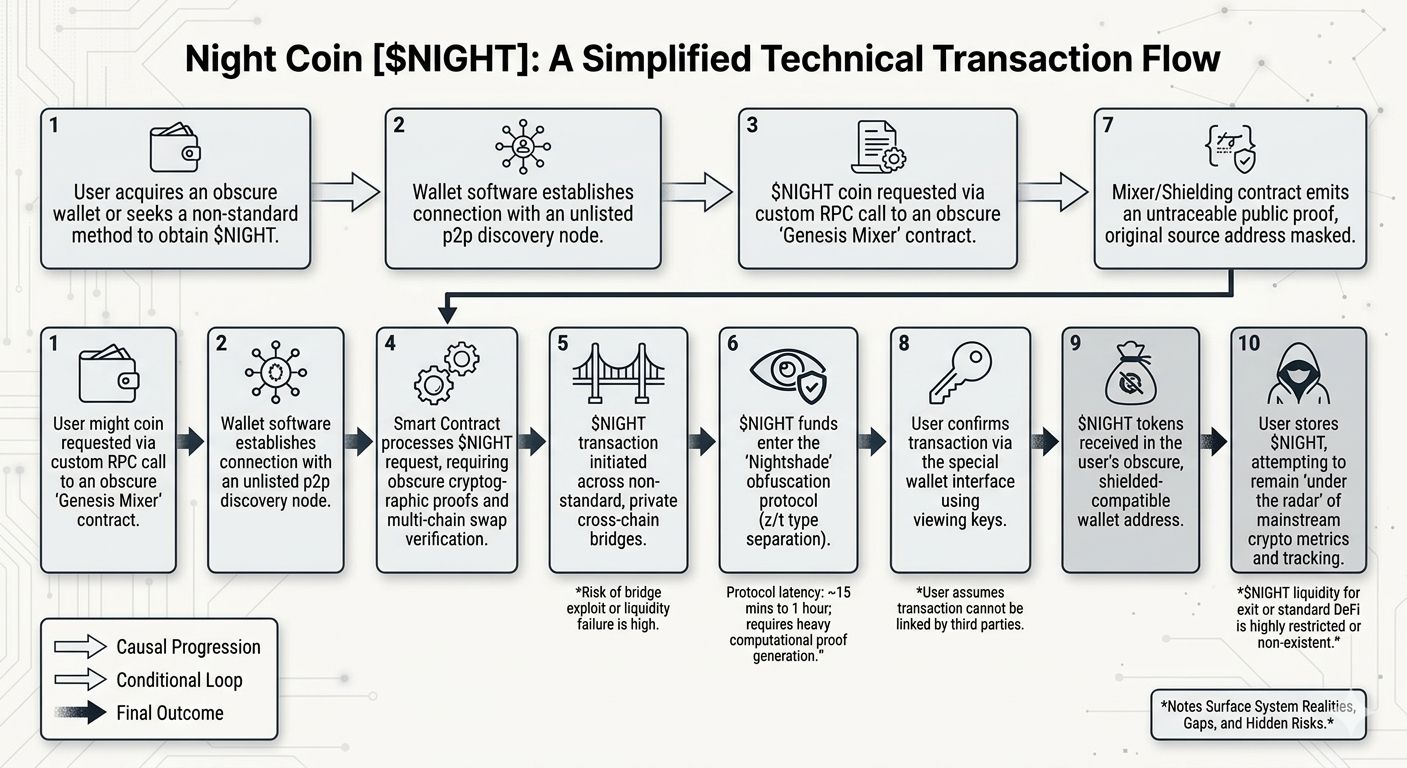
@MidnightNetwork #night $NIGHT
