
I’ve noticed a particular feeling that tends to surface whenever a new crypto project appears. It isn’t excitement anymore, at least not immediately. Instead, there’s a quiet fatigue that seems to follow the announcement of yet another protocol promising to reshape industries, reinvent infrastructure, or unlock entirely new economic systems. After years of ambitious whitepapers and bold narratives, many people instinctively approach new ideas with caution. That was more or less my reaction the first time I came across Fabric Protocol.
At first glance, it sounded familiar. Another blockchain project positioning itself as infrastructure for the future. Another system promising to coordinate complex networks in ways existing systems cannot. Crypto has produced countless variations of this narrative over the years, each introducing new technical concepts or economic models meant to solve the limitations of earlier designs.
So my initial instinct was simple: skepticism.
But after looking a little closer, I realized that Fabric Protocol seemed to approach a slightly different problem than many crypto projects before it. Most blockchain systems focus on digital assets, financial transactions, or decentralized applications that live entirely within software environments. Fabric Protocol, however, appears to focus on something less purely digital: machines operating in the real world.
That distinction matters more than it might seem at first.
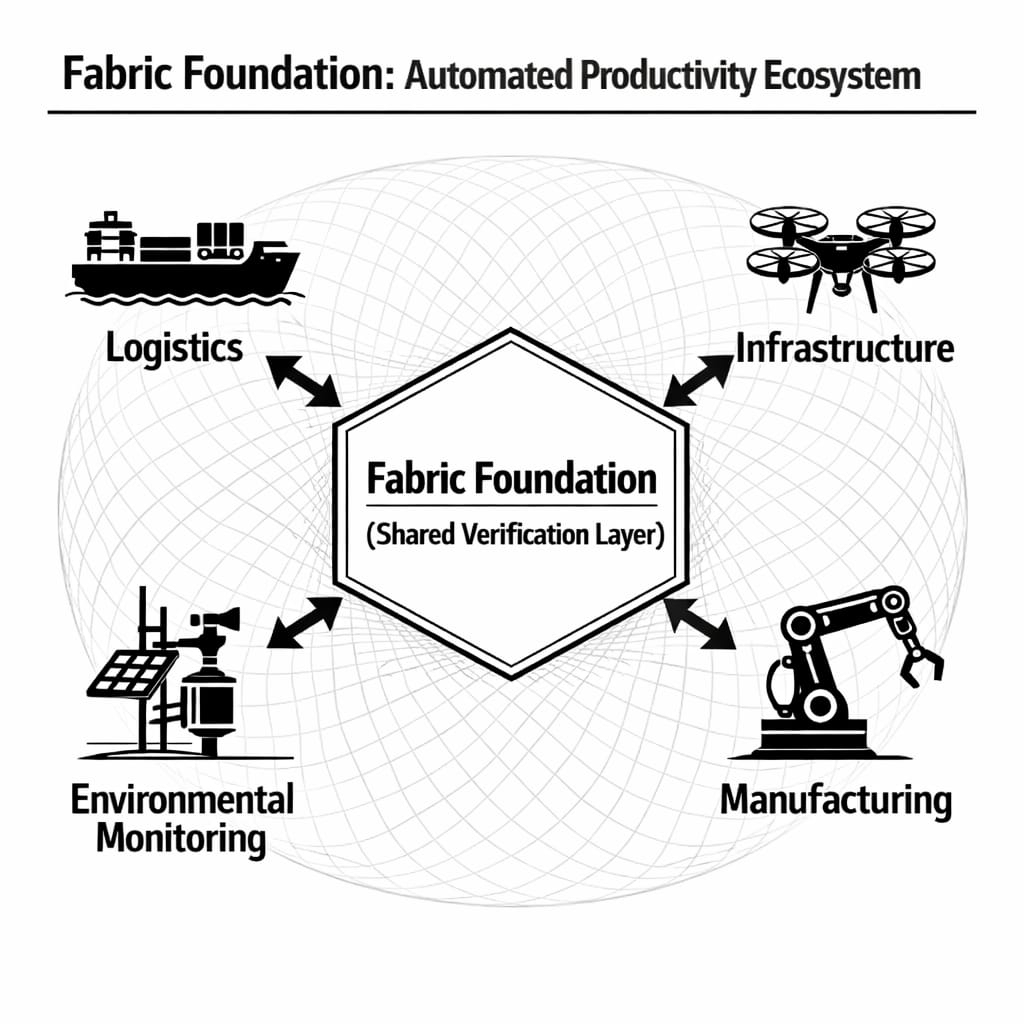
Robotics systems already exist everywhere. Warehouses rely on automated machines to move inventory. Inspection drones monitor infrastructure across large geographic areas. Autonomous systems manage logistics, data collection, and environmental monitoring in industries that depend on consistent information. These machines produce real outcomes in the physical world, but the records of what they do typically remain within the organizations operating them.
From a purely operational standpoint, that arrangement works.
But the moment multiple organizations need to trust the results of machine activity, things become more complicated. If a robot inspects infrastructure owned by one company but maintained by another, who verifies the inspection actually occurred? If autonomous systems collect environmental data used by several stakeholders, how does each participant confirm the accuracy of that information?
Fabric Protocol appears to approach this problem by creating a decentralized verification layer for machine activity.
Instead of focusing on financial transactions, the protocol attempts to record and verify the actions of machines operating in the physical world. Robots perform tasks locally, but their actions can be anchored in a decentralized infrastructure that allows multiple parties to confirm what occurred.
From an analytical perspective, the idea is intriguing.
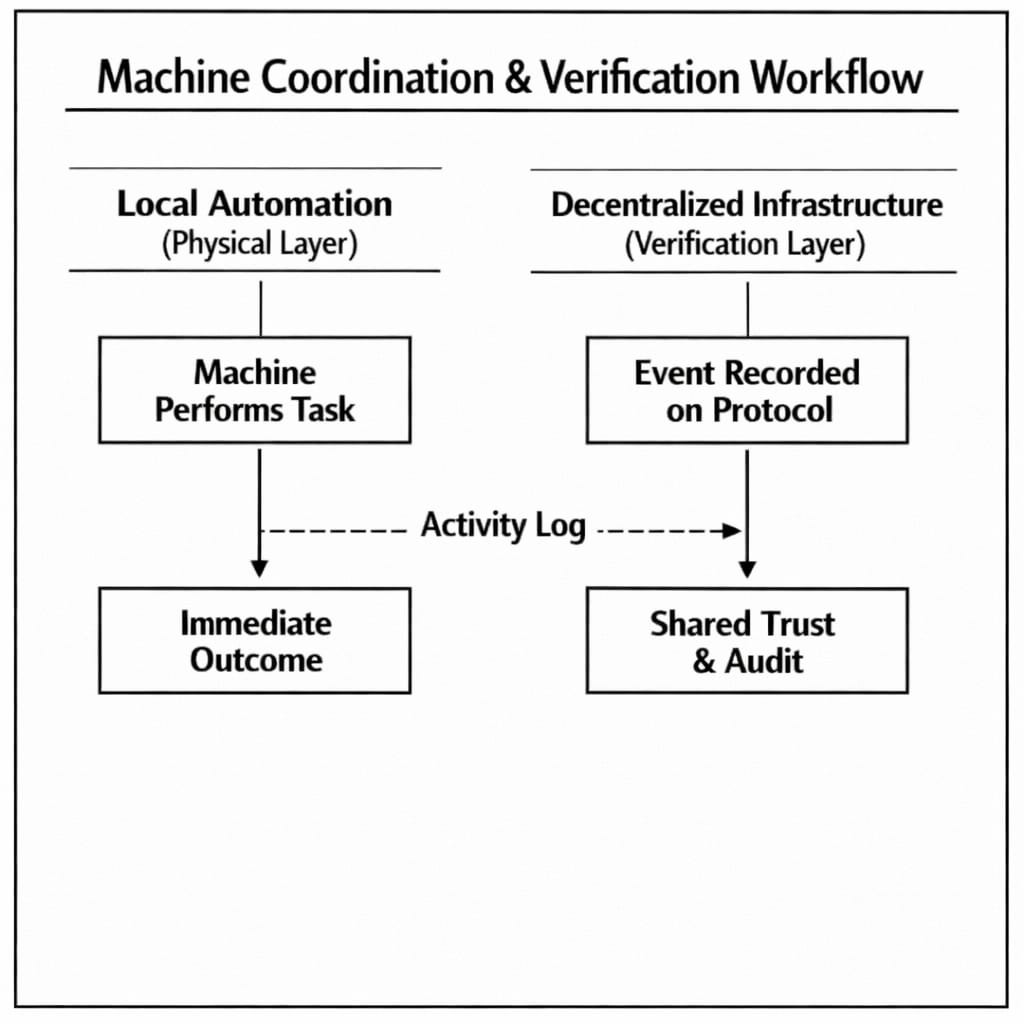
Blockchain networks are fundamentally designed to verify events across distributed participants. Applying that mechanism to machine activity rather than financial transactions introduces a different type of use case—one that connects digital infrastructure with physical systems.
Still, the quiet fatigue I mentioned earlier doesn’t disappear easily.
Crypto history is filled with projects that sounded logical on paper but struggled once they encountered real-world complexity. Robotics environments are messy. Sensors malfunction, machines behave unpredictably, and the data generated by physical systems rarely fits neatly into theoretical models. Building infrastructure that can interpret and verify that activity reliably is far more complicated than validating digital transactions on a blockchain.
There is also the question of necessity.
Industrial systems already use monitoring tools, data platforms, and centralized databases to track machine activity. These tools are familiar, reliable, and deeply integrated into existing workflows. For Fabric Protocol to become meaningful infrastructure, it would need to offer advantages that clearly outweigh the simplicity of centralized alternatives.
At the same time, I can’t ignore the broader trend shaping modern technology.
Automation continues to expand across industries, and machines increasingly interact with systems beyond the organizations that control them. Supply chains, infrastructure networks, and environmental monitoring systems often involve multiple stakeholders relying on data generated by automated machines.
In those environments, the problem of shared verification begins to look more relevant.
Fabric Protocol might be attempting to solve exactly that problem. Instead of positioning blockchain as a replacement for existing robotics systems, it appears to function as a verification layer that sits above them, recording machine activity in a way multiple participants can trust.
Whether that idea ultimately proves valuable is still uncertain.
The fatigue surrounding new crypto ideas exists for good reason. Many promising concepts have struggled to move beyond early experimentation. But occasionally, a project appears that quietly addresses a problem the industry has not fully articulated yet.
Fabric Protocol might be one of those ideas. Or it might simply be another attempt in a long line of experiments exploring where decentralized infrastructure actually belongs. For now, the most honest position may be somewhere between curiosity and caution.