
Many blockchain ideas sound brilliant on paper.
In fact, some of the most interesting innovations in Web3 start with a simple and elegant concept that tries to fix something people are tired of. Transaction fees are one of those problems. Users dislike unpredictable gas costs, developers struggle with onboarding friction, and applications constantly try to abstract away complexity.
This is where the design philosophy behind @MidnightNetwork begins to stand out.
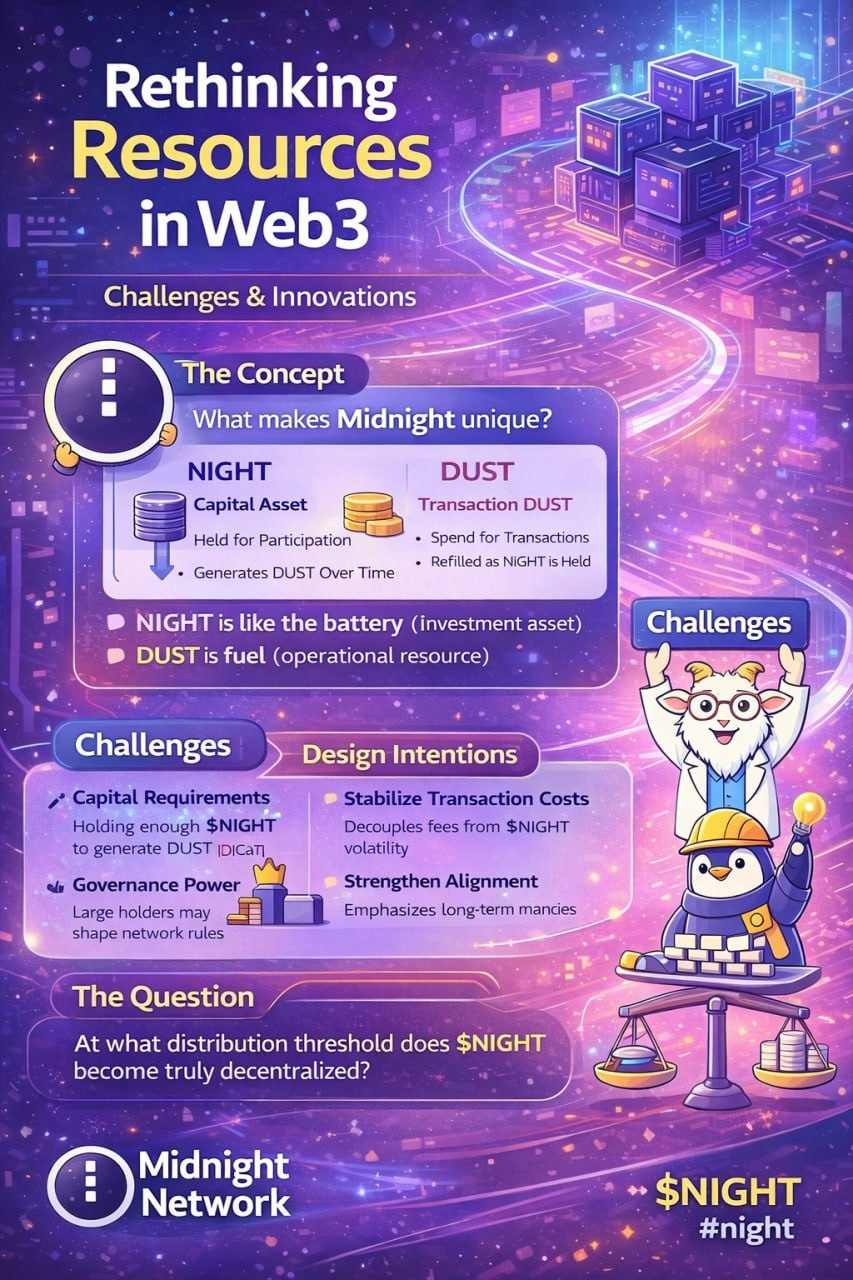
Instead of using the traditional “pay gas for every transaction” model, Midnight introduces a different approach that separates long-term network ownership from operational resources. In simple terms, the system distinguishes between the asset that represents participation in the network and the resource used to execute transactions.
That distinction is expressed through two elements of the ecosystem: $NIGHT and DUST.
At first glance, the concept feels almost intuitive.
You hold $NIGHT, which represents capital and long-term alignment with the network. Over time, that holding generates DUST, a consumable resource that is used for transactions and application activity.
A common analogy used by observers is that Night functions like a battery, while DUST acts as the energy consumed by applications.
You do not spend your battery directly — instead, it generates energy that can be used to power activity.
It is a surprisingly clean abstraction.
And like many elegant models, it raises deeper questions once you begin to imagine how it behaves in the real world.
Why This Model Exists
The motivation behind Midnight’s resource model is relatively clear.
Traditional blockchain fee systems often create a direct link between token price volatility and operational cost. When token prices rise dramatically, transaction costs may become unpredictable. When prices collapse, validator incentives weaken.
This coupling between speculation and infrastructure has been a persistent challenge in Web3.
Midnight’s architecture attempts to break that relationship.
By separating the capital asset ($NIGHT) from the transaction resource (DUST), the network attempts to create a more predictable environment for applications. Instead of constantly buying tokens to pay for each transaction, developers can hold night and rely on the generation of DUST over time.
From a design perspective, this offers several appealing advantages.
First, it allows applications to potentially abstract fees away from users. If a developer holds sufficient $NIGHT, the generated DUST could cover operational activity for their users.
Second, it may make costs more predictable. Rather than reacting to token market swings, developers could model how much DUST their applications require.
Third, it reinforces long-term alignment with the network. Holding night becomes a commitment to the ecosystem rather than a short-term transaction requirement.
These properties explain why many people initially find the model intellectually satisfying.
But elegant abstractions often hide complicated trade-offs.
Where Friction Begins
The moment you move from theoretical models to practical adoption, new dynamics appear.
One of the most frequently discussed concerns around resource-generation systems is capital requirements.
In Midnight’s case, generating enough DUST to support an application requires holding a meaningful amount of $NIGHT.
For large organizations or well-funded teams, this may not be a significant obstacle. Holding capital on the balance sheet is a normal part of operating infrastructure.
For smaller developers or independent builders, however, the requirement may feel very different.
A developer launching an experimental application may need to acquire and hold night before their product gains traction. If their user base grows, the amount required to sustain DUST generation could grow as well.
In this sense, the model shifts part of the economic burden away from users and toward builders.
This trade-off is not necessarily wrong — but it does reshape who bears the cost of running decentralized systems.
Another area where complexity emerges is governance.
Because night represents long-term participation and decision-making power in the network, large holders may play a significant role in shaping future parameters of the ecosystem.
If adjustments to DUST generation rates or resource policies are governed by night holders, then economic distribution could influence the evolution of the system.
Again, this is not unusual in blockchain design.
But it highlights an important tension: systems designed to stabilize infrastructure sometimes concentrate influence in ways that require careful balance.
Why the Design Still Matters
Despite these questions, the underlying intention behind Midnight’s model remains compelling.
Many blockchain systems struggle with the relationship between infrastructure and speculation. Token price volatility often leaks into every layer of network activity.
Midnight attempts to rethink this relationship.
By separating the token used for long-term alignment from the resource used for daily operations, the system experiments with a different economic architecture.
Instead of paying for every interaction in a reactive way, the network encourages participants to provision resources in advance.
This approach resembles how infrastructure works in many other industries.
Companies do not typically purchase computing power transaction by transaction. Instead, they invest in capacity that allows their systems to operate smoothly over time.
In that sense, Midnight’s design feels less like a payment model and more like a resource allocation model.
And if Web3 infrastructure eventually supports complex applications — identity systems, enterprise workflows, data markets, and privacy-sensitive platforms — predictable resource management could become increasingly valuable.
The Real Question
None of this guarantees success.
As with most infrastructure experiments in Web3, the ultimate test will not be theoretical design but behavior under real usage.
Will developers find the model intuitive?
Will the capital requirements create barriers or encourage long-term commitment?
Will governance structures maintain balance as the ecosystem evolves?
And perhaps most importantly:
At what scale of night distribution does the system truly begin to feel decentralized rather than simply well-structured?
These are not criticisms so much as the natural questions that emerge whenever a new economic model enters a complex ecosystem.
Because sometimes the most interesting part of a system is not the design itself, but how that design interacts with real human behavior.
Midnight’s resource model may turn out to be one of the more thoughtful attempts to rethink blockchain economics.
Or it may reveal new challenges that only become visible once applications begin to scale.
Either way, it represents a serious attempt to explore a problem many networks have quietly struggled with for years.
And that alone makes @MidnightNetwork and the evolving role of $NIGHT worth watching as the ecosystem develops.