In every crypto cycle, a few narratives emerge that redefine how people think about technology and markets.
In 2026, the intersection of AI, robotics, and blockchain infrastructure is becoming one of those narratives.
Among the projects leading this discussion is $ROBO, the native token of the Fabric Protocol, a decentralized network designed to coordinate intelligent machines and autonomous agents.
While many traders initially categorize ROBO as simply another “AI coin,” the deeper thesis behind the project suggests something more ambitious: the creation of a programmable robot economy.
The Concept Behind ROBO
The core idea of Fabric Protocol is straightforward but powerful.
As artificial intelligence becomes more capable and robotics hardware becomes more accessible, machines will increasingly perform real-world tasks.
However, there is a fundamental problem.
Machines today do not have:
economic identity
financial accounts
independent payment mechanisms
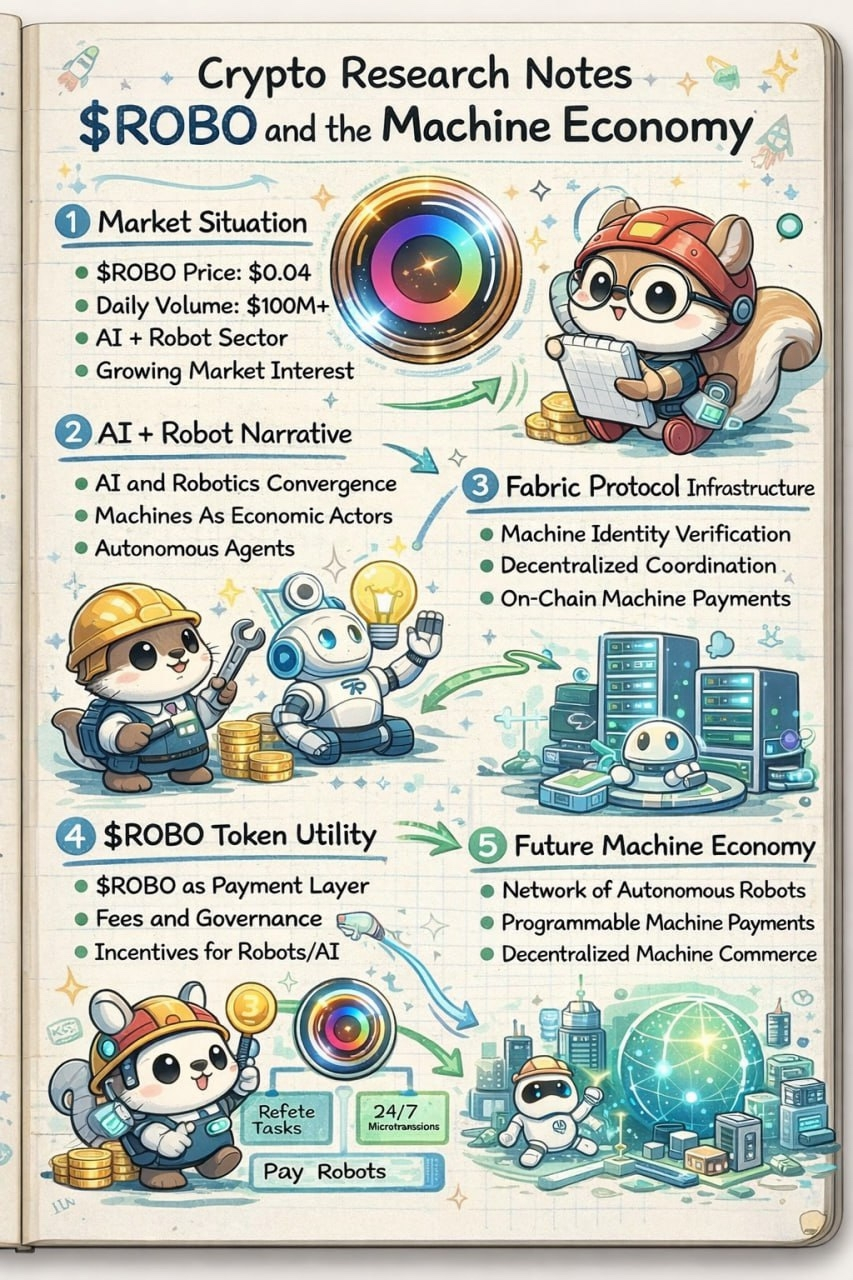
Fabric Protocol attempts to solve this by creating a decentralized infrastructure where robots and AI agents can interact economically on-chain, including identity, task coordination, and payments.
In this system, the $ROBO token acts as the native utility asset, enabling network fees, governance participation, and coordination incentives across the ecosystem.
Rather than simply representing speculative value, the token is designed to support the economic activity generated by autonomous machines.
Why the Market Is Paying Attention
The narrative surrounding ROBO aligns with several macro trends currently dominating the crypto market:
AI infrastructure tokens
Autonomous agent economies
Machine-to-machine transactions
The broader industry is beginning to explore how machines might operate as independent economic actors.
This includes tasks such as logistics automation, robotic services, data collection, and distributed compute.
If these systems require continuous microtransactions between machines, traditional financial systems may struggle to support them efficiently.
Blockchain-based settlement systems could therefore become a natural solution.
This is where Fabric’s architecture becomes interesting.
Recent Market Activity
From a market perspective, ROBO has recently gained attention among traders and researchers tracking AI-related assets.
The token currently trades around $0.04 with daily trading volumes exceeding $100 million, reflecting growing market activity and liquidity.
Despite short-term volatility, the project has continued to attract attention from both retail investors and institutional observers interested in robotics infrastructure.
Several factors contribute to the current discussion around ROBO:
increasing AI investment globally
rapid development in robotics hardware
the expansion of autonomous agents in digital environments
Together, these trends create a potential foundation for what some analysts call the machine economy.
The Token Economy
Unlike many speculative tokens that rely primarily on staking rewards or inflationary emissions, the ROBO model attempts to tie token demand to actual network activity.
In the Fabric ecosystem, ROBO can be used for:
network transaction fees
robot identity registration
task coordination bonds
governance voting
decentralized verification of machine work
This design introduces a feedback loop where economic activity generated by robots could increase demand for the token.
Of course, this thesis depends heavily on real-world adoption of robotic systems.
The Bigger Narrative
The most interesting aspect of ROBO may not be its short-term price movement.
Instead, it lies in the question the project raises:
What happens when machines begin participating directly in economic systems?
If millions—or eventually billions—of autonomous devices begin interacting with digital infrastructure, the existing financial system may not be optimized for their needs.
Machine-driven economies could require:
programmable payments
decentralized identity
automated coordination layers
real-time settlement systems
Fabric Protocol attempts to position itself as the infrastructure layer for that futures
Final Thoughts
In the short term, ROBO will likely continue to behave like many emerging crypto assets—driven by narrative cycles, liquidity, and market sentiment.
But the long-term vision behind the project extends far beyond a typical altcoin story.
If autonomous machines truly become active participants in the global economy, the infrastructure required to coordinate them could become one of the most important technological layers of the next decade.
Whether Fabric Protocol ultimately achieves this vision remains uncertain.
But the question it raises is becoming harder to ignore.
What happens when machines start earning, paying, and coordinating value on their own?
The answer may define the next chapter of both AI and crypto.