I’ve been chewing on this late at night, the way you do when something keeps nagging at the edge of real work. Not the flashy stuff settlement speed or token economics but the quiet, grinding friction that actually stops things from moving. You’re a compliance lead at a bank, or maybe a hospital network trying to share patient records across borders, or a logistics firm moving high-value goods with proprietary routing data. Tomorrow you need to settle a payment, verify eligibility, or log a transfer on some shared ledger. The regulator wants proof you followed the rules. Your counterparties and customers signed agreements that their data stays protected. And the ledger itself? Most blockchains broadcast everything by default. So what do you do? Fake it off-chain and hope the auditors never notice the gap? Or expose just enough to satisfy one side and watch the other side walk away? That’s the practical pinch point I keep circling back to. It isn’t theoretical. It’s the email at 2 a.m. asking how you’re going to square KYC with GDPR data-minimisation, or AML checks with commercial confidentiality.
The problem isn’t new. Blockchains were born transparent for a reason: anyone could audit the money supply or the state of a contract without trusting a middleman. That transparency bought real settlement finality in public markets. But the moment you drag regulated institutions or sensitive human data into the picture, transparency turns into liability. Regulators don’t just want to see that rules were followed; they want verifiable evidence. At the same time, data-protection laws (and plain old customer behaviour) punish unnecessary exposure. One breach, one leaked wallet history, and suddenly you’re facing fines, lost trust, or class-action headaches. I’ve watched enough systems crack under exactly this tension. Early DeFi platforms that started “public by default” ended up retrofitting privacy patches after hacks or regulatory letters; the patches always felt bolted-on, leaky at the seams. Privacy-focused alternatives went the other way total opacity and regulators responded by delisting or freezing liquidity. Neither path feels durable when you’re moving real money or real patient outcomes.
What makes most current approaches feel awkward or incomplete in practice is how they treat privacy as an exception rather than the ground state. You build on a transparent base layer, then add a toggle, a mixer, a side-channel, or a zero-knowledge wrapper that only kicks in for certain transactions. In theory that sounds flexible. In the real world it creates its own mess. Developers have to decide transaction by transaction whether privacy applies; auditors have to chase metadata to figure out which bits were hidden and why. Costs become unpredictable because you’re constantly bridging public and private worlds. Human behaviour compounds it people assume the default (public) is what actually happens most of the time, so they either avoid the system or game the exceptions. Institutions hate that uncertainty; they need predictable compliance costs and audit trails that survive a regulator’s spreadsheet. I’ve seen pilots die quietly because the legal team couldn’t sign off on “sometimes private.” The friction isn’t technical;
it’s that privacy-by-exception keeps forcing everyone to choose sides every single time, which is exactly what busy humans and risk-averse institutions refuse to do at scale.
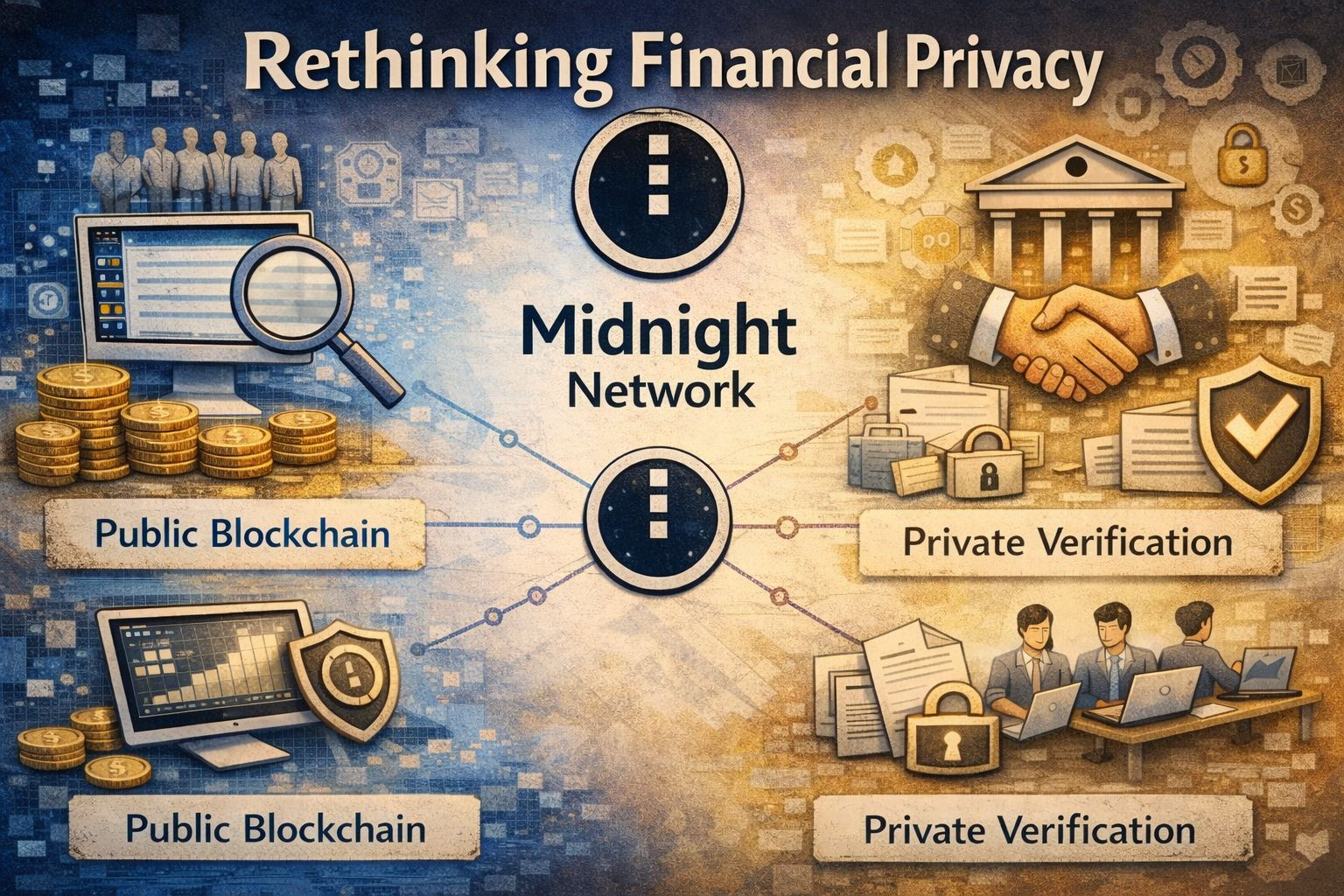
That’s why something like @MidnightNetwork Midnight Network sits in my head differently. Not as the next shiny L1, but as infrastructure that starts from the opposite assumption: privacy as the default architecture, with verifiability layered on top only where needed. The network is built so that sensitive data never has to hit the ledger in the clear. You can still prove solvency, compliance, age, or eligibility—whatever the regulator or counterparty demands—without broadcasting the underlying facts. Settlement stays on-chain and final, but the details stay protected by design. No retrofits, no “switch to private mode” complexity. The cost model is meant to be predictable because you’re not paying extra every time you hide something; hiding is the baseline. From what I’ve observed in other systems over the years, that kind of default alignment matters more than people admit. It reduces the cognitive load on builders, the legal exposure for operators, and the behavioural hesitation for users. You don’t have to keep explaining why this transaction is private and that one isn’t. The ledger just works that way.
I’m skeptical enough to poke at it. I’ve seen too many “privacy-first” projects quietly soften their claims once liquidity arrives, or regulators demand more visibility. Midnight talks about “rational privacy”—selective disclosure on your terms—and that sounds right in principle for regulated environments. A bank could prove it isn’t routing funds to a sanctions list without revealing every client’s balance. A healthcare provider could verify treatment eligibility across jurisdictions without exposing medical histories. Supply-chain partners could confirm origin and quality without leaking proprietary pricing or routing. The proofs are verifiable, the data stays minimised. In theory, that lines up with how real law actually works: data-protection regulators want minimisation and purpose limitation, while financial regulators want auditability. You satisfy both without choosing. But theory and practice diverge when the first big compliance audit lands. Will the proofs be accepted as easily as a PDF report? Will the cost of generating them stay low enough for high-volume settlement? I don’t know yet. I’ve watched ZK tech mature, but scaling it into regulated workflows still feels conditional—dependent on how friendly the next wave of regulators actually is.
Costs and human behaviour are the other quiet killers. Public blockchains keep compliance cheap in one sense (transparent audit) but expensive in another (data-breach insurance, customer churn, legal reviews). Privacy-by-exception layers on engineering overhead and uncertainty premiums. A design where privacy is baked in from the start could flip that: lower breach risk, simpler legal sign-off, more predictable gas or resource fees because the hard part is done at the protocol level. People—whether retail users guarding their finances or institutions guarding client trust—behave differently when the system doesn’t force them into uncomfortable visibility. They participate more readily. I’ve seen it in smaller pilots; the moment exposure risk drops, onboarding curves improve. Midnight seems structured to lean into that, treating the ledger as shared infrastructure rather than a public square. No hype, just a quieter, more workable surface for real usage.
Still, I keep coming back to the failures I’ve lived through. Whole privacy ecosystems got sidelined not because the tech was bad, but because they couldn’t speak the language of compliance at scale. If Midnight ends up too complicated for average developers, or if the selective-disclosure mechanisms prove fiddly under cross-border rules, adoption will stall. Liquidity needs counterparties on both sides; institutions move slowly and will wait for proven integration with existing rails. Regulators could still decide the proofs aren’t transparent enough, or auditors could demand raw data anyway. Human inertia is real—teams stick with what they already audit, even if it’s clunky. And if the network stays niche, the very settlement benefits evaporate because there’s no one to settle with.
The grounded takeaway, after turning it over, is this: the people who would actually use something like Midnight aren’t the retail degens chasing yield. They’re the compliance officers, hospital admins, trade-finance desks, and regulated asset managers who need to move value or data across borders without choosing between utility and liability every single day. It might work precisely because it refuses to treat privacy as an optional add-on; instead it makes the infrastructure match the real constraints of law, settlement finality, and human caution. Regulated environments don’t reward heroic exceptions—they reward predictable, auditable defaults. That’s where the quiet advantage sits. What would make it fail? If the proofs prove too opaque for real-world auditors, if integration costs stay high, or if it never reaches the critical mass of counterparties willing to trust the default. I’m not certain it won’t. But I am certain that the friction I started with—the 2 a.m. compliance headache—only gets worse on transparent-by-default rails. Infrastructure that starts from the other direction feels like the only path that doesn’t eventually force another awkward retrofit. Whether it actually scales without friction, time and real usage will tell. For now, it’s the first design I’ve seen that at least acknowledges the problem without papering over it.
#midnight $NIGHT @MidnightNetwork