
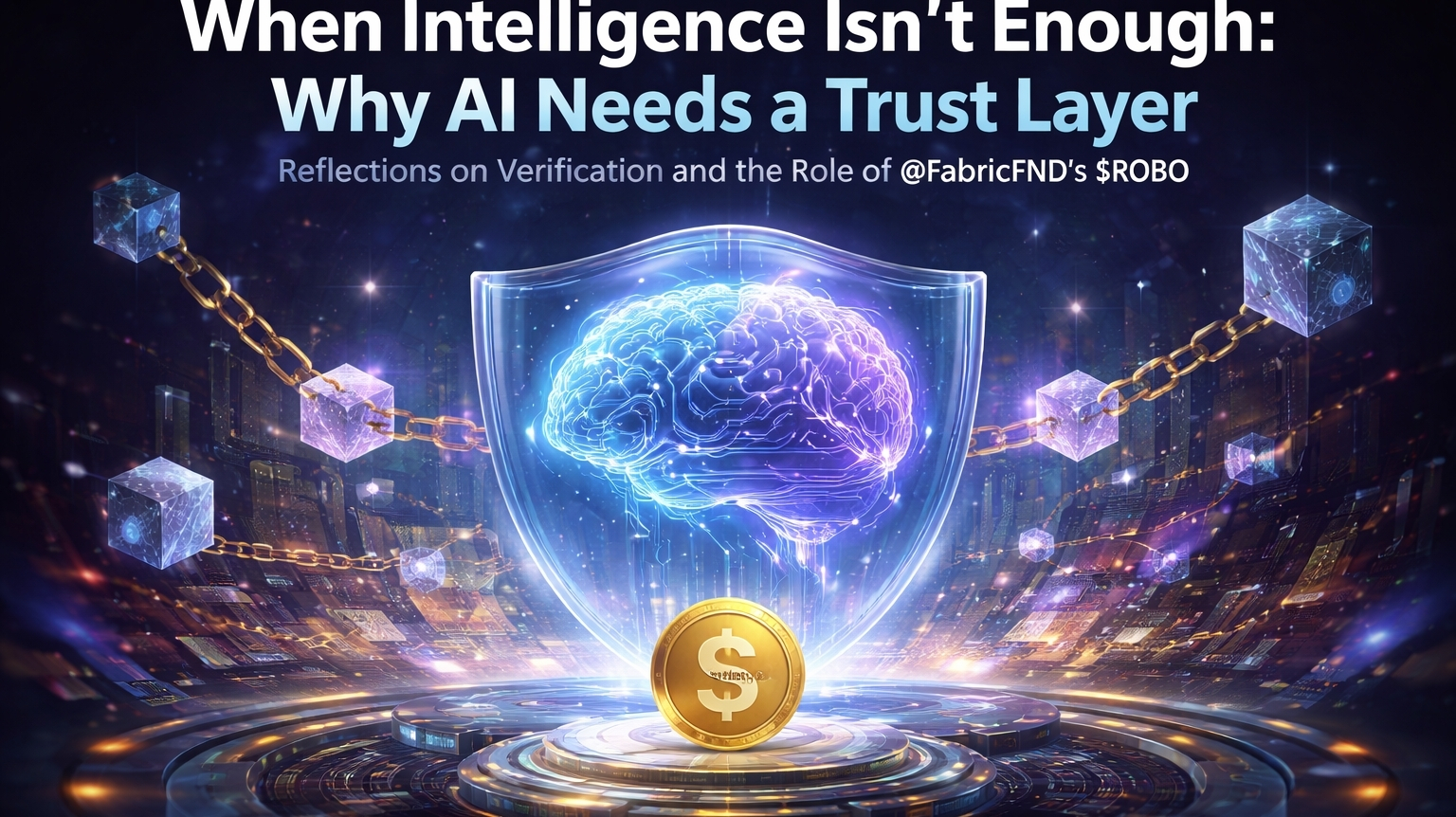
A few months ago I asked an AI assistant a simple question about a smart contract pattern I thought I understood. The answer came back instantly. Clean explanation. Confident tone. It even included code.
The problem was that the code didn’t work.
At first I assumed I had copied something incorrectly. I checked again. Then again. Eventually I realized the AI had invented part of the solution. It wasn’t guessing uncertainly. It was certain.
That moment stayed with me longer than I expected. Not because the mistake was large. But because the confidence was.
We are getting used to systems that speak with certainty even when certainty doesn’t exist.
In casual settings this is mostly harmless. If an AI suggests the wrong restaurant or slightly misquotes a historical date, nothing really breaks. But the moment these systems begin to influence financial decisions, automated workflows, or autonomous agents interacting with markets, the consequences shift.
The problem is not intelligence.
The problem is trust.
Artificial intelligence has become very good at producing answers. What it has not become good at is proving those answers are reliable. We tend to confuse fluency with accuracy. A well-structured paragraph feels truthful even when it is constructed on unstable ground.
This is where the conversation around verification becomes more interesting than the conversation around model capability.
I started thinking about this again while reading discussions around @FabricFND and the role of $ROBO inside the broader architecture being built there.
What stood out to me wasn’t another attempt to combine AI and blockchain. That phrase has been repeated so many times that it barely carries meaning anymore.
What felt more important was a different framing entirely.
The idea that AI might need its own trust layer.
In crypto, we are already familiar with this concept. Blockchains did not emerge because databases were inefficient. They emerged because databases required trust in whoever controlled them.
Consensus mechanisms replaced that trust with verification.
No single actor could quietly alter the ledger because the network itself would reject invalid changes. Incentives aligned participants toward maintaining the system’s integrity. Misbehavior could be punished. Honest participation could be rewarded.
Over time we began to treat these properties as normal. But they remain unusual in most other computing environments.
AI systems today still operate closer to traditional centralized services. A model produces an output, and the user either accepts it or does not. There is rarely a structured mechanism for verification.
This is where the analogy with crypto becomes surprisingly useful.
If AI outputs become inputs for automated decision systems, then we are essentially allowing opaque models to introduce state changes into real economic environments. That is not very different from letting a single validator control a blockchain.
In both cases the risk is similar.
One entity makes the claim.
Everyone else has to trust it.
What @FabricFND appears to be exploring with $ROBO is the idea that AI responses could pass through something resembling consensus. Not consensus on computation, but consensus on verification.
Multiple actors participate in validating whether an output meets certain criteria. Economic incentives shape honest participation. Misaligned behavior can be penalized.
If that sounds familiar, it should.
Crypto has been experimenting with these mechanisms for more than a decade.
The interesting question is whether they translate well to AI systems.
Because the problems are not identical.
Verification introduces cost. Latency increases when multiple participants must evaluate outputs. And there is always the possibility that verification networks themselves become dominated by a small set of actors, recreating the same centralization risks they were meant to avoid.
Another complication is model homogeneity.
If verification relies on similar models or training data, then errors can propagate across the entire network. Consensus becomes less meaningful if everyone shares the same blind spots.
Adoption also presents a quieter challenge.
Developers are often incentivized to prioritize speed and convenience. Verification layers add friction. In the short term, that friction can make systems less attractive even if it improves reliability over time.
We have seen this pattern before.
Early blockchain infrastructure was slower and more expensive than centralized alternatives. Many people dismissed it for that reason alone. Only later did the trade-offs become clearer.
Whether AI verification follows a similar trajectory is still uncertain.
Even if the architecture works technically, long-term sustainability depends on careful incentive design. Tokens tied to verification networks must maintain enough economic value to motivate participants without encouraging manipulation.
Designing those systems is not trivial.
Crypto history offers plenty of examples where incentive structures looked elegant on paper but failed under real market pressure.
So skepticism remains healthy here.
Still, the underlying question feels increasingly difficult to ignore.
What happens when AI systems start making decisions that affect real assets, financial markets, or autonomous agents operating without human supervision?
At that point the reliability of each output becomes more than an academic concern.
Mistakes are inevitable. That much seems clear.
Large language models will hallucinate. Data will be incomplete. Edge cases will appear where no training dataset prepared the system for the situation it encounters.
The goal cannot be eliminating errors entirely.
The goal is designing systems where errors are visible, challengeable, and accountable.
This is precisely the principle that shaped early crypto networks.
We assumed participants would behave imperfectly. So the system was designed to tolerate imperfection while discouraging dishonesty.
Verification replaced blind trust.
In that sense, the idea behind projects like @FabricFND and the role of feels less like a radical new concept and more like an extension of something the crypto community already understands well.
Consensus is not about making everyone agree.
It is about ensuring that no single voice can define reality on its own.
AI systems are becoming powerful enough that this distinction matters.
If intelligence continues advancing without parallel improvements in verification, we may find ourselves surrounded by systems that sound convincing while quietly introducing errors into complex environments.
And those environments will not always offer a simple undo button.
Maybe the future of AI will not be defined solely by better models.
Maybe it will also require stronger mechanisms for proving when those models are wrong.
Whether the structures being built today can support that responsibility remains an open question.
But it is a question worth asking before we hand too many decisions to machines that still speak with more confidence than certainty.
#robo @Fabric Foundation $ROBO
