
I noticed this feeling a few times recently while using crypto, and it stayed in my head longer than I expected.
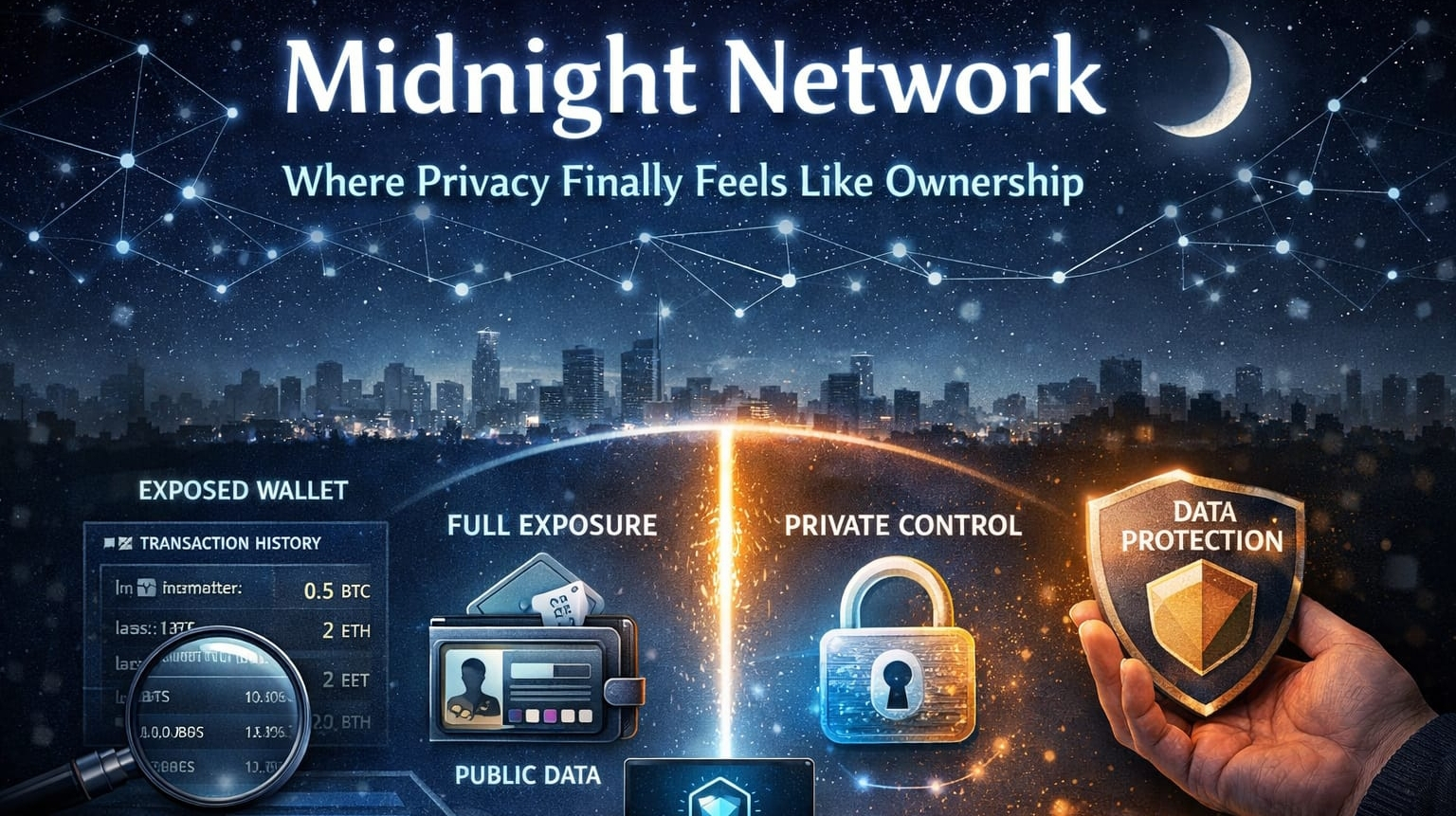
You make a normal transaction, check the wallet, maybe open the explorer for a second, and then suddenly you realize how much of the story is just… there. Not only the transaction itself, but the trail behind it too. Old transfers, wallet activity, patterns. It is all visible, all connected, all sitting in public.
I used to treat that like a normal part of crypto. Just the system working as designed.
But the more time I spent around the space, the more strange it started to feel.
We always talk about ownership here. We say crypto gives people control. Your wallet, your funds, your freedom. But sometimes that idea feels incomplete, because what kind of control is it if your activity is still so easy to track and piece together?
That question is what pulled me toward Midnight Network.
What caught my attention was not hype. It was the fact that the idea behind it touched something real. Midnight is built around zero-knowledge proof technology, which sounds technical at first, maybe even a bit distant, but the deeper meaning is actually very human. It is about proving something without exposing everything behind it.
And honestly, that makes sense.
In normal life, we do this all the time. We answer what is needed. We do not hand over our full personal history every time we want to confirm something simple. But on many blockchains, that balance does not really exist. Too often, using the system means revealing more than feels necessary.
That is why Midnight feels interesting to me.
It is not really about disappearing or hiding from the world. It feels more like trying to build a version of blockchain where usefulness and privacy can exist together. A place where people can interact, verify, and participate without turning their data into an open window.
I think that matters more now than it did a few years ago.
Back then, public transparency felt exciting. It felt radical. It felt like proof that no one could manipulate the system in the dark. And that part still matters. But over time, people also started to see the other side of it. Transparency can create trust, yes, but it can also create discomfort when every move becomes part of a permanent public record.
That tension is real, and I think more users are beginning to feel it.
From my experience, a lot of crypto problems are not always about speed or fees or even adoption. Sometimes the deeper issue is whether people feel comfortable using these systems in everyday life. If a network works well but leaves users feeling exposed, that is not a small design flaw. That is a real barrier.
Midnight seems to be responding to that barrier.
The idea, as I see it, is not to remove accountability. It is to stop treating total exposure as the only path to trust. That is a pretty meaningful shift. It suggests that blockchain can grow up a little, becoming more realistic about how people actually want to live and interact.
Of course, none of this means the road is easy.
Privacy-focused ideas in crypto have always faced pressure, both technically and socially. There are concerns, misunderstandings, and the usual challenge of making advanced tools feel simple enough for normal users. That part will matter a lot. Because even strong ideas can fade if they are too difficult to use or too hard for people to relate to.
Still, I think Midnight is pointing toward something worth paying attention to.
Not because it is loud. Not because it promises too much. But because it reflects a more mature question inside crypto: can we build systems that protect both ownership and personal boundaries?
That question feels bigger than one project.
It feels like part of where the space is heading next.
And maybe that is why Midnight stayed in my mind. It does not just talk about utility. It quietly brings up something deeper — the idea that data protection should not be treated like an extra feature, but like a basic part of digital ownership itself.
The more I think about it, the more that feels less like a niche crypto idea and more like something people will eventually expect by default.