

The difference that made me change my opinion was that I could see that the burden hidden in Midnight is not transmitting a transaction.
It is educating the wallet on what to continue watching afterwards.
That is not so big until you imagine the failure that will be revealed to the user.
A DApp mints you something, or generates a new output which ought to belong to you. The sale is processed. The interface says success. But your wallet has not yet changed to what you believe you now possess. On Midnight, it is not merely a make-up sync problem. The wallet API makes it very clear that a newly minted coin must be put into the wallet by means of newCoins so that the wallet can monitor it and put it into state. Midnight also defines wallet state to also cover local zswap state, transaction history, blockchain offset, protocol version and network ID. That is, being a hold under no "browse chain data then you are finished." The wallet must be instructed what to adhere to.
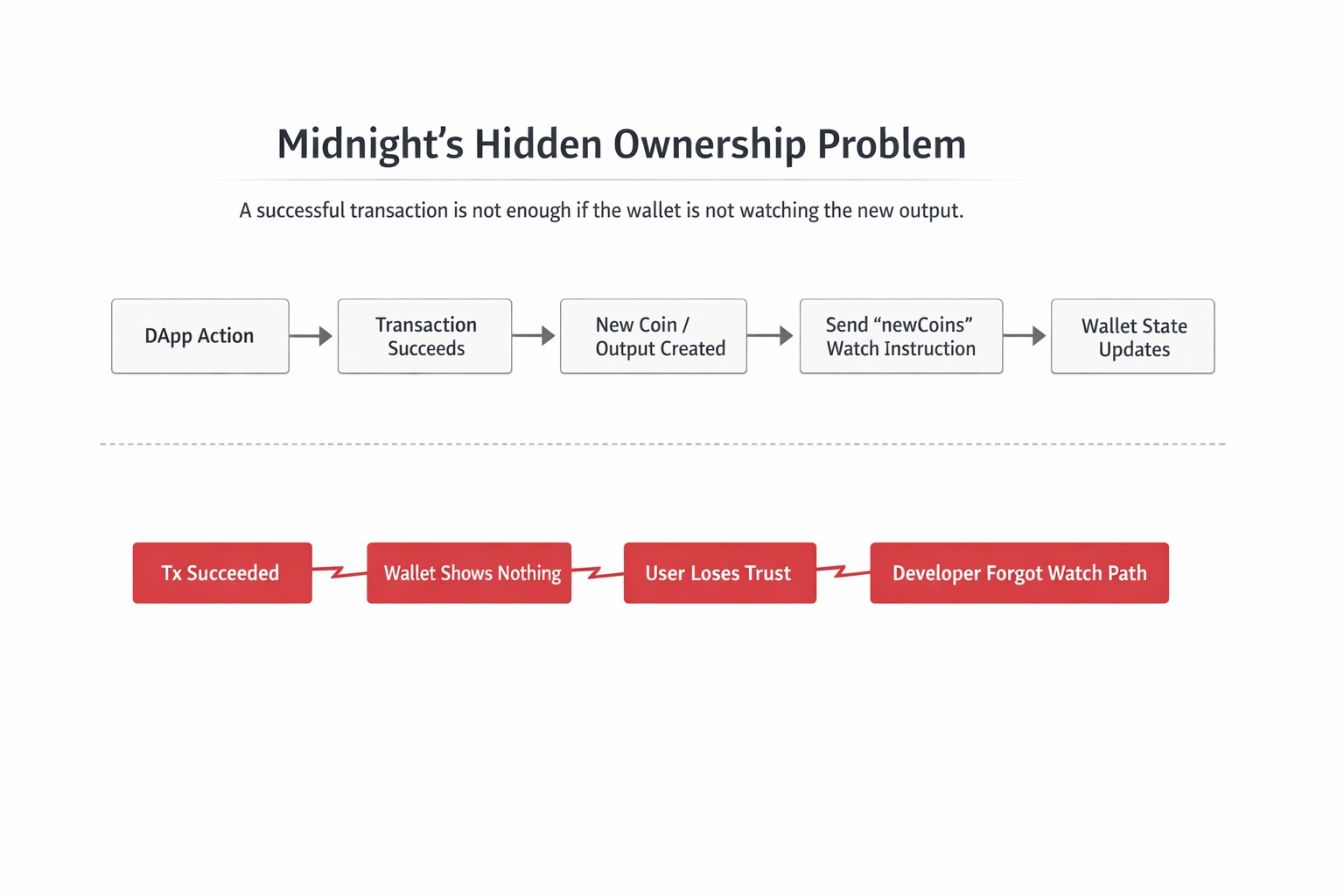
That is the bottleneck that I believe most of the people jump over.
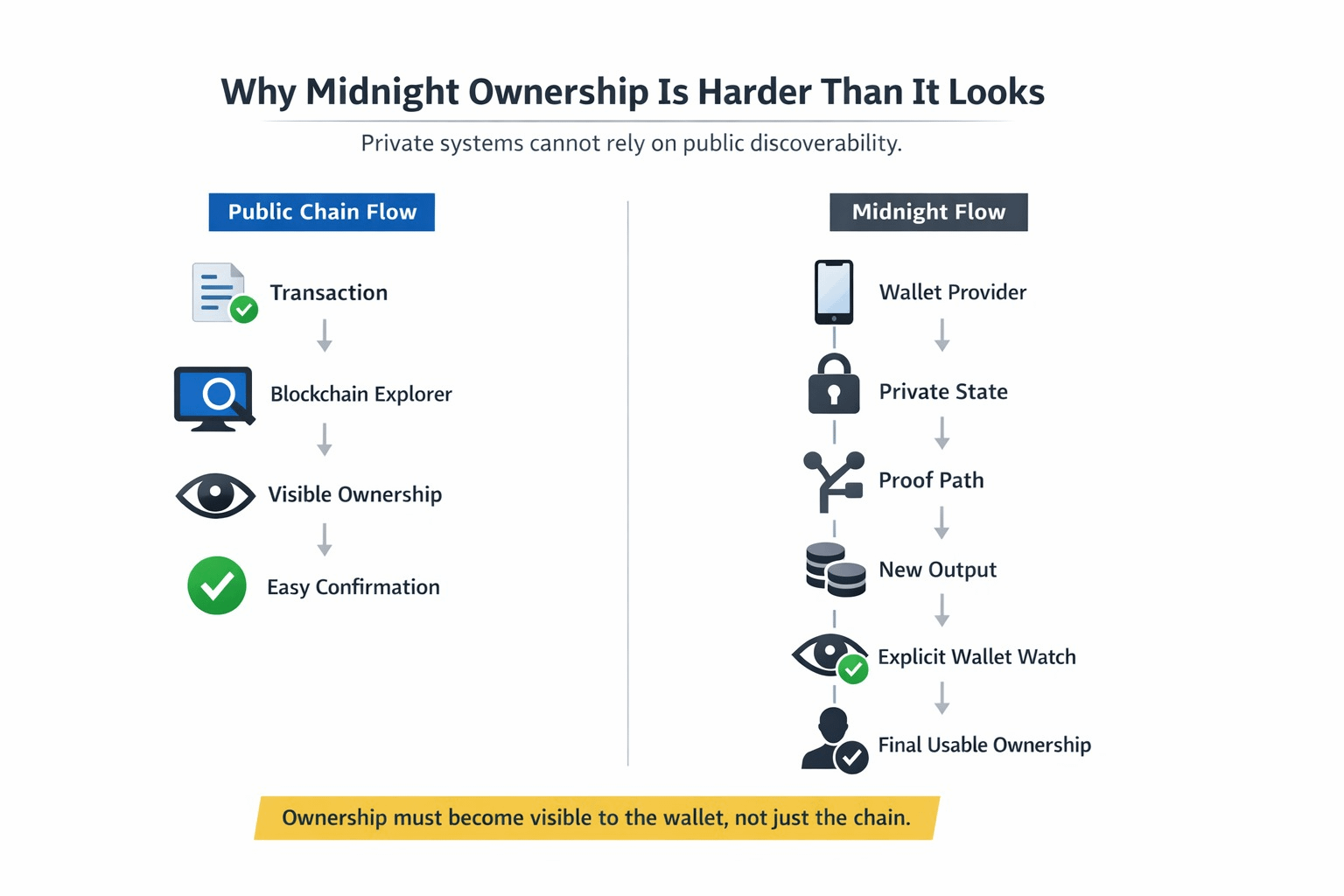
On a mindset of a public-chain, a successful transfer is final since it can be discovered easily. Much of the explaining can be done by a block explorer. Midnight is bearing another burden. The wallet is balancing, proving, submitting and tracking a local state which is significant to what the user can actually do next. That is visible in the onboarding code on its own: wallet provider, midnight provider, public data provider, private state provider, proof provider, zk config provider. That is a more grave handoff issue than even most campaign posts will acknowledge.
It is straightforward to envision the workflow mess which is visible.
An action is performed in one of the Midnight apps. The application generates a new coin or output on behalf of the user. The developer fails to forward such an output to the watch path of the wallet. There is no pitiable appearance of being broken. There is no loud exploit. It is only a silent distrust leak. The user would have a success, and then one would have nothing changed where one would have expected it to be changed. When the actual issue is that Midnight ownership must be explicitly brought into the wallet awareness, they pre-empt the fault onto the app, or the network, or the wallet. It is quite another type of UX risk.
It is there that I began to feel more important at MidnightNetwork.
This is precisely the angle that the project is more concerned with since privates can never depend on the effortless public discoverability. Midnight is not just posing the question as to whether confidential computation can work. It is posing the question of whether ownership can be believable when the place of state becomes usable is not the open surface of the chain, but the wallet. The docs do not hide that. They present an example with proving being resource and time intensive, wallet states constantly evolve, and certain balances or capacities must be read in the wallet they are connected with and not determined by public indexing alone.
It was the breaking point with me.
I also ceased reading Midnight as privacy enhanced with superior mechanics and began reading it as a system in which asset discoverability becomes a product feature. A design job like that is much more difficult. When a user does not know what he really commands or actually commands after he or she has made a successful action, the beauty of the proof system will not save the experience. The ugly truth is brought into sight by the design of Midnight.
That was a change in my perspective towards $NIGHT also.
According to Midnight docs, holding NIGHT produces DUST, and this is the resource of transaction fees. The same documentation goes on to state that not all capacity readings are exact following remittances of fees and that the linked wallet is the true source when the publicly accessible data is not able to completely indicate shielded operation. So it is not some generic utility paragraph in terms of token story. The point that the design can hit is that NIGHT-linked capacity only comes into play to a user when the wallet is able to monitor the correct outputs, the correct state and the correct spendable reality once the action has been completed.
The question that I am subjecting myself to, which I keep revisiting is the question of pressure.
Will Midnight be able to privatize without privatizing it? Will a normal user have faith that something created on their behalf is indeed being watched, used and brought to the top at the wallet layer before confusion becomes support debt? Since in case the answer requires too much relying on the ideal DApp implementation, then the friction is not going to vanish. It only becomes buried one layer deeper.
What stayed with me is this:
On Midnight, it is not the end of the job with the transaction successful.
The possession yet must be manifested to the wallet.
$NIGHT #night @MidnightNetwork