

I’ve been in this space long enough to stop getting impressed by the things people tell me I should be impressed by. You know how it goes. Every week there’s a new "revolutionary" partner, a fresh "paradigm shift," or some L1 promising 100k TPS that’ll probably halt three times in its first month.
After a while, you develop this internal filter. You open a whitepaper, skim the tokenomics, look at the VCs, and your brain just files it away in a dusty drawer labeled "Same Old Sh*t." It’s mechanical.
But every now and then—rarely—something slips through that filter. Not because it’s loud, but because it’s… quiet.
That was Midnight for me.
It wasn't a "wow" moment. It was more of a "wait, what?" moment. I remember closing the tab and then, three hours later, while I was making coffee, still thinking about one specific design choice.
The Chain That Doesn't Want to See Everything
We’re obsessed with visibility in Web3. We turned "Don't Trust, Verify" into this weird digital panopticon where every single move you make—every swap, every failed gas transaction, every dust token you received—is etched into a public diary forever.
In the beginning, we called that transparency. We called it trust.
But it’s also a nightmare.
Midnight does something that feels almost like a quiet rebellion. They looked at the blockchain and asked: What if the chain didn't have to see everything? What if it just… confirmed?
The heavy lifting happens off-chain. The sensitive data stays with you. The chain just gets a proof. A Zero-Knowledge Proof. It’s a mathematical whisper that says, "I’m not showing you the guts of this transaction, but I swear on the math that it’s correct."
When you let that sink in, it changes the whole vibe. The blockchain isn't a public ledger anymore. It’s a silent, impartial referee standing in the background.
The "Selective" Middle Ground
Crypto has always been stuck in this dumb binary trap.
On one side, you have the "Glass House" chains (Ethereum, Solana). Total transparency. Great for auditors, terrible for anyone with a strategy they don't want stolen by a bot. On the other side, you have the "Black Hole" chains (Monero). Total opacity. Incredible privacy, but a total non-starter for anyone who needs to stay compliant or institutional.
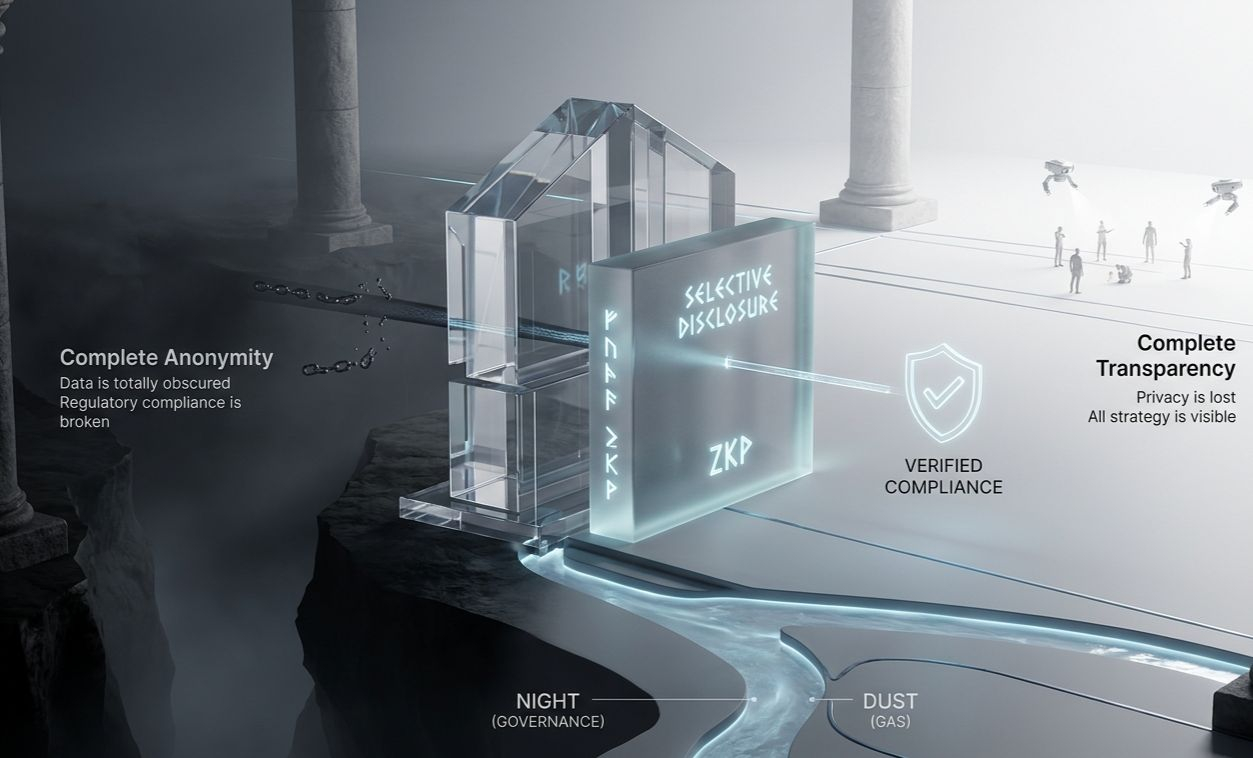
Midnight is trying to build a door in that wall. They call it "selective disclosure." I call it "controlled exposure."
You don't show everything. You don't show nothing. You show just enough. Think about a loan. In the old DeFi world, you’d have to expose your entire financial history to a smart contract for the world to see. Here? You just provide a proof: "I have the collateral." Done. No extra details. No digital stripping.
Unlearning the Scarcity Gospel
Then there’s the token, $NIGHT. And this is where the crypto-orthodoxy gets uncomfortable.
24 billion. That’s a big number.
This isn't Bitcoin. There’s no "digital gold" narrative here. No one is pretending this is absolute scarcity. The whole model is built on distribution—getting the tokens out there through things like the Glacier Drop.
I’m always skeptical of airdrops. Usually, it’s just farmers looking for a quick exit. And even though they’ve got this 450-day "thawing" mechanism, the reality is that by 2025, 69% of the supply was already out there. In any other project, the "number go up" crowd would have declared it dead.
But maybe scarcity was never the point.
Maybe the question isn't "how much is left to be mined?" but "who is actually using it?" If you’ve absorbed most of the supply already, the narrative shifts from scarcity to utility. And utility is a much harder game to play.
The DUST Feedback Loop
The real genius—or the real risk—is the dual-token thing. NIGHT and DUST.
You hold $NIGHT. You generate DUST. You use DUST to do stuff.
It aligns holding with using. But it also creates a brutally honest feedback loop. If the network is a ghost town, DUST demand hits zero. If DUST is zero, the reason to hold NIGHT evaporates.
It’s a bet on real usage. Not just trading. Not just "liquidity mining." Actual, honest-to-god usage.
The War on Front-Running
I don't think people talk about MEV enough. DeFi today is a paradise for predatory bots. They watch the mempool, they see your trade before it’s confirmed, and they jump in front of you. They pick your pocket before you even finish clicking "swap."
Midnight blinds the bots. By hiding the intent until the proof is finalized, it levels the field. It’s not just about privacy; it’s about restoring basic fairness to the market.
The Reality Check
Look, I'm not saying this is a guaranteed win. Far from it.
ZK stuff is complex. Under the hood, it’s heavy. If the user experience feels like a chore, people will choose convenience over privacy every single time. Most users don’t care about the math; they just want the app to work.
Then there’s the regulatory tightrope. "Programmable privacy" is a beautiful idea, but engineering it so it satisfies a regulator without creating a backdoor is a massive, ongoing headache.
Final Thought
Midnight isn't going for the extremes. It’s not full transparency, but it’s not full anonymity either. It’s somewhere in that messy, complicated middle ground.
A system where you can prove something is true without exposing your soul to do it.
I don’t know if it’ll be the "winner." But it feels like it’s at least asking a real question. And in a space that usually just shouts the same three answers, that’s enough to keep me watching.
$NIGHT #night #marouan47 @MidnightNetwork
