

Honestly, I’m not even fully sure why this topic stuck with me.
Most projects I read in this space disappear from my mind within minutes. Same promises, same language, same feeling that everything is “revolutionary” in a very polished, almost rehearsed way.
But Sign didn’t quite fade the same way.
There’s something that’s been bothering me for a while about how the digital world actually works.
Not money transfers. Those are fine now. Honestly, they work better than they ever have. I can send value across the world in seconds and barely think about it anymore.
But the moment identity gets involved, everything slows down again.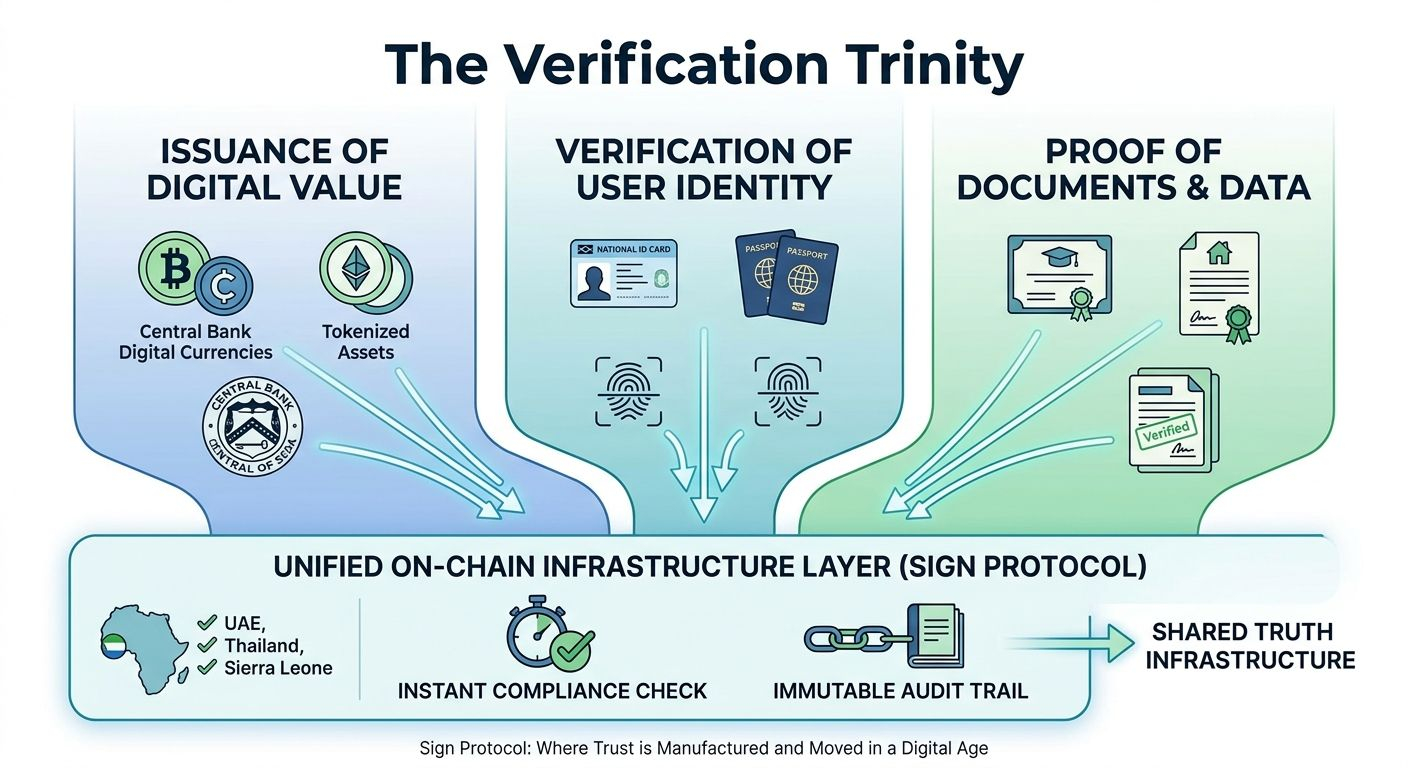
It feels like we built highways for money… but every exit still has someone asking for paperwork.
Scanned documents, manual checks, delays that don’t really make sense anymore in a system that’s supposed to be “digital.”
What keeps coming back to me is how fragmented everything still is.
Money lives in one system. Identity in another. Verification somewhere else entirely.
And none of them really talk to each other properly.
So when something needs to move across all three, you become the bridge. You carry the data between systems that clearly weren’t designed to work together.
From what I understand, Sign is trying to reduce that friction.
Not by replacing everything, but by creating a shared layer where verification, identity, and attestations can actually exist in the same place.
So instead of re-checking the same things over and over again, you verify once and reuse that proof when needed.
That idea sounds simple, maybe even obvious. But systems like this are rarely simple in practice.
The CBDC angle is where things start to get more interesting.
Governments want digital money, obviously. Cash is fading, and private digital currencies already move faster than most public systems can react.
But they also want control. Compliance. Eligibility checks. Anti-abuse systems.
And they want all of that without turning the whole thing into a surveillance machine.
That’s a hard balance.
Right now, most systems solve this by adding layers.
Banks verify users. Then intermediaries store documents. Then other entities re-check the same information again later.
It’s slow, redundant, and honestly kind of fragile.
The idea of cryptographic attestations changes that structure a bit.
Instead of showing documents every time, you carry proofs. Signed statements from trusted issuers that say something about you is true.
Not the raw data itself — just the fact that it was verified.
And in theory, that’s enough.
A system can check the signature, confirm the condition, and move on.
What I find interesting is not just the technical side, but the behavioral shift it implies.
Because institutions are used to seeing things. Paper, documents, records.
Trusting a mathematical proof instead of a visible file is a different mindset entirely.
Some will adapt quickly. Others probably won’t.
There’s also this constant problem in Web3 that I keep noticing.
Every application rebuilds verification from scratch.
Every single one.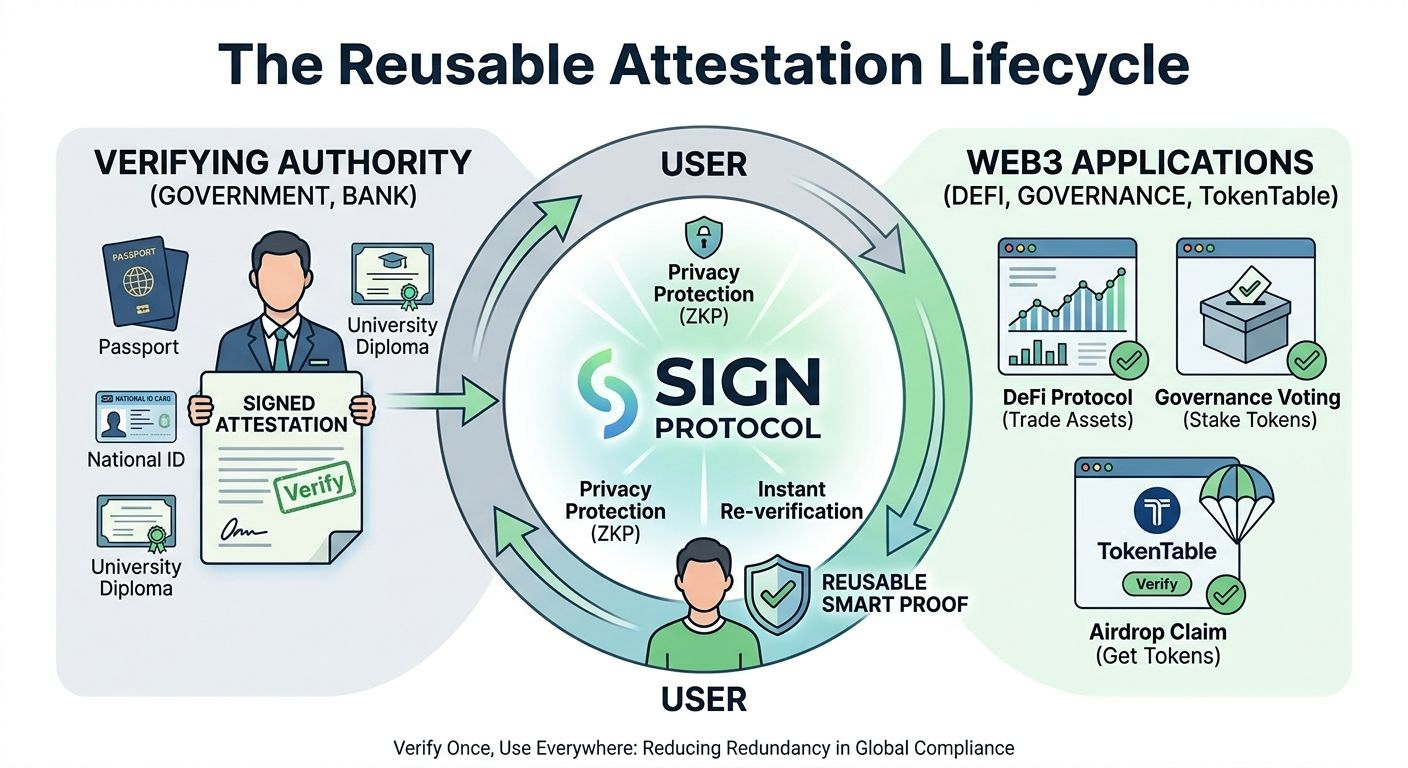
KYC, eligibility checks, bot protection, identity layers… all duplicated across dozens of platforms.
And users just keep repeating the same steps everywhere they go.
It doesn’t feel scalable. It feels like early internet chaos before standards existed.
If something like Sign actually works the way it’s described, then the real shift isn’t just about identity or compliance.
It’s about reuse.
One verification becomes usable across multiple systems, instead of being locked inside a single application.
That’s the part that actually feels different to me.
I don’t know where all of this goes.
Sometimes it feels like we’re watching the early formation of a new infrastructure layer for digital trust.
Other times it just feels like another ambitious idea trying to solve a very old problem in a new language.
Probably it’s somewhere in between.
But I keep coming back to it, which is usually the only signal I trust at this stage.
Not certainty. Not hype.
Just the fact that something doesn’t leave my head easily.
#SignDigitalSovereignInfra #marouan47 @SignOfficial $SIGN
