
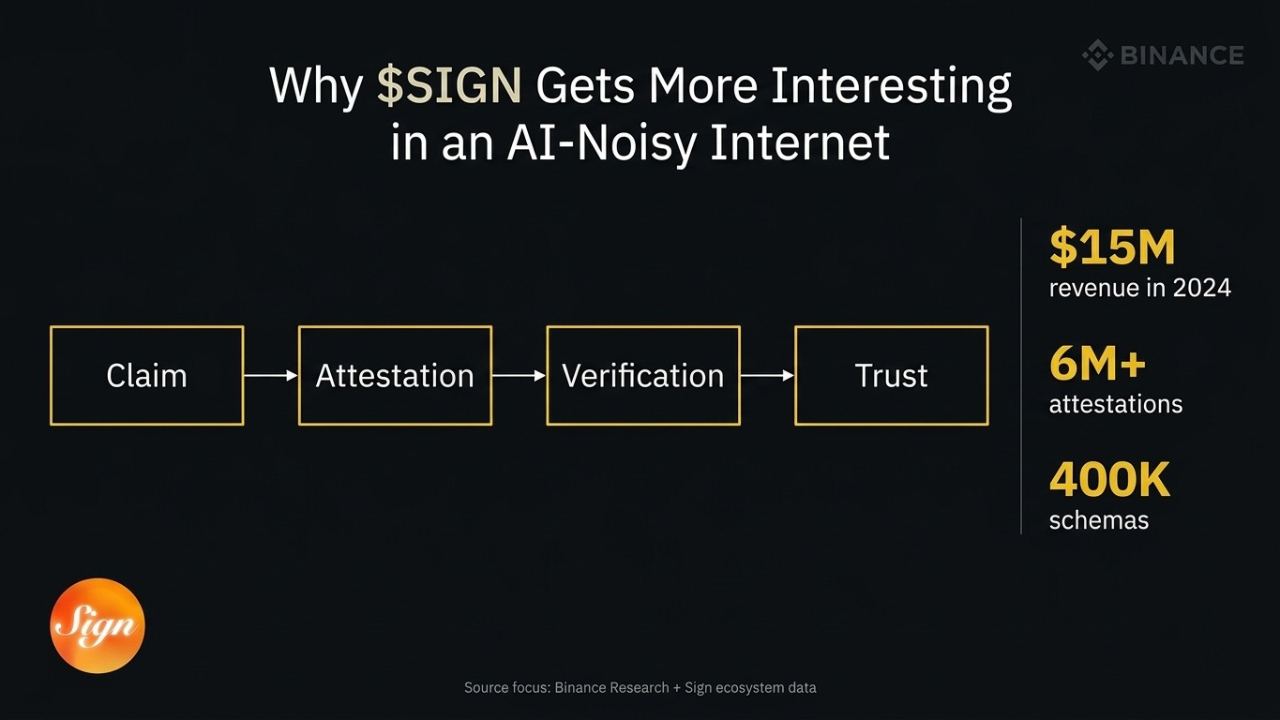
The more time I spend watching crypto narratives rotate, the more I feel like most people are still looking in the wrong direction. Everyone is trained to chase speed, liquidity, attention, and memes. That’s where the dopamine is. But after digging into $SIGN, I keep coming back to a different thought: what happens when the internet gets so flooded with noise that proving something becomes more valuable than just saying it?
That’s the part that made me stop and actually pay attention to Sign Protocol.
I think a lot of people still file Sign Protocol under a lazy mental label like “identity infra” and move on. I almost did the same at first. But the deeper I looked, the more that framing felt incomplete. Sign is not just about identity in the narrow sense. It is about structured proof. It is about who can verify what, under which rules, and in a way that can actually travel across systems. That sounds dry on paper, but the market has a habit of underestimating dry infrastructure until it becomes impossible to ignore.
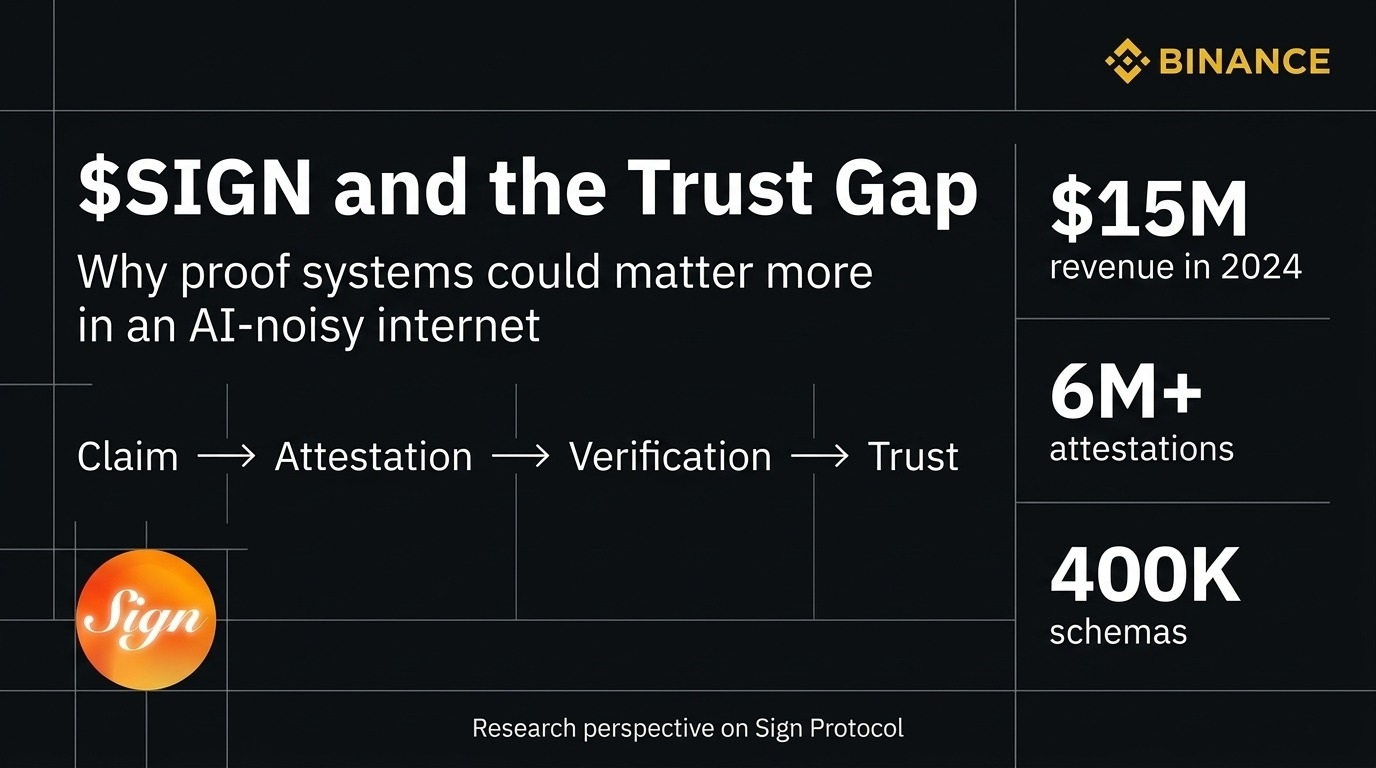
What stood out to me first was the scale. Binance Research notes that Sign generated $15 million in revenue in 2024, which is already the kind of number that makes me take a project more seriously because it cuts through the usual Web3 fantasy language. They also reported schema adoption growing from 4,000 to 400,000, while attestations expanded from 685,000 to more than 6 million in 2024. That is not tiny lab activity. That is real usage momentum. Binance Research also says TokenTable has already distributed more than $4 billion worth of tokens to over 40 million wallets. Those numbers are big enough that I stop thinking in terms of “interesting concept” and start thinking in terms of “this thing may already be sitting closer to actual infrastructure than most people realize.”
And honestly, that changes the way I look at $SIGN.
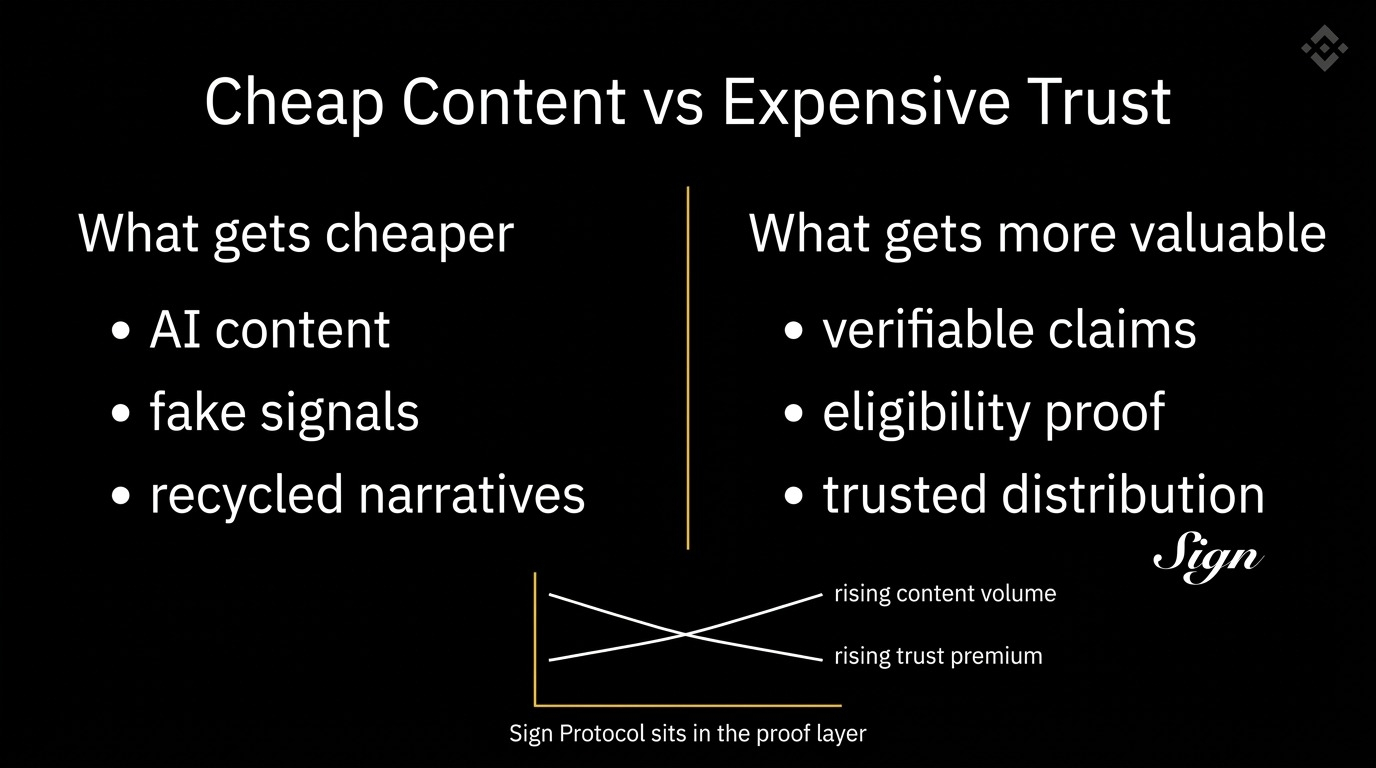
What I think the market is missing is that trust itself is getting more expensive. Not emotionally. Structurally. We’re heading into a period where synthetic content is everywhere, AI can produce endless polished text, fake social proof is cheap, and surface-level signals are getting weaker by the month. In that kind of environment, systems that help verify claims start looking less like optional tooling and more like core rails. I’m not saying every verification project wins by default. Far from it. But I do think the category becomes more important as digital noise gets cheaper.
That’s why Sign Protocol interests me more now than it would have a couple of years ago.
The docs frame Sign Protocol as an attestation layer built around schemas and attestations, and the broader Sign stack includes products like TokenTable and EthSign. What I like about that setup is that it is not just abstract theory. There is a practical angle here. If a user claims eligibility, if a project wants to distribute tokens to the right segment, if an agreement needs proof, if a system needs verifiable records, this starts to move from concept to operational value. The official docs even lean into a bigger systems framing around digital infrastructure for money, identity, and capital, with Sign Protocol positioned as an evidence layer across those contexts. That makes the whole thing more ambitious than the average “onchain credential” pitch people toss around casually.
The reason I keep using the word “evidence” is because I think that’s the better mental model. Crypto spent years optimizing movement. Move tokens faster. Move liquidity better. Move capital across chains. But proving things is a different problem. Proving a wallet belongs to a qualified participant. Proving someone is eligible for a program. Proving a distribution happened under specific rules. Proving an agreement exists and was executed. That’s a less flashy lane, but I would argue it is a very sticky one if adoption deepens.
And this is where I think $SIGN has a more interesting narrative than the market may currently price in.
A lot of people only get excited when infrastructure is directly visible. That’s usually late. The deeper value in infrastructure often shows up when it disappears into the background and just becomes part of how serious systems operate. Nobody wakes up excited about middleware, but plenty of markets eventually depend on it. That’s the lens I’m increasingly using here. If Sign Protocol becomes one of those layers that quietly powers qualification, verification, distribution, and evidence across different applications, then the upside case is not about hype. It is about hidden dependency.
At the same time, I’m not pretending this is some guaranteed slam dunk. That would be lazy. Infrastructure is a brutal category because being useful is not always enough. The market has to understand the category, developers have to integrate it, projects have to actually need the verification flow, and the product has to stay easy enough to use that it does not become pure friction. Good infrastructure can stay underpriced for a long time if the narrative around it is weak or the demand curve is slower than expected.
That’s the real tension I see with $SIGN.
Still, I can’t ignore what the data suggests. Revenue matters. Growth in schemas and attestations matters. TokenTable scale matters. And the broader docs now framing Sign around sovereign-grade evidence systems is also one of those details I don’t think enough people are connecting yet. It pushes the conversation past “another Web3 tool” into something more strategic. Whether that becomes investable upside depends on execution and market timing, but it definitely makes the project more serious in my eyes than a generic campaign post would suggest.
My honest take is simple. I think the internet is moving toward an environment where raw content gets cheaper and trust gets scarcer. When that happens, proof stops being a niche feature. It becomes leverage.
And that is exactly why I think $$SIGN s worth researching harder than most people are right now.👍🤑
@SignOfficial #signDigitalSovereignlnfra $SIGN #SignDigitalSovereignInfra
