

I continue to read the identical story across all the places - more advanced robots, intelligent AI algorithms, enhanced hardware. Any update is another intelligence step. However, nowadays, it is not that part that attracted my attention.
And what happens when machines come into prudent use?
When a machine is actually capable of doing some work in the real world, then the problem changes. No longer is it the matter of ability, but it is the matter of form. Who assigns the task? Who verifies the outcome? Who keeps the contribution of the contribution? And best of all, who is the coordinator of all this without making it operational chaos?
That is where Fabric Foundation finally makes sense to me, and why I am paying attention to it in a different way.
Fabric is not competing in hardware. It is not competing on the construction of smarter robots. Rather, it is putting its bet on something far more fundamental, a coordination layer in which machines are not merely a tool, but actors within an economic system.
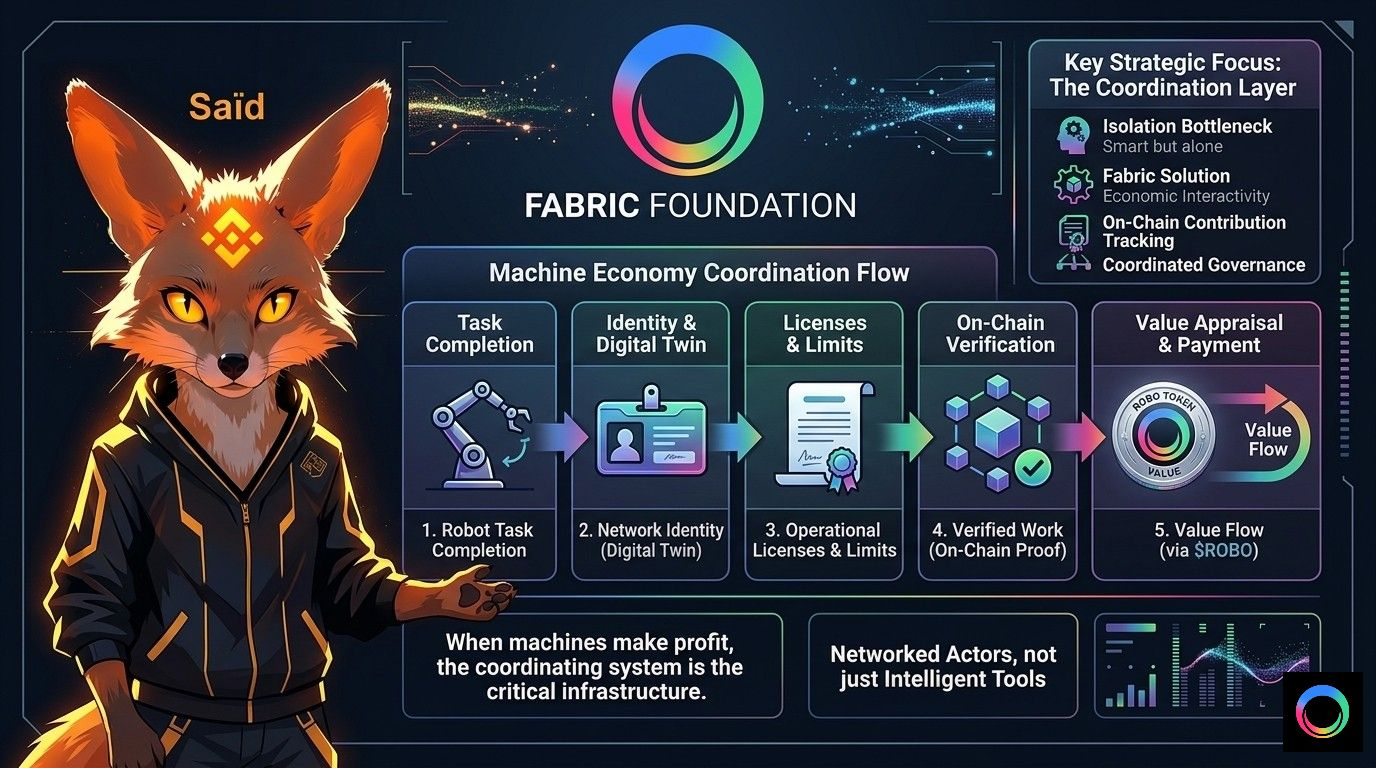
Think about a simple flow. A robot completes a task. It is even pointless to do that outside of context. The machine must have the identity to be a part of a network. It requires licenses to do its business under specified limits. Its production must be confirmed in a manner that is acceptable to others. And when that has been done, value must be appraised and paid.
This is the strata that most individuals overlook when discussing automation.
It is around that gap which is being constructed with fabric. As infrastructure, not as a concept. A structure in which contributions can be tracked on-chain, in which work can be coordinated across parties, and in which value flows via $ROBO as a component of that structure.
I find it interesting that this is not set as a story line, it is a design decision. It presupposes the fact that machines will not be isolated tools. Rather they will be networked actors, which need to be coordinated, governed and economically aligned.
And that alters the prism altogether.
Since machines will need to run on scale, it will not be sufficient to simply have machines to be intelligent. Even the most sophisticated systems are not coordinated without coordination. The actual bottleneck is the interaction of these systems, management of the systems, and the trust that is upheld among the participants.
That is the layer which Fabric is aiming at.
In my case this is where the discussion gets interesting. It is not about how smart machines become but how do they interact when they are already smart enough?
The system that structures the machines becomes the actual infrastructure since the moment machines start generating a profit.
And that is where Fabric is positioning itself.