
There is a specific kind of silence that makes inexperienced investors nervous and experienced ones pay closer attention. It is not the silence of abandonment. It is not the silence of a project that has run out of ideas or lost its footing. It is the silence that follows a sharp moment of recognition — when the initial excitement has cleared, the noise has settled, and what remains is something quieter and far more durable. Most people scroll past that silence. The ones who understand infrastructure stop and read it carefully.
That silence has a name right now. It is called Sign.
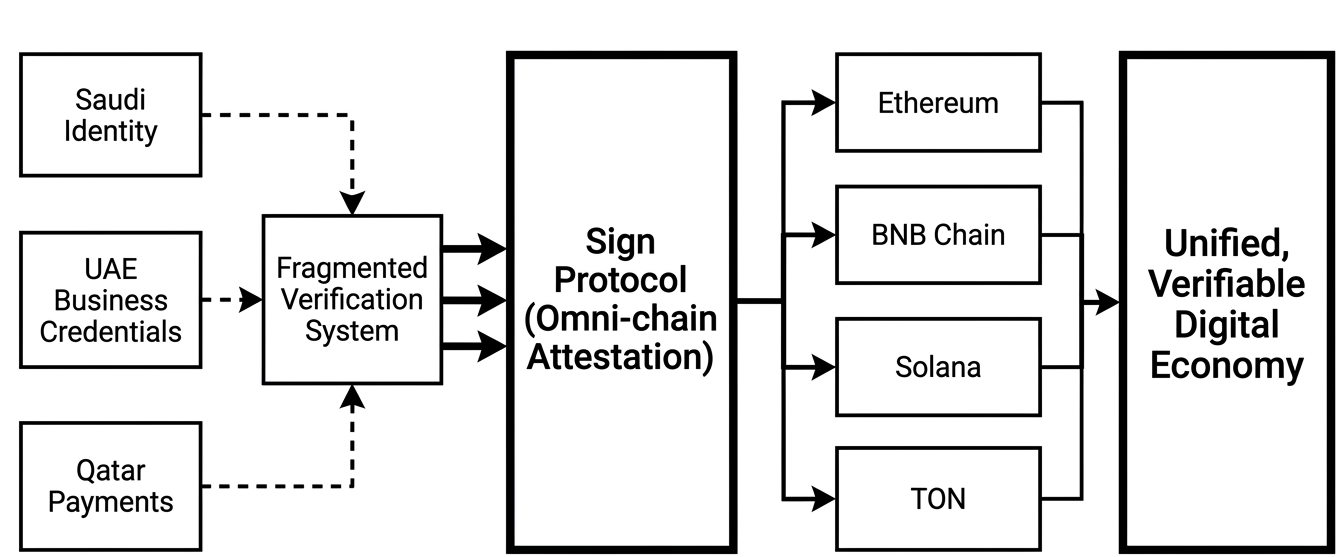
The Middle East is in the middle of the most ambitious economic transformation any region has attempted in modern history. Saudi Vision 2030 is restructuring an entire national economy away from oil dependency. The UAE is targeting a $140 billion digital economy contribution by 2031. The GCC is building cross-border digital payment frameworks that will move trillions across sovereign borders. Underneath all of that ambition — beneath the megaprojects, the policy frameworks, the capital flows — there is a foundational question nobody is asking loudly enough. Who verifies it? Who ensures that digital identities are sovereign and tamper-proof? Who builds the decentralized trust layer that makes financial inclusion possible for the millions of unbanked and underbanked populations moving through Gulf economies every year? Sign Protocol is being built as the answer to every single one of those questions. It is omni-chain attestation infrastructure — the real-world adoption story the Middle East's digital economy cannot afford to ignore, whether the region has fully named it yet or not.
Sign is not a cryptocurrency project in the way most people reach for that phrase. It is not another DeFi mechanism, not a trading product, not a token engineered for attention cycles. What Sign has built is sovereign digital infrastructure — Sign Protocol for omni-chain attestation, SignPass for decentralized sovereign identity, and TokenTable for incorruptible token distribution at national scale. These are not experimental products. TokenTable has already distributed over $4 billion across 40 million users and more than 200 projects globally. SignPass issues verifiable credentials that travel with their owner across borders, presenting selectively through zero-knowledge cryptography — proving one specific fact without surrendering the full picture. Sign's hybrid attestation model stores verification metadata on-chain while keeping sensitive data off-chain, giving governments and institutions the flexibility to build sovereign systems without exposing everything to a public ledger. That architecture was built precisely for the multi-sovereign, cross-border trust environment the GCC represents more completely than almost any region on earth.
$SIGN is trading at $0.04555 today, March 21st, up 1.49% on the day with 229 million SIGN tokens changing hands — roughly $10.5 million in 24-hour volume for a token in consolidation. The chart is worth reading carefully. From an all-time low of $0.02376, SIGN surged to approximately $0.062 in early March before pulling back in an orderly, controlled manner. It is now consolidating just above its MA(99) at $0.04538, with EMA(99) sitting at $0.04234 providing deeper structural support. Volume is compressing. The moving averages are converging. This is not a broken chart. This is a chart building a base — and infrastructure projects building bases quietly are exactly where the most asymmetric opportunities have always lived.
The proof of real-world adoption is already accumulating in places that deserve far more attention. Sierra Leone's Ministry of Communication has integrated Sign's blockchain solutions directly into their national identity system. Sign's CEO signed a formal technical agreement with the National Bank of the Kyrgyz Republic for CBDC infrastructure development. These are sovereign governments making sovereign decisions and choosing Sign as the backbone of their digital future. If a West African nation and a Central Asian republic have already moved — the question for the Middle East isn't whether Sign's infrastructure is ready. The question is why a region with this much at stake hasn't moved faster.
The institutional conviction behind Sign answers that with its own clarity. Sequoia Capital led a $12 million seed round. YZi Labs led a $16 million Series A in March 2025. These are not speculative bets placed on whitepapers. These are the world's most sophisticated capital allocators making decisions about what the foundational decentralized trust layer of the next digital economy looks like. They have already decided. The market is still catching up.
Digital infrastructure decisions made in the next two years will define the Middle East's economic architecture for the next two decades. The trust layer, the credential layer, the sovereign distribution layer — these are not features that get added later. They are the foundation. And foundations don't wait for ribbon-cutting ceremonies to become necessary.
Sign is already there. The Middle East just needs to look down.
#signDigitalSovereignlnfra @SignOfficial $SIGN
