

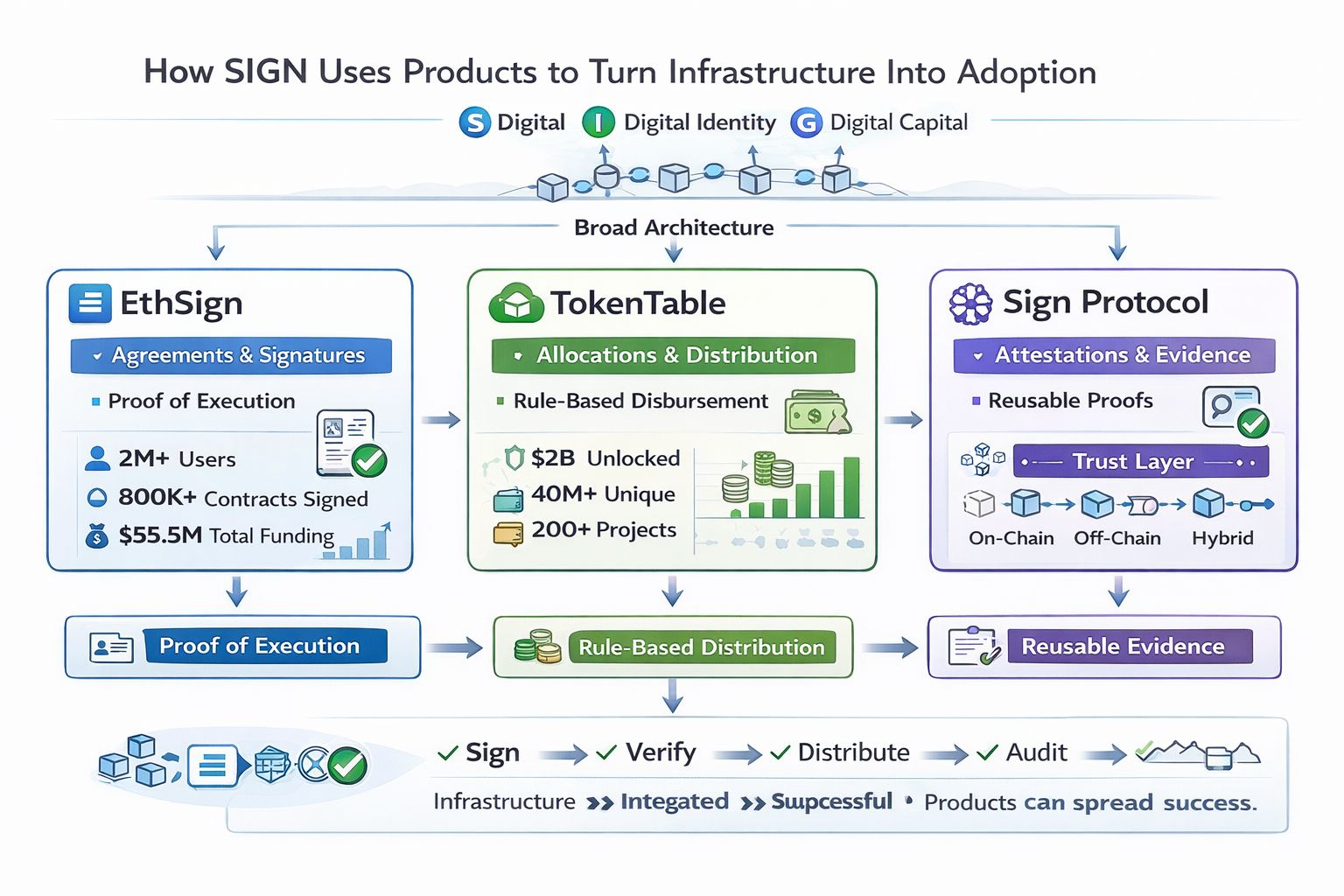
@SignOfficial I think the clearest way to understand Sign is to stop calling it “infrastructure” for a minute and look at the products people actually touch. That is where the story becomes more interesting. Sign is not only describing a future of verifiable digital systems; it is packaging that future into products with distinct jobs. In its current documentation, Sign frames the bigger architecture as S.I.G.N., built around digital money, identity, and capital, while its three main products do the practical work: Sign Protocol handles attestations and evidence, TokenTable handles allocation and distribution, and EthSign handles agreements and signatures. That product structure matters because adoption rarely begins with architecture diagrams. It begins when someone can use a tool, solve a problem, and come back for more.
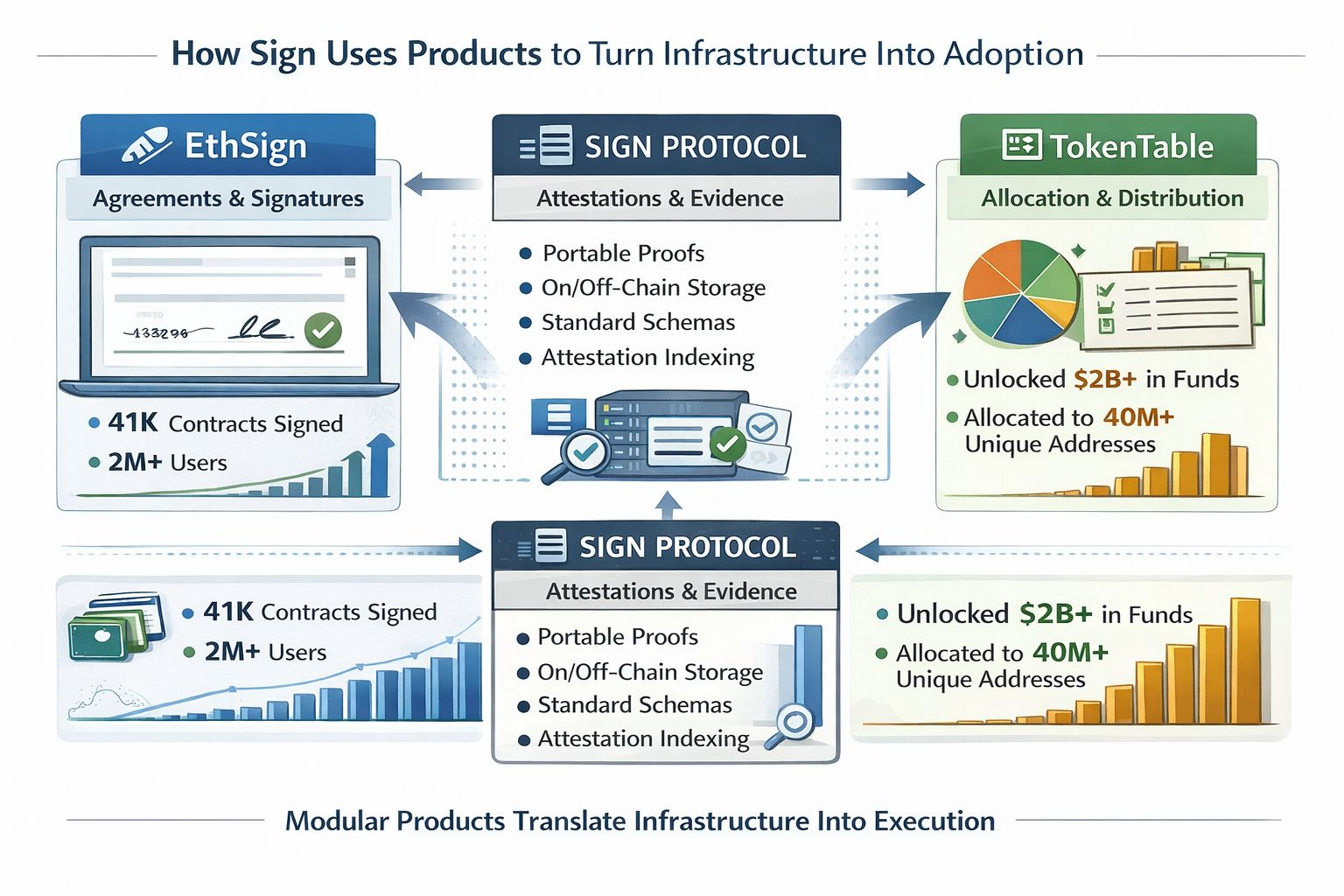
What stands out to me is that Sign did not start from a purely abstract protocol pitch. It had a front door first. EthSign, the agreement product in the stack, already reports more than 2 million users and 800 thousand contracts signed. That is not a small detail. It suggests Sign learned something many infrastructure teams learn too late: trust systems spread faster when they are attached to a familiar action. Signing an agreement is concrete. People understand the moment, the stakes, and the value of proof. In Sign’s own case studies, EthSign becomes more than a signing app when its contracts can produce reusable attestations through Sign Protocol. That turns a one-off signature into a portable proof that other systems can verify later.
I also think TokenTable shows the same pattern from a different angle. Instead of asking markets to care about back-end coordination, it focuses on a visible outcome: who gets what, when, and under which rules. Sign describes TokenTable as the distribution engine for allocations, vesting, benefits, subsidies, grants, and tokenized capital programs. The product exists because manual spreadsheets, opaque lists, and after-the-fact audits do not scale well. On the commercial side, Sign’s public site says TokenTable has unlocked $2 billion to 40 million unique addresses across more than 200 projects. Whether the use case is crypto-native distribution or more regulated capital flows, the product makes infrastructure feel like execution rather than theory.
Underneath those apps sits Sign Protocol, and this is where the company’s design feels smart to me. Sign Protocol is not presented as a blockchain of its own. It is an evidence layer that standardizes how claims are structured, signed, stored, queried, and verified. The docs describe schemas and attestations as the two core primitives, with support for fully on-chain, off-chain, and hybrid storage models, plus indexing through SignScan. In plain language, Sign is trying to reduce the mess that happens when every app invents its own proof format and retrieval logic. That is a technical problem, yes, but it is also an adoption problem. When developers do not have to rebuild the trust layer every time, products ship faster and institutions can inspect what happened without detective work.
My read is that this is exactly why Sign is getting more attention now. The company raised a $25.5 million strategic round in October 2025, bringing total funding to more than $55 million, and said it planned to keep developing infrastructure while pursuing national deals. At the same time, its February 2026 documentation widened the frame from crypto tooling to “sovereign-grade” systems for money, identity, and capital. That shift is happening during a broader market moment when blockchain is being treated less like an experiment and more like plumbing. The World Economic Forum has described 2026 as an inflection point in which digital assets move from experimentation toward enterprise-grade deployment, and Reuters recently reported Mastercard’s planned acquisition of stablecoin infrastructure firm BVNK for up to $1.8 billion.
I do not think Sign’s real achievement is that it has big ambitions. Plenty of companies do. The more convincing part is that its ambitions are chained to products with specific behavior. EthSign creates proof of execution. TokenTable creates rule-based distribution. Sign Protocol creates reusable evidence. Put together, they form a path from user action to system trust. That is much healthier than the old pattern in crypto, where teams launched infrastructure first and waited for adoption to appear out of thin air. Here, the product seems to teach the market why the infrastructure matters.
I keep coming back to a simple thought: infrastructure becomes real when nobody has to talk about it all the time. They just sign, verify, distribute, audit, and move on. Sign appears to understand that. Its products do not eliminate complexity, and there is still a long distance between promising architecture and durable public adoption. But the company’s recent direction suggests a disciplined bet that adoption will come from repeated, useful workflows rather than grand claims. To me, that is the most credible version of the Sign story: not infrastructure for its own sake, but infrastructure translated into products people can actually use.
@SignOfficial #SignDigitalSovereignInfra $SIGN #signDigitalSovereignlnfra