

The more I think about Midnight the less it feels like one of those crypto projects built mainly to look exciting in a tweet.
It feels heavier than that.
And honestly, that is probably why it interests me.
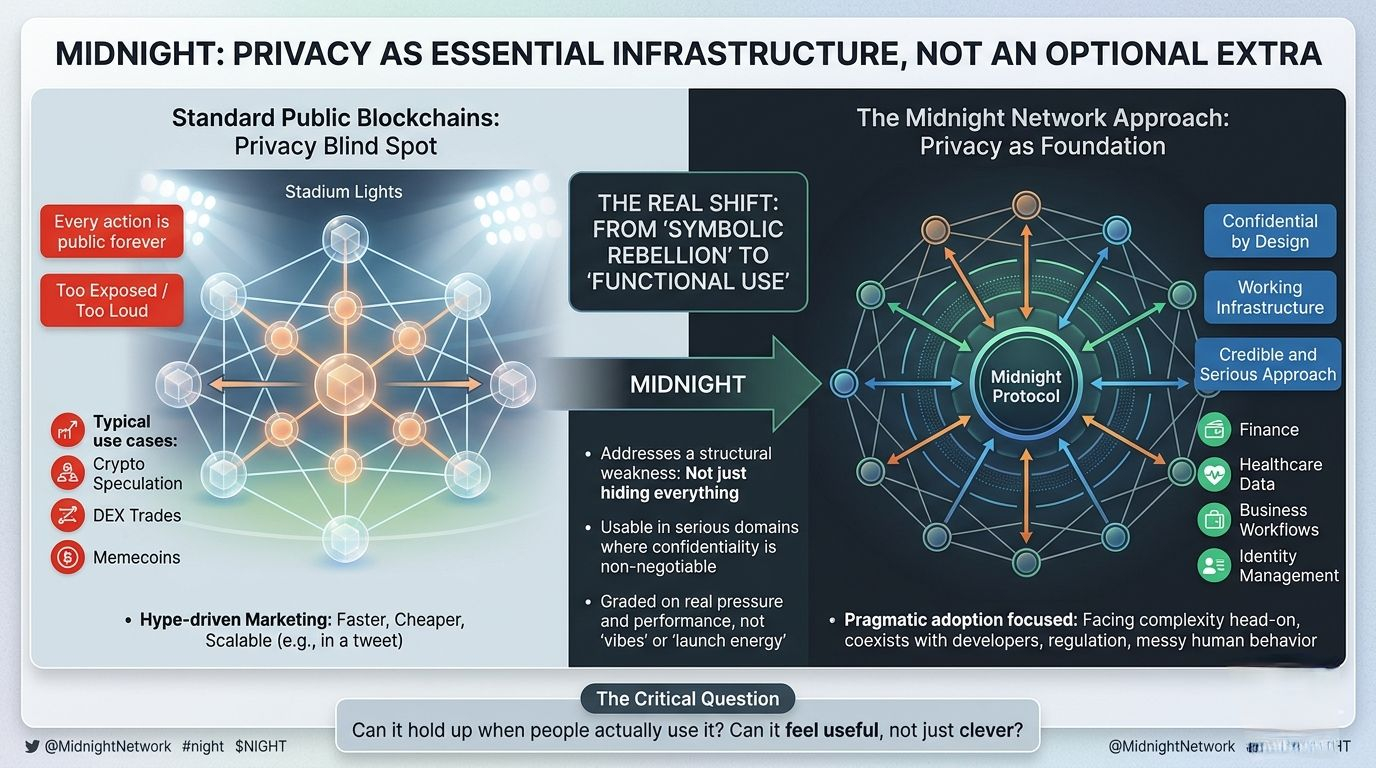
A lot of blockchain projects are easy to market because they are built around things people already know how to get excited about. Faster. Cheaper. More scalable. More community-driven. More whatever the market wants to hear that week.
Privacy projects have their own version of that too. They usually get wrapped in the same dramatic language. Freedom. Secrecy. Revolution. Very intense. Very pure. Very likely to sound amazing right up until someone asks how any of it fits into the actual world.
That is where things usually get awkward.
Because public blockchains do have a real weakness. A pretty obvious one actually. They are great if you think every important action should happen under stadium lights. They are less great if you are dealing with finance healthcare, business workflows, identity or basically anything sensitive enough that normal people do not want it sitting in public forever.
This has always felt like one of the strangest blind spots in crypto to me.
People talk about adoption like it is some magical next phase that arrives because the technology is cool enough. But if the underlying system makes privacy feel unnatural, then a huge number of real use cases were never going to show up in the first place. Not seriously. Not at scale. Not in the boring parts of the economy where people actually need confidentiality without turning the whole system into a black box.
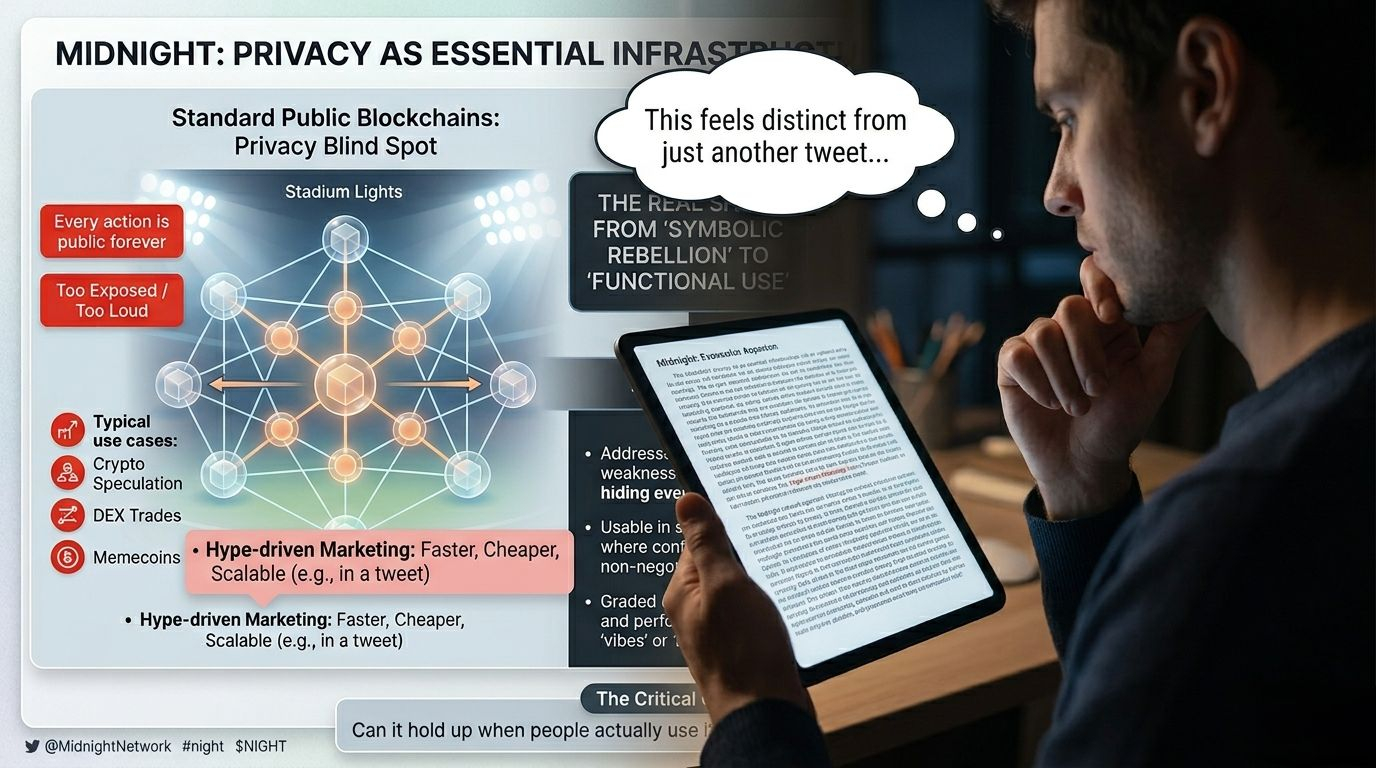
That is why Midnight stands out.
Not because it is flashy. Almost the opposite.
It stands out because it seems to be treating privacy less like a marketing accessory and more like infrastructure. That changes the whole tone. The project does not feel like it is saying, look how radical we are. It feels more like it is saying, this weakness in public blockchains has been obvious for years, and someone should probably try to fix it properly.
I trust that instinct more.
Maybe because it sounds less fun.
Usually when something in crypto sounds slightly less fun, there is a chance it is aimed at a real problem.
And I think that is what Midnight is doing. It is not selling privacy as some abstract moral pose. It is treating privacy like a condition for serious use. That is a much stronger angle. It suggests the goal is not just to attract people who already care about privacy as an ideology. It is to make blockchain usable in places where privacy is simply non-negotiable.
That is a different level of ambition.
It is also a riskier one.
Because once you move from hype to infrastructure, people stop grading you on vibes. They start grading you on whether the thing actually works when pressure arrives.
And pressure changes everything.
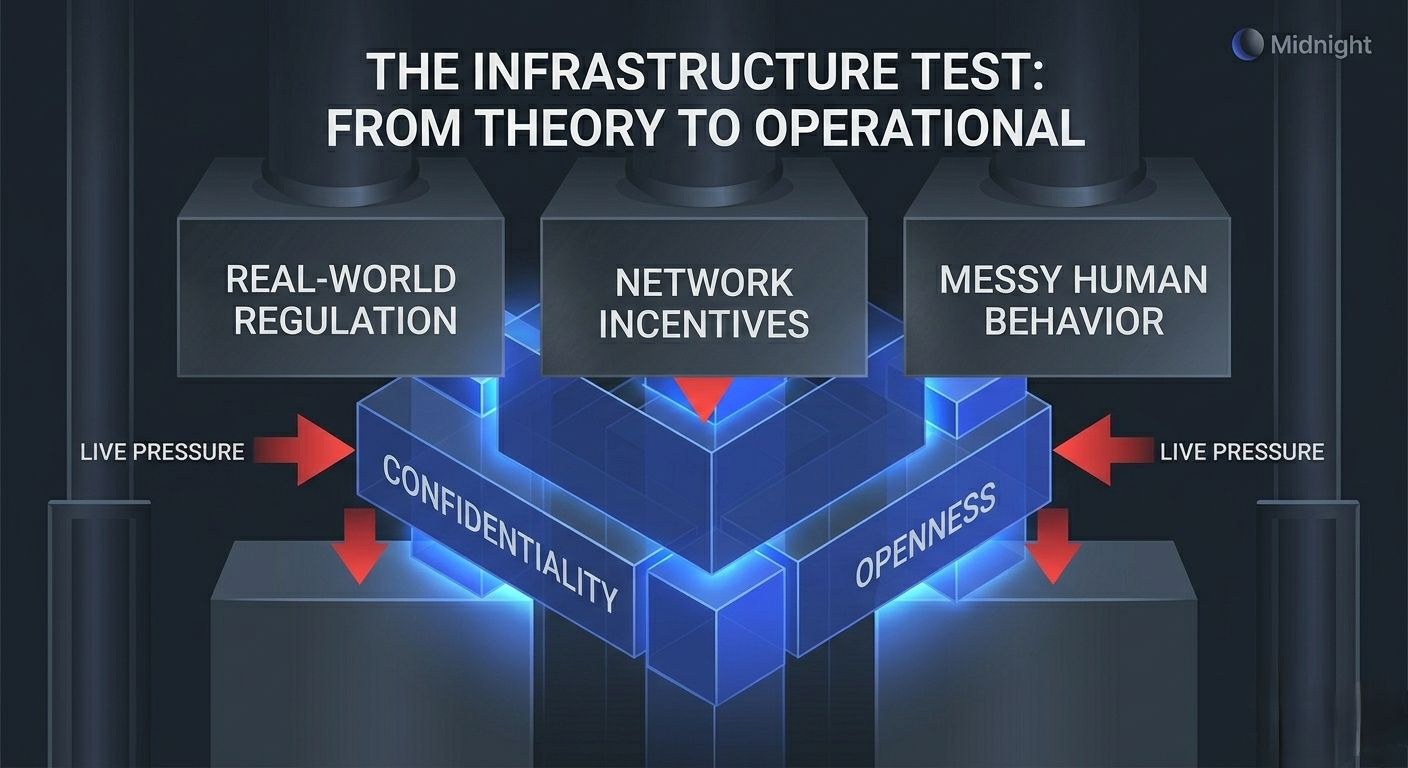
Before launch, a project can sound incredibly coherent. Every design choice looks smart in isolation. Every tradeoff sounds manageable. Then real users show up. Real incentives show up. Real friction shows up. And suddenly the nice clean story has to survive contact with behavior.
That is the part I keep in mind with Midnight.
I think it sounds more credible than the older privacy-project template. It feels more grounded. More serious. More aware that real adoption lives in environments where privacy has to coexist with developers, institutions, regulations, product design, network incentives, and people doing messy human things.
That is already a big step up from the usual “we hid everything and called it the future” approach.
But credibility before launch is still only credibility before launch.
That is why I cannot fully buy into any grand conclusion yet. Not because the idea is weak but because the opposite.
The idea is heavy enough that it actually has something to prove.
Midnight is not just trying to be interesting. It is trying to solve a real structural weakness in blockchain design. And when a project goes after something that fundamental, the only test that matters in the end is live pressure.
Can it hold up when people actually use it?
Can it feel useful not just clever?
Can it stay coherent once launch energy fades and real-world demands start piling up?
Those questions matter more than the pitch does.
And honestly, that is why Midnight feels different to me.
It does not seem built mainly for applause.
It seems built for an argument the industry has been avoiding for too long.
Public blockchains are powerful, yes.
But for a lot of serious use cases they are also too exposed. Too loud. Too casually public.
Midnight is one of the few projects that seems to be saying:
maybe privacy is not some optional extra we bolt on later
maybe it is part of what makes blockchain viable in the first place.
That is a much stronger claim.
And a much more useful one too — if it works.
So when I look at Midnight, I do not really see another fashionable privacy story.
I see a project trying to do the less glamorous thing:
turn privacy into working infrastructure instead of symbolic rebellion.
Make it useful enough that people care about it for practical reasons, not just ideological ones.
That is harder to market.
It is also more worth building.
Which is probably why it feels more credible than most of the louder narratives in the space.
Not because it promises less complexity
but because it seems more willing to face the real complexity head-on.
Still, that seriousness cuts both ways.
The heavier the idea the less it gets to hide behind theory.
Midnight will not be judged by how well it explains itself
but by how well it behaves when the system is live, when usage becomes real, and when the tradeoff between openness and confidentiality stops being theoretical and starts becoming operational.
That is where the real answer will come from.
Not whether Midnight sounds important
but whether it can actually carry the weight of a problem that is.