

I Respect Sign Because It Is Trying to Fix the Parts of Crypto Everyone Pretends Are Fine
The more I look at Sign the more I think its biggest strength is that it is not chasing the glamorous part of crypto.
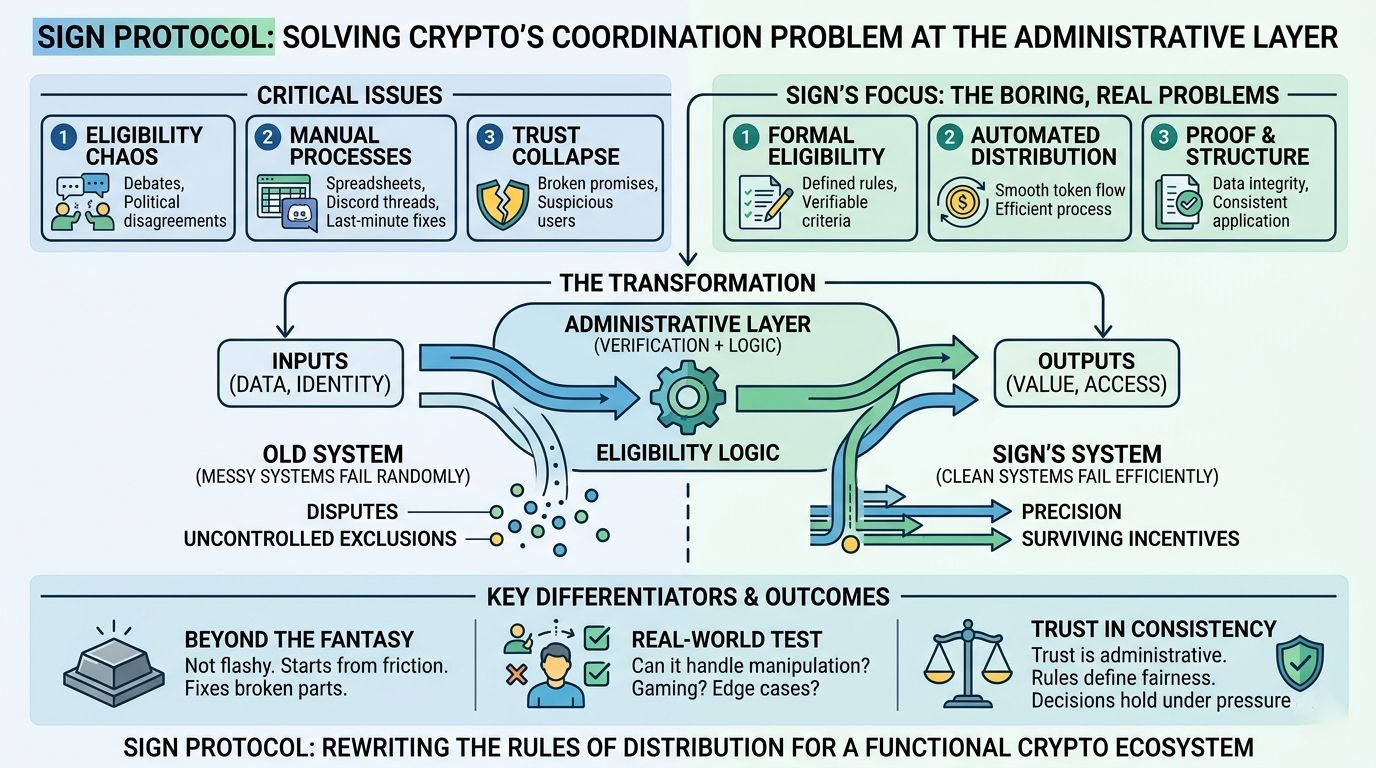
It is going after the paperwork.
And I mean that as a compliment.
Most projects want to be seen as revolutionary. They want the big narrative. The future of finance. The next internet. Freedom scale community, destiny and whatever other word is currently being overused in all caps.
Meanwhile half the industry still cannot answer basic questions cleanly:
who actually qualifies who gets what when they get it and why everything turns chaotic the moment real users are involved.
That is where Sign starts to feel more serious than most.
Because the uncomfortable truth is simple crypto does not have a branding problem.
It has a coordination problem.
Every time value needs to be distributed fairly, things fall apart.
Eligibility lists turn into debates.
Wallet snapshots turn into politics.
Claims become confusion.
Unlock schedules become suspicion.
And suddenly the so-called trustless system is running on spreadsheets Discord threads, last-minute fixes and manual decisions.
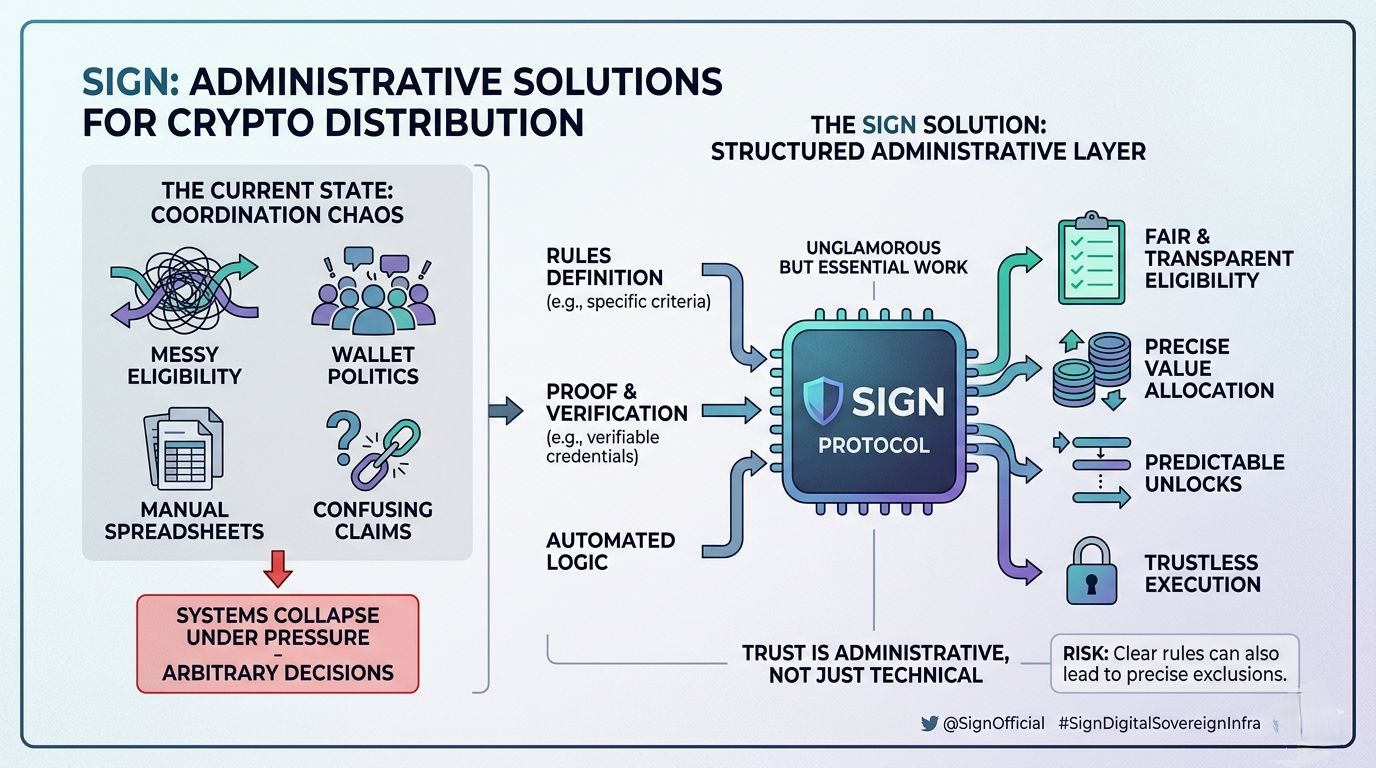
Not exactly the future people were promised.
That mess is exactly why Sign matters.
It is not just asking who you are.
It is asking something more important:
what do you qualify for and how should the system respond?
That is a far more practical problem than most projects want to admit.
Because in reality, value distribution is never just about sending tokens.
It requires rules.
It requires proof.
And most importantly it requires a system that can apply both without collapsing into chaos.
That is the layer Sign is trying to build.
And that is why it matters because boring problems are usually the real ones.
Nobody celebrates eligibility infrastructure until it breaks.
Nobody talks about distribution logic until people start getting excluded overpaid, or confused.
Crypto loves to treat distribution as a minor detail.
It is not.
Distribution is power.
Access is power.
Verification is power.
The moment a system decides who qualifies and who receives value, it stops being technical it becomes political.
That is why I do not see Sign as just another infrastructure project.
I see it as an attempt to clean up one of the most ignored and most critical layers in crypto.
But that also introduces a different kind of risk.
The clearer the rules become, the clearer the exclusions become too.
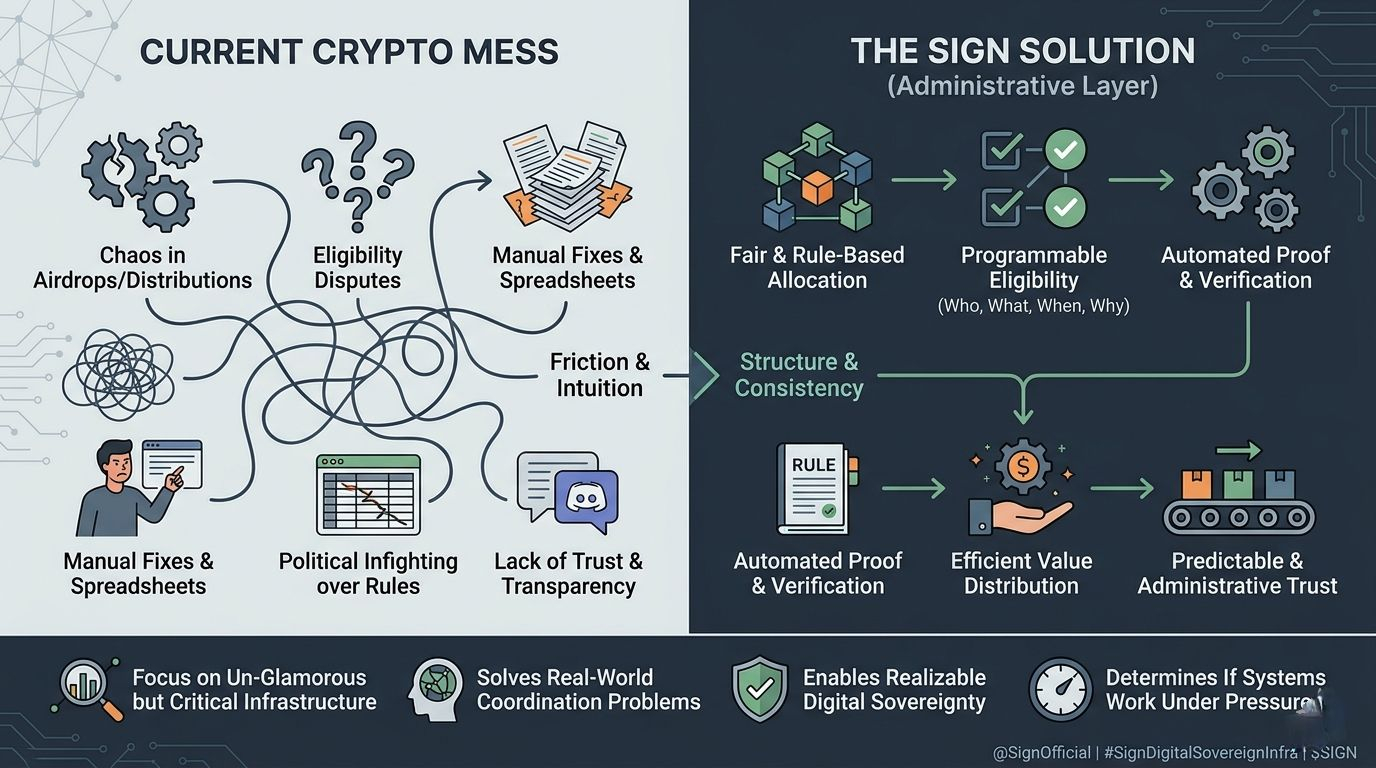
Better systems can improve fairness
but they can also make denial more precise.
A messy system fails randomly.
A clean system can fail efficiently.
That does not mean structure is bad.
It just means structure is not the same thing as justice.
And crypto often confuses the two.
So the real question is not whether Sign’s architecture looks good on paper.
The real question is whether it can survive incentives.
Because that is where every system gets tested.
Can it handle manipulation?
Can it handle disputes?
Can it handle edge cases where reality does not fit neatly into predefined rules?
Can it deal with people gaming eligibility, splitting identities or extracting value while appearing legitimate?
That is the real exam.
Not the demo.
Not the terminology.
Not the diagrams.
What matters is what happens when things get messy because they always do.
That is why Sign stands out to me.
It is not selling a fantasy.
It is starting from friction.
From the annoying unglamorous layer that everyone ignores
until it breaks everything.
Because in the end, crypto is not just about code execution.
Trust is not only technical.
It is administrative.
It lives in rules.
In consistency.
In whether people believe the system can allocate value without becoming arbitrary or chaotic.
That is the domain Sign is stepping into.
Not the loudest domain.
Not the most marketable one.
But one of the most important.
So yes, I take it seriously.
Not because it is flashy because it is not.
Not because it promises impossible futures because it does not.
I take it seriously because it focuses on the part of crypto that actually determines whether systems work under pressure.
The administrative layer.
Where trust access and value are not ideas but decisions.
And those decisions have to hold.
That is not glamorous work.
It is just the work that matters.