

@MidnightNetwork I think Midnight becomes much more interesting when I stop looking at NIGHT as a typical crypto token and start seeing it as a claim on usable network capacity. On Midnight, NIGHT is the public native and governance token, but holding it is meant to do more than represent ownership. It also generates DUST, a shielded and non transferable resource that pays for transactions and smart contract execution. That idea matters more now because Midnight has already launched NIGHT on Cardano and is pushing toward mainnet in March 2026.
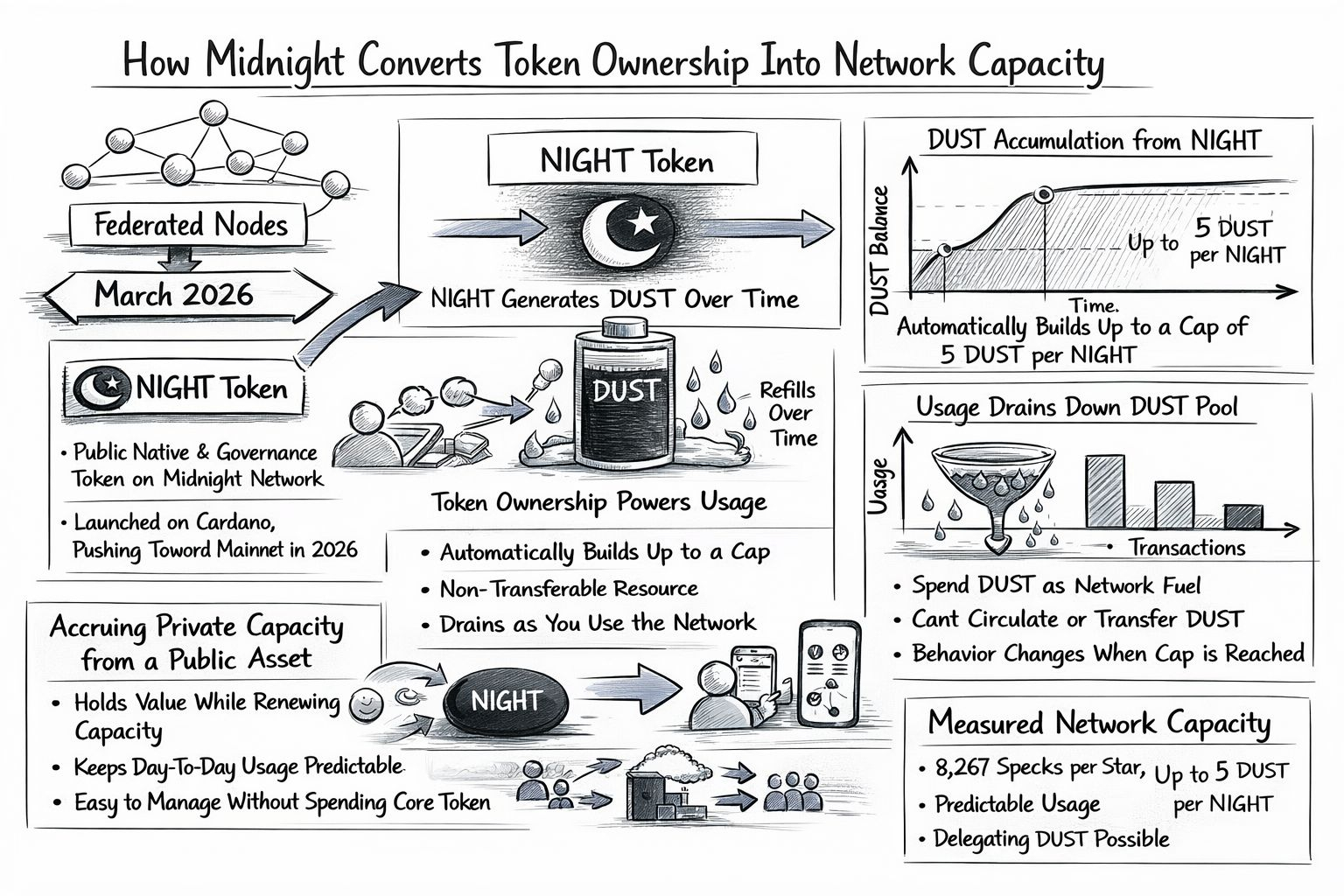
What stands out to me is the way Midnight separates capital from day to day usage. On many networks, one token is expected to do everything at once. It is the asset people hold, the token they spend for fees, the thing they speculate on, and often the thing they use in governance as well. Midnight takes a more deliberate approach. NIGHT is the asset I hold, while DUST is the resource I use. Midnight’s own materials compare the system to a battery, and I think that image works because DUST refills over time from NIGHT holdings. In practice, that means access to the network can renew itself instead of constantly forcing users to spend down the base asset just to remain active.
That is the point where the phrase “network capacity” starts to feel precise rather than rhetorical. Midnight’s developer documentation explains that DUST is derived from the NIGHT behind it, that it accumulates over time until it reaches a cap, and that its behavior changes once the underlying NIGHT is spent. The indexer documentation even publishes concrete parameters, including a generation rate of 8,267 Specks per Star per second and a maximum capacity of 5 DUST per NIGHT. I do not see that as a minor technical footnote. To me, it shows Midnight is trying to turn token ownership into something measurable and operational, closer to a renewable usage budget than a simple balance sitting in a wallet.
I also think the non transferable nature of DUST is one of the most important parts of the design. It cannot simply circulate as money for trade or settlement, and Midnight presents that limit as a way to avoid using privacy as a cover for anonymous value transfer. At the same time, DUST can be delegated, which creates room for developers to sponsor activity for users without giving away the NIGHT itself. That matters because it creates a more realistic path for applications that feel accessible at the point of use. For me, this is where the model becomes practical. It tries to make privacy infrastructure easier to live with instead of assuming every user wants to actively manage gas costs every time they interact with an app.
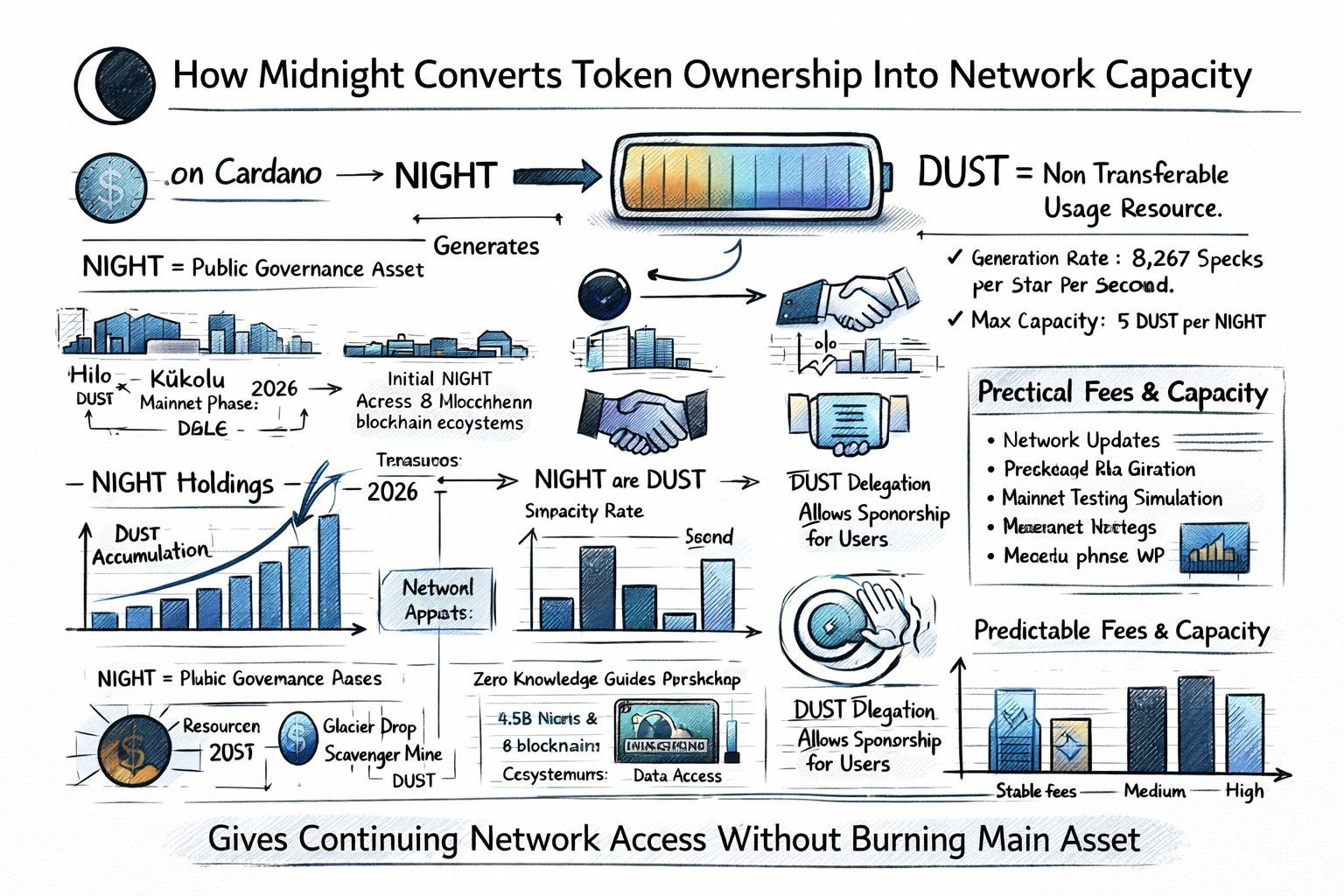
The reason this topic is drawing more attention now is not only the elegance of the token model. Midnight has moved well beyond abstract roadmap language and into visible rollout. In its January 2026 network update, Midnight said Glacier Drop and Scavenger Mine had allocated 4.5 billion NIGHT across a fast growing community that stretched over eight blockchain ecosystems. Since then, the network has continued shifting toward production. NIGHT went live on Cardano in December 2025, and the roadmap points from the current Hilo phase toward Kūkolu for mainnet and then toward Mōhalu, where broader participation and a future DUST capacity exchange are part of the plan. That makes the ownership to capacity idea feel less like theory and more like a system the ecosystem is actively preparing to use.
I can see that momentum in the surrounding infrastructure too. Midnight’s March 2026 developer updates focused on getting projects ready for mainnet, including guidance around Preprod migration, zero knowledge training, and DUST generation for transaction processing. The broader network updates have also tied the mainnet transition to a growing federated node model and to Midnight City, a live simulation designed to show how the protocol handles real world transaction volume while supporting selective disclosure. All of that gives the project a more grounded feel. It suggests the conversation is no longer only about what Midnight wants to become, but also about what it is already testing and preparing for in public.
My honest takeaway is that Midnight makes the most sense when I read it less as tokenomics theater and more as a form of infrastructure accounting. The core question is surprisingly simple: what changes when owning the asset gives me continuing access to the network instead of forcing me to burn that same asset every time I use it? That question lands at a moment when privacy has become more urgent again. Midnight’s February 2026 survey framed the issue directly by arguing that users increasingly want stronger data protection while $1.22 trillion in web3 transaction volume still moves across transparent rails. I do not think Midnight has proven everything yet, and I would be cautious about anyone claiming otherwise. Still, I do think it has found a sharper and more usable way to connect token ownership with actual network capacity, which is exactly why more people are paying attention now.