


When I first stumbled into zero-knowledge systems, it felt almost magical. The promise was simple and beautiful: prove something is true without showing the actual data. Privacy without sacrifice. Verification without exposure. I thought, "This is it—this is the how we finally fix so many broken things in tech.@MidnightNetwork
But reality has a way of humbling you.
I still remember that evening with Kashif. We were sitting on the charpai outside, scrolling through my laptop, and I was excitedly walking him through zk-SNARKs. He listened quietly for a while, then hit me with the question that stopped me cold:
"Bhai, agar itni powerful cheez hai, toh phir sab log kyun nahi use kar rahe?"
(If this tech is so powerful, why isn't everyone already using it?)
I opened my mouth to give some polished answer about adoption curves... and then I realized I didn't have a good one. That question forced me to look at the uncomfortable truth: hardware is a massive wall.
Proof generation is brutally heavy. Verification? Lightning fast, usually #night milliseconds. But actually creating the proof? It eats CPU, RAM, and time like nothing else. I tried it myself on my old laptop—one of those mid-range machines most people in Faisalabad have. I set up a simple circuit, ran the prover... and watched it crawl. Memory spiked, fans screamed, and after several long minutes, I got a proof for something that should've taken seconds in plain code.
Kashif just smiled and said, "Dekha? Agar powerful machines chahiye, toh yeh abhi bhi 'common man' ke liye nahi hai."
That line stuck $NIGHT with me. Accessibility isn't just a nice-to-have—it's make-or-break.
A couple of days later, I was chatting with Noman over call. He's the type who always thinks in systems and structures. We started talking about how zk keeps everything consistent when the actual data stays hidden. That's when constraint systems really clicked for me.
Every rule in your zk circuit turns into a mathematical constraint that has to hold true. Mess up the design, and either your proof blows up in size and time, or the whole thing becomes unreliable. It's not optional optimization—it's survival.
I spent nights tweaking my own tiny circuits, trying to shave off constraints. One bad loop or inefficient comparison, and boom—proof time doubled. It felt less like regular programming and more like sculpting something delicate out of pure math. One wrong cut, and it falls apart.
Then came Talha. He's deep into AI, always ranting about models and datasets. One day he casually asked: "Yaar, what if we could use zk to prove an AI model did what it was supposed to—without showing the weights or the training data?"
My brain lit up.
AI outputs are black boxes to most people. You get a result, but how do you know it followed the rules? ZK could let someone prove "Yes, this model ran exactly this inference path" while keeping the model private. It's still early—ZKML is experimental, computationally insane for big models the third but the idea shifted everything for me.
ZK isn't just hiding secrets. It's building trust where you can't peek inside the box.
All these conversations slowly changed how I think about ownership too.
Before, blockchain ownership meant private keys and tokens. Control the key own the thing. Simple.
But zk adds nuance. You can participate in a system, prove you meet the rules, and still decide exactly what gets revealed. It's ownership of visibility. Not just "I have this," but "I control how much of this the world sees." That's a deeper, more human kind of control.
Looking back, I didn't learn zk from whitepapers or YouTube tutorials alone (though those helped). I learned it through these late-night talks:
Kashif making me face the hardware reality
Noman showing me the beauty and pain of good constraints
Talha opening my eyes to applications I hadn't even considered
Each one peeled back a layer and made the picture more real.
ZK is incredible, no doubt. But it's also demanding. It forces you to wrestle with hardware limits, obsess over efficiency, and constantly weigh trade-offs. You can't just throw code at it and expect magic.
The biggest lesson for me?
Zero-knowledge isn't only about privacy. It's about reimagining how we prove truth, tame complexity, and give people real control over their digital lives—all at the same time.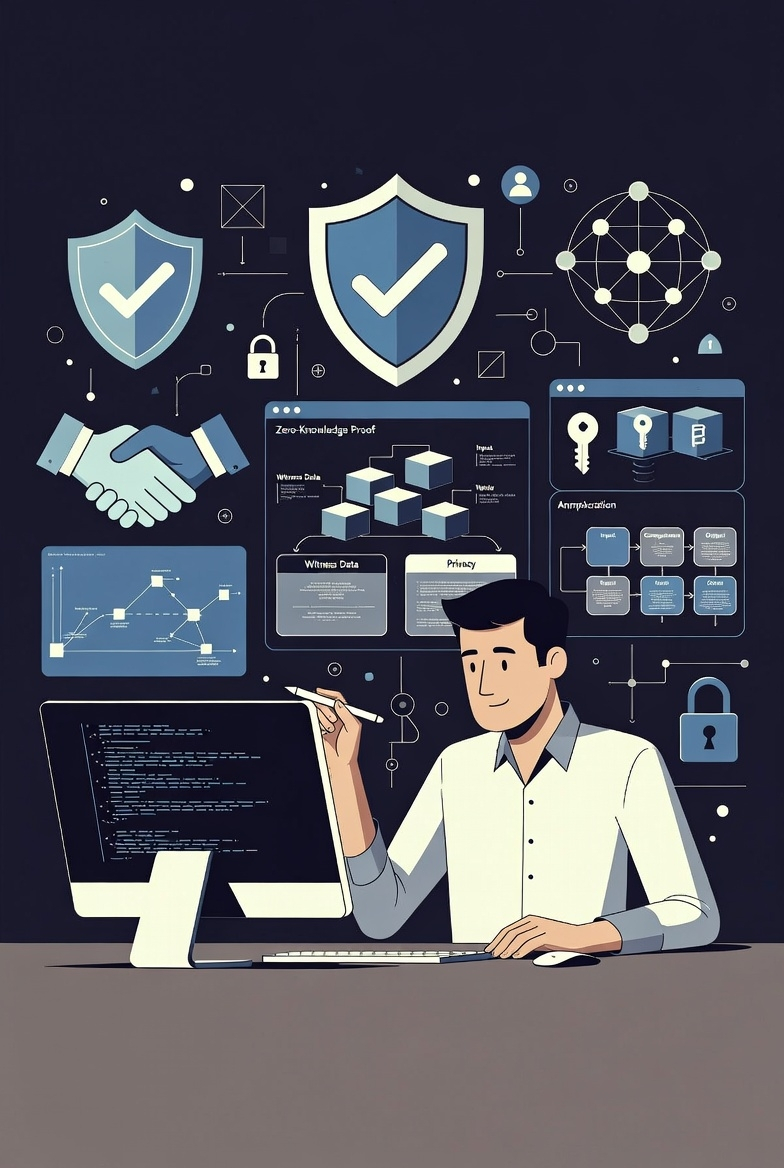
I'm still learning, still hitting walls, still getting excited about small wins. But now when someone asks me "What is zk really about?", I don't start with theory.
I start with the conversations that changed how I see it. Because that's where the real understanding lives.