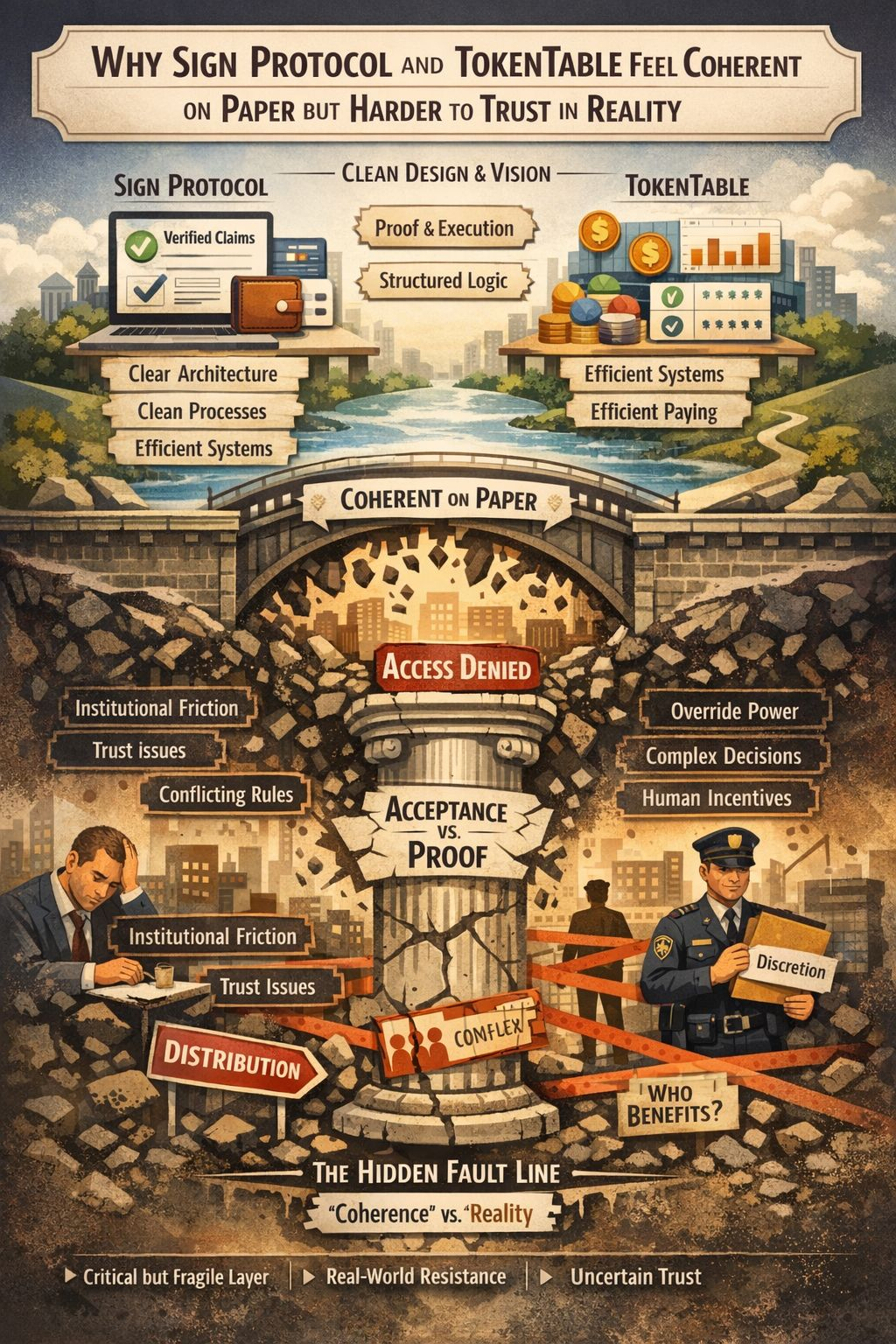
That is what Sign Protocol and TokenTable have done for me.
Not because I am fully sold on them. Not because I think they are flawless. And definitely not because I have reached the point where seeing the word infrastructure automatically makes me think something is profound. If anything, that word makes me more cautious now. I have seen too many projects reach for it the moment louder narratives stop working. The tone becomes calmer. The branding becomes cleaner. The language starts sounding more serious, more disciplined, more mature. But beneath that polished surface, the same weaknesses often remain.
So I did not come to Sign with admiration. I came to it with resistance.
Maybe that is exactly why it has stayed with me.
The more I look at it, the more it feels like it is aimed at something real. Not loud. Not glamorous. But real. The kind of problem people ignore until it begins quietly breaking everything around it.
And that is where my interest starts, even if trust still does not.
What Sign is working on sits in an awkward part of the stack. Not the part people hype in a single sentence. Not the part that fits neatly into a market cycle. It is dealing with verification, credentials, structured claims, permissions, eligibility, issuance, audit trails, and distribution logic. The operational layer. The administrative layer. The part that sounds boring until a system fails and suddenly everyone realizes it mattered far more than they thought.
That is what keeps pulling me back.
Because over time, I have started to believe these boring layers decide more than the exciting ones ever do.
Anyone can talk about scale. Anyone can talk about adoption. Anyone can sell a clean vision of how things are supposed to work. What matters more is what happens when a user is excluded and cannot tell why. Or when someone asks for proof and the system cannot explain itself clearly. Or when value moves according to conditions written somewhere, interpreted somewhere else, and enforced in a way the people affected by them cannot actually understand.
That is where systems start telling the truth about themselves.
And that is the territory Sign keeps moving toward.
At a high level, the structure is easy to understand. Sign Protocol handles attestations and verification. It is meant to create structured, verifiable claims — a way to prove that something about a person, wallet, or entity is true according to a defined schema.
TokenTable is where that proof starts turning into consequence. Distributions, vesting, unlocks, claims, allocations — the mechanics of who gets what, when they get it, and under what conditions.
On paper, it is a clean separation.
One layer handles proof. The other handles execution. One records what is supposed to be true. The other acts on that truth.
That makes sense. Honestly, more sense than a lot of projects I have looked at.
And maybe that is exactly why I hesitate.
Because I have learned that clean architecture is rarely where the real problems live. Clean architecture tends to arrive first. The mess comes later.
The question I keep circling is simple: a verified record is not the same thing as a recognized one.
That gap matters more than people want to admit.
A protocol can say a claim is valid. A schema can say a wallet is eligible. A system can say a user has satisfied the required condition. But none of that guarantees the surrounding institution, platform, regulator, or operator will treat that proof as enough.
That is the part people skip over.
They act as if technical clarity naturally leads to social clarity. As if once a rule is structured well enough, the real-world disagreement around it disappears. But that is not how these systems work. It never has been.
Who wrote the rule? Who benefits from it? Who has the power to override it? Who gets trapped when the system makes a decision that looks perfectly clear internally but feels impossible to understand from the outside?
That is why I cannot look at Sign as just a tidy infrastructure story. Once you are dealing with verification tied to money, access, or eligibility, you are no longer just dealing with software. You are dealing with institutions. And institutions rarely move with the clean discipline protocol logic wants from them.
If Sign Protocol were only about attestations, I would still find it interesting. But TokenTable changes the weight of the whole thing for me.
Because once verification is tied directly to distribution, the stakes change. The system is no longer just recording information. It is helping decide outcomes. It is helping determine who receives value, who unlocks something, who qualifies, who does not, and whether that decision can be traced back to a piece of evidence someone else is expected to trust.
That is much bigger.
It turns the stack into something more than a technical tool. It starts to feel like a coordination system. A place where proof and consequence meet.
And that is exactly where things get uncomfortable.
Because consequence exposes everything. It exposes the quality of the logic, the quality of the inputs, the quality of governance, and the quality of the assumptions underneath the entire system. It forces the question people usually avoid: what happens when the proof exists, but acceptance still does not follow?
That is the doubt I keep coming back to.
To be fair, this no longer feels like an empty narrative.
There are enough signs of traction that it deserves more than a dismissive glance. The project feels like it has moved beyond the kind of early infrastructure pitch that survives only on elegant framing. It has edged closer to real usage, real integrations, and more serious counterparties.
That matters.
Because there is a real difference between a project that sounds intelligent and a project that has actually had to operate under pressure. Even if I stay cautious, I can still recognize when something has moved out of theory and into a more consequential phase.
That is what makes Sign harder to brush aside.
It feels like it is trying to touch an actual fault line — the place where identity, evidence, permissions, and value distribution all begin colliding. That is not a fake problem. That is one of the more important hidden problems in digital systems.
So yes, I understand why it keeps pulling attention.
I just do not think attention should automatically become trust.
The hardest part is never the polished version of the idea. It is what happens when real-world friction shows up.
What happens when a rule changes? What happens when an attestation becomes outdated? What happens when a user is denied and nobody can explain the reason in plain language? What happens when one institution accepts a piece of proof and another refuses it? What happens when the protocol says yes, but the operator still wants discretion?
That is where systems like this usually begin losing their elegance.
Not because the code is broken. Because the world around the code is not clean.
There are always exceptions. There are always manual layers. There are always cases where someone wants the benefits of standardization without giving up the freedom to make side decisions when it suits them. And once that starts happening, the original clarity of the system can begin to feel more decorative than real.
That is the part I am watching for.
Not whether the design sounds smart.
Whether it still holds shape once the surrounding people, institutions, and incentives start pressing against it.
Even with all of that doubt, I still keep coming back to it.
That means something.
I think the reason is that Sign Protocol and TokenTable are pointed at a layer that genuinely matters. They are not chasing a superficial problem. They are trying to work on the hidden machinery underneath recognition, access, and distribution — the quiet systems that decide what counts, who qualifies, and how value moves once those decisions are made.
That layer is easy to underestimate because it is not glamorous.
But when it fails, it fails in ways that are painful, confusing, and hard to repair.
People suddenly realize that trust was never really solved. It was just buried inside process, paperwork, custom approvals, and institutional habit.
That is why I keep looking.
Not because I think the answer is obvious.
Because I think the problem is real.
So where do I land with it?
Somewhere uncomfortable, honestly.
I can see the coherence in Sign Protocol and TokenTable. I can see the appeal of the design. I can see why the category matters, and I can see why the project has become harder to ignore.
But I can also see how fragile this kind of clarity can become once it leaves the protocol layer and starts dealing with the messy realities of institutions, policy, discretion, and human incentives.
That is why I am not ready to fully endorse it.
And it is also why I am not ready to dismiss it.
There is something real here. Something deeper than the usual market noise. But naming the right problem is not the same as proving you can survive it.
That is the part I care about now.
Not whether the system looks clean before the mess begins.
Whether it still makes sense after.
#SignDigitalSovereignInfra @SignOfficial $SIGN