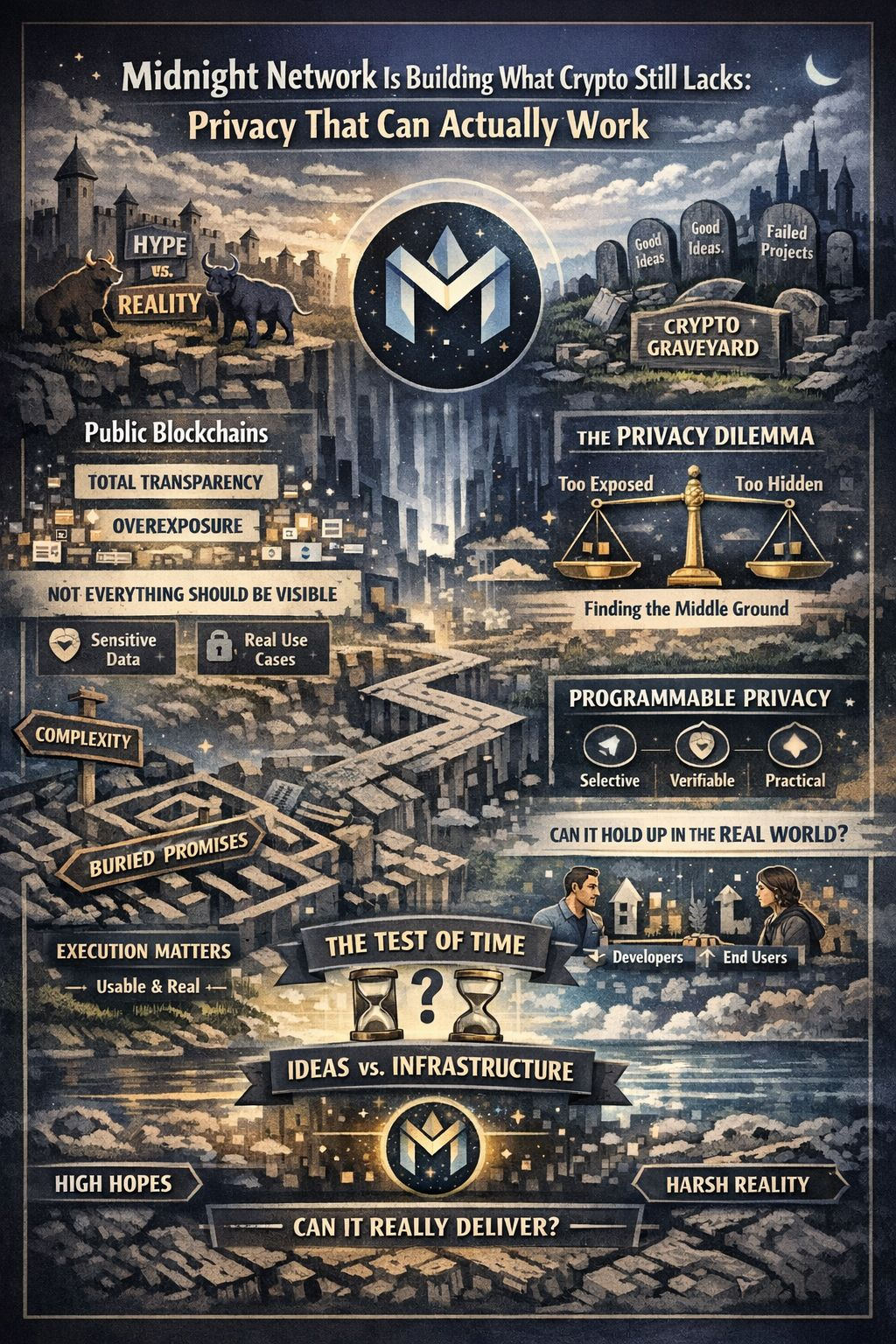
I’ve looked at enough crypto projects at this point to know how this usually goes.
A new network shows up with a polished identity, a clean message, and a promise that it’s finally fixing what everyone else got wrong.
People get excited.
The language spreads fast.
And before long, the project starts sounding bigger than it actually is, mostly because the market starts filling in the blanks and acting like unfinished infrastructure is already proven.
Then time passes.
Launch gets closer.
Expectations get heavier.
The story starts carrying more weight than it was ever built to hold.
And if the product underneath is not actually strong enough, the whole thing slowly fades into the same pile as everything else that once sounded important.
That’s why I’m usually careful.
And that’s also why Midnight has my attention.
Not because I think it’s guaranteed to win.
Not because I’m desperate for a new narrative.
Honestly, I’m tired of narratives. Most of the market is.
But Midnight feels like it’s pointing at a real problem, not a made-up one, and that alone gives it more substance than most projects get.
Because the truth is, crypto still hasn’t fully solved what privacy is supposed to look like when the stakes are actually real.
For years, public blockchains treated transparency like it was automatically a good thing.
Everything visible.
Everything traceable.
Everything out in the open.
And to be fair, that model works for a lot of activity.
It works for speculation.
It works for public markets.
It works for the kind of on-chain behavior where exposure is just part of the game.
But that doesn’t mean it works for everything.
Once you start thinking about real payments, business activity, treasury movement, sensitive data, trading strategy, identity, or anything even slightly serious, total transparency stops looking ideal.
In a lot of cases, it starts looking like a liability.
Not because people are trying to hide something shady, but because not everything is supposed to be fully exposed by default.
That’s the part I think Midnight understands.
And more importantly, it doesn’t seem to be approaching privacy in the lazy old way where the answer is just “hide everything.”
That model has problems too.
A system that reveals nothing can become hard to trust just as quickly as a system that reveals too much becomes hard to use.
Midnight seems to be aiming for the harder middle ground, where some things stay private, but proof still exists when it matters.
That’s what makes it interesting to me.
Because that middle ground is messy.
It’s not easy to explain.
And it’s definitely not easy to build.
A lot of teams talk confidently about combining privacy, compliance, security, and usability like those things naturally fit together.
Usually they don’t.
Usually one side gets sacrificed.
Either the system becomes too exposed to support real-world use, or it becomes so closed-off that nobody feels comfortable trusting it.
Midnight looks like it’s trying to sit right in that tension instead of pretending the tension doesn’t exist.
That’s a much more serious ambition than just launching another privacy-themed chain and hoping the word privacy does all the heavy lifting.
What keeps me watching is that the project feels like it wants to be useful, not just impressive.
That sounds obvious, but in crypto it really isn’t.
A lot of projects are built to look advanced.
They want the architecture to sound intelligent.
They want the branding to feel high-level.
They want people to say the tech looks sophisticated.
But when you get past the surface, the actual experience of using or building on the thing is full of friction, overhead, and unnecessary complication.
It ends up feeling like something that was made to be admired from a distance rather than used in real conditions.
That’s one of the fastest ways to lose me.
Midnight only matters if it avoids that trap.
And I think that’s why this stage matters more than the earlier ones.
When a project is still distant enough from launch, people can project anything onto it. They hear the right words, they imagine the future, and the gaps feel harmless because nobody has to deal with them yet.
But once a network starts getting closer to real usage, the mood changes.
The concept has to start carrying actual weight.
Questions get sharper.
The market gets less generous.
That’s where Midnight is now.
And that’s the only phase that really tells you anything.
Because this is the point where you find out if the design can survive contact with reality.
Not just whether it sounds smart.
Not just whether it makes sense in theory.
Whether people can actually build with it.
Whether users can actually benefit from it.
Whether the privacy it offers feels like a real advantage instead of extra complexity wrapped in good branding.
That’s the difference between an idea and infrastructure.
And crypto is full of ideas that never became infrastructure.
I also think Midnight is interesting because the problem it’s targeting doesn’t feel forced.
It feels obvious once you sit with it long enough.
Public chains do expose too much in certain situations.
They do make some forms of activity harder than they should be.
They do push people into a weird tradeoff where you either accept overexposure or leave the system entirely.
That’s not a fake issue.
That’s a real limitation.
So when Midnight builds around the idea that privacy should be programmable, selective, and usable instead of absolute, I can at least see the logic.
That doesn’t make me automatically bullish.
It just means I think the thesis is grounded in something real.
And that already puts it ahead of a lot of projects that are mostly built on atmosphere.
But this is also where the hard part begins.
Because being right about the problem is only the beginning.
You still have to build something people actually want to deal with.
You still have to prove that the model is usable.
You still have to show that developers don’t need to fight the system just to make anything meaningful.
You still have to show that privacy doesn’t turn into friction so heavy that the whole value proposition starts collapsing.
That’s where most teams get exposed.
Not in the idea stage.
In the implementation stage.
That’s why I’m not really interested in overhyping Midnight right now.
I think it deserves attention, but attention is different from trust.
The network still has to prove that it can hold real activity, that its design won’t become a burden, and that the need it identifies actually translates into demand once the market has a choice in front of it.
Because the market does not care how elegant your theory was if the thing never becomes necessary.
That’s the brutal part.
A project can be thoughtful, technically impressive, and completely right about what’s broken, and still fail if it doesn’t create enough pull.
Crypto has buried plenty of smart ideas already.
The graveyard is not full of dumb projects.
It’s full of projects that made sense and still didn’t stick.
Midnight has to avoid becoming one of those.
And I think that’s why I keep coming back to it.
Not because I’m convinced.
Not because I want to force conviction where it hasn’t been earned.
I keep coming back because I can see the shape of why it might matter if execution holds.
There are real parts of this market, and even more of the world outside it, where total visibility just doesn’t make sense.
There are too many situations where people need to protect data, strategy, or activity without giving up the ability to verify what matters.
There are too many cases where everything public all the time stops feeling like innovation and starts feeling like bad design.
Midnight seems to understand that.
And if it can turn that understanding into something practical, stable, and usable, then it has a chance to matter in a way a lot of projects never do.
That’s still a big if.
But at least it’s a real one.
So that’s where I’m at with Midnight.
I’m not treating it like a guaranteed winner.
I’m not brushing it off either.
I’m just watching closely, because this feels like one of those rare projects where the friction it’s built around might actually be pointing to something real.
And in a market full of recycled excitement, that’s enough to keep me paying attention.
#night @MidnightNetwork $NIGHT