
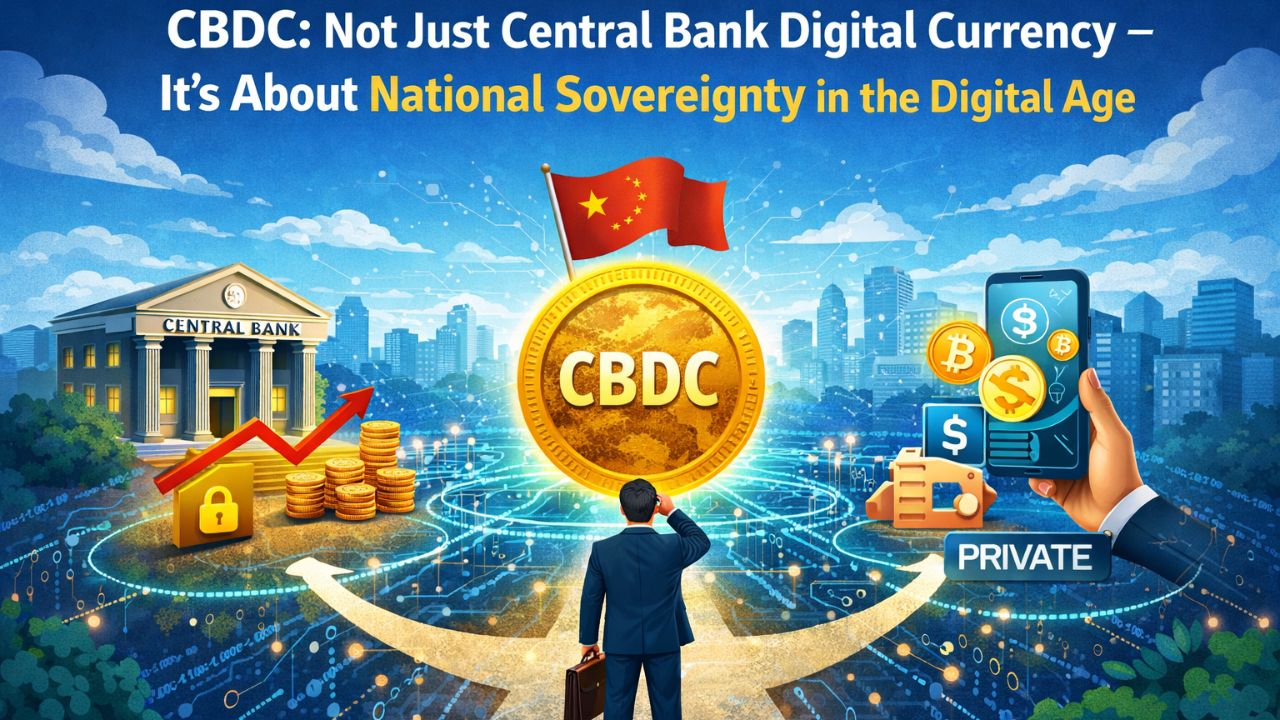
There are things in life so familiar that we rarely pause to question their true nature. Money is one of them. We use it every day, transferring funds, scanning QR codes, receiving salaries… yet we seldom ask: what is money, really, and who holds the power over it? As we step into the digital age, that question becomes sharper than ever. And this is where the concept of CBDC - Central Bank Digital Currency, shaped by @SignOfficial - is no longer a distant idea, but a matter closely tied to the sovereignty of every nation.
Looking back at history, money has never been just a medium of exchange. It has always been a symbol of power. From primitive forms like shells and livestock, to precious metals, then paper money and modern fiat currency, each transformation has been accompanied by the state reinforcing its control over the economy. Yet in the digital era, a paradox emerges: information can circle the globe in an instant, while money still “moves” through outdated, slow, and multi-layered systems. What we call digital money today is, in essence, just an electronic version of traditional money, not truly native to the digital world.
It is within this gap that CBDC begins to emerge as a foundational solution. Not merely a new payment application, nor simply a regulatory tool, CBDC represents the rebirth of money in a digital environment, carrying all the properties of sovereign currency. It is as if a nation is not just upgrading old roads, but rebuilding the entire transportation system to fit a completely new world.
Looking deeper, it becomes clear why CBDC is not just an option, but almost an inevitability. As private stablecoins grow rapidly and gain widespread use, especially in countries facing high inflation or strict capital controls, money begins to drift beyond traditional monetary borders. This weakens the effectiveness of national monetary policy. In this context, CBDC acts like laying down new rails, guiding the flow of finance back within sovereign control.
Beyond that, CBDC opens the door to financial inclusion for billions of people who remain outside the traditional banking system. While commercial banks operate on profit, CBDC carries the nature of public infrastructure, much like electricity, water, or roads. It does not ask whether you are wealthy or poor, documented or not. It simply grants access to national currency.
From another perspective, cross-border payments, long known for being slow and costly, could be fundamentally reimagined through CBDC. As nations connect their digital currency systems, transfers can become faster, more transparent, and less dependent on traditional intermediaries.
Perhaps the most intriguing, and also most debated aspect of CBDC, lies in the programmability of money. For the first time in history, money can carry conditions: where it can be spent, when it can be used, and for what purpose. This allows monetary and social policies to operate with precision, like a finely crafted mechanical clock, where every gear moves with intention.
Yet, as cash gradually fades from daily life, another quiet question arises: without CBDC, will people still have direct access to state-issued money, or will they become entirely dependent on private platforms? In such a world, not only the flow of money, but also data and economic behavior, could fall under the influence of entities beyond public control.
All of this leads me to realize that CBDC is not a dry concept reserved for finance or technology experts. It is closer to us than we think, and more important than we often assume. It touches how a nation functions, how citizens access money, and how power is distributed in a digital society.
As money gradually becomes software, the question is no longer just “where is money,” but “who controls the system that runs it.” In that world, CBDC is not simply a technological choice, but a strategic step to protect and shape national sovereignty. Understanding CBDC, therefore, is not just about understanding money. It is about understanding the future.
$SIGN #SignDigitalSovereignInfra
