The more I look at SIGN, the more I feel like I’m not really looking at a typical crypto project.
It doesn’t hit in the usual way. There’s no instant rush to it. No clean one-liner you can lift out and turn into a post. It feels heavier than that. More structural. More administrative, almost. And honestly, I think that’s part of why I keep coming back to it.
Because the more I read, the less I think this is really a story about performance.
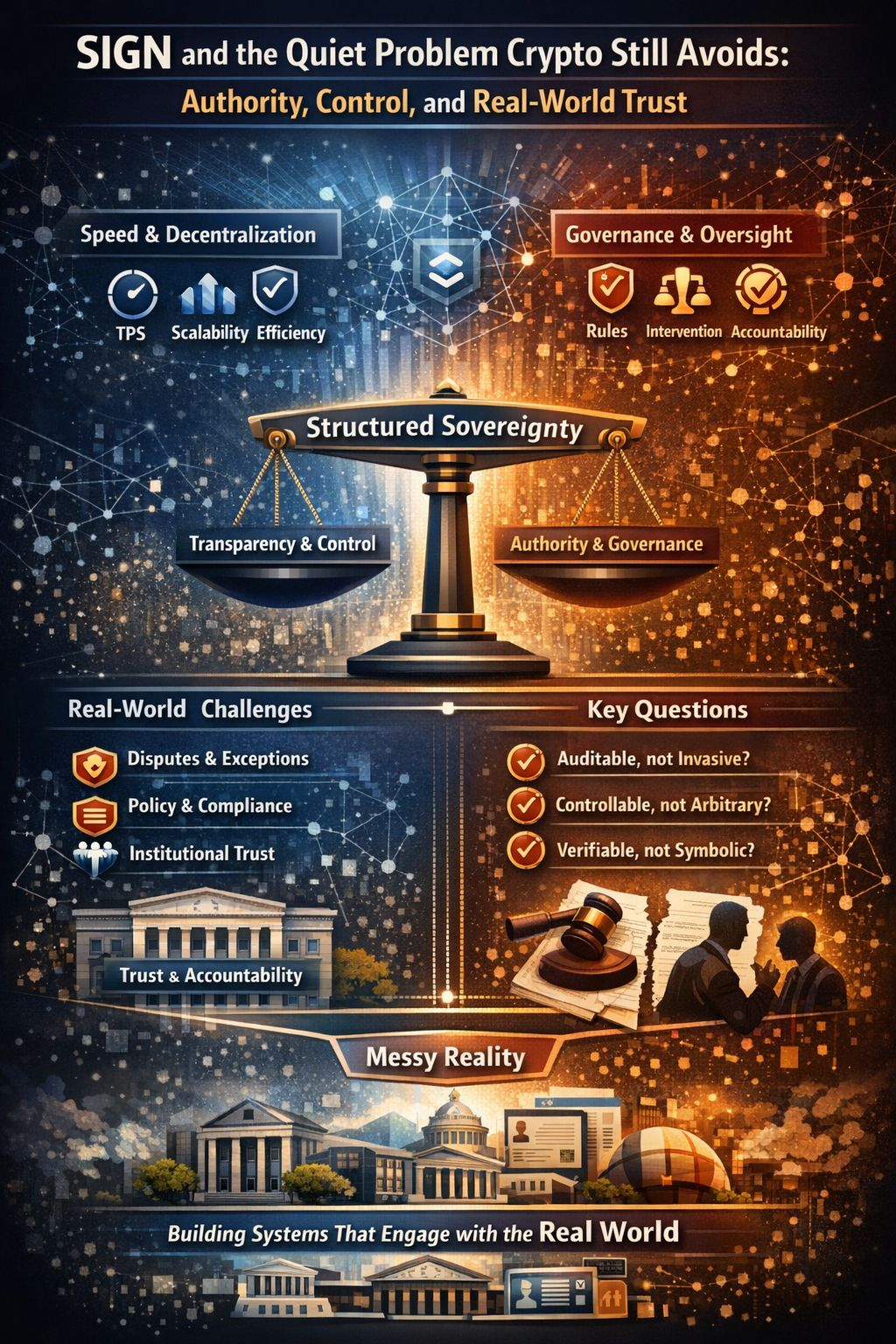
That’s usually where crypto begins. Speed. Scale. Lower costs. Better UX. More decentralization. Every new system gets framed as if it’s solving infrastructure by making it faster or more efficient. And to be fair, that’s what gets attention. TPS, finality, latency. Those things are easy to point to. They make a project feel tangible.
But that framing only takes you so far.
Once blockchains start moving closer to real-world use, the problem changes. The moment governments, institutions, public systems, or regulated money enter the picture, it stops being only about whether the network can process transactions quickly. It becomes about who is allowed to do what, under which rules, and what happens when something doesn’t go according to plan.
That’s where things get complicated.
Because real systems are messy. Rules change. Exceptions happen. Disputes happen. Oversight exists. Sometimes someone has to step in. Sometimes a process has to be paused, reviewed, or reversed. And most blockchain systems, at least in the way they’re usually imagined, aren’t really built for that kind of reality. They’re built around fixed rules and automatic execution. That works nicely in theory. It gets much harder when power and responsibility enter the picture.
That’s the part I think crypto still underestimates.
We don’t really have a shortage of infrastructure. What we have is a shortage of systems that can deal with control in a serious way without collapsing into centralization. That’s a much harder problem. It isn’t just technical. It’s institutional.
And that’s where SIGN starts to feel different.
At first glance, something like Arma BFT looks like the usual infrastructure pitch. Another consensus design. Another architecture with big performance claims. Another system trying to prove it can run faster than everything around it.
But the more I sit with it, the less I think the real point is speed.
What stands out more is the way responsibility is split across different parts of the system. Instead of forcing one layer to do everything, different roles seem to handle different parts of execution and validation. That might sound like a technical detail, but I think it matters for a bigger reason. It makes the system feel less like it was designed only to go fast, and more like it was designed to remain understandable when things get messy.
That’s a different kind of strength.
It shifts the question from how fast is this to how does this behave when something goes wrong.
And to me, that’s a much more important question.
Because once you’re talking about systems that might actually be used by governments or institutions, throughput is not really the main story anymore. It has to be there, obviously. If the system is going to operate at scale, it can’t be slow. But speed becomes the baseline. The real issue is whether the architecture can support that scale without losing control of its own trust assumptions.
That’s where the idea of sovereignty becomes more interesting.
A lot of projects use words like sovereignty in a vague or ideological way. SIGN feels more practical than that. It seems to treat sovereignty less like a philosophical claim and more like an operational reality. If a state or institution is going to adopt something like this, it needs a certain amount of control. Not unlimited control, but enough to manage policy, execution, intervention, and oversight.
And that creates a tension that I think SIGN is deliberately trying to work with.
On one side, you have the need for control. On the other, you have the need for transparency, verifiability, and auditability. The challenge is building a system where authority can exist without everything disappearing into a black box. That isn’t easy. But that seems to be the actual design space SIGN is operating in.
And that’s what makes it interesting to me.
Not because of the headline numbers.
Not because of the architecture in isolation.
And not because it fits neatly into a familiar crypto category.
It’s interesting because it’s trying to deal with the layer most of crypto still avoids — the layer where rules, authority, and verification collide.
That isn’t the glamorous part of infrastructure. It doesn’t sound exciting in the way new chains or consumer apps sound exciting. It’s more procedural than that. More grounded. But it’s also probably the part that decides whether a system can survive real-world use at all.
At the same time, this is also where I become more cautious.
Because everything sounds clean when you explain it at the architecture level. Clear roles. Defined responsibilities. Performance claims. Structured control. On paper, all of that holds together.
Reality is rarely that neat.
What happens when incentives stop aligning?
What happens when one part of the system ends up with more influence than expected?
What happens when emergency controls that were meant to be rare become normal?
What happens when governance turns political instead of technical?
Those aren’t edge cases. Those are the real tests.
And that’s why I find SIGN compelling, but not in a simple bullish way. I’m not looking at it and thinking this is obviously the answer. I’m looking at it and thinking this is at least asking a more serious question than most projects are.
Because the truth is, code alone doesn’t solve everything. It never did. There are parts of the world — especially around money, identity, and public systems — where trust can’t just be removed. It has to be structured. It has to be bounded. It has to be visible. And ideally, it has to leave evidence behind.
That seems to be what SIGN is trying to build around.
A critic could say this is all just dressed-up administration. That if a system still needs intervention, policy layers, and formal authority, then maybe it isn’t really delivering on the deeper promise of blockchain at all.
I get that criticism.
And honestly, some of it is fair. There is always a risk that systems like this end up looking more decentralized than they really are. There is always a risk that the verification layer becomes more symbolic than meaningful. There is always a risk that structured authority turns into ordinary central control with better language around it.
That risk is real.
But I also think that criticism misses something important. SIGN doesn’t seem to be trying to eliminate institutions or pretend they don’t matter. It seems to be trying to design around the fact that they do. The goal isn’t to remove trust from the system entirely. The goal is to make trust more explicit, more accountable, and harder to hide.
That’s a very different ambition.
And maybe a more realistic one.
Because if blockchain infrastructure is ever going to matter in areas like state systems, regulated finance, digital identity, or public coordination, then it has to engage with the world as it actually is — not as crypto once imagined it would be.
That means dealing with authority.
That means dealing with exceptions.
That means dealing with governance.
That means dealing with oversight.
That means dealing with accountability.
In other words, it means dealing with administration.
And that’s why SIGN stays with me.
Not because it looks like the cleanest or most exciting project in the market, but because it feels like it’s trying to solve a harder problem. A less marketable one, maybe, but a more real one.
So when I think about SIGN, I don’t really think the main question is whether it can reach some huge throughput number.
I think the real question is whether this kind of structured sovereignty can actually hold up when it meets real institutions, real incentives, and real conflict.
Can it stay auditable without becoming invasive?
Can it stay controllable without becoming arbitrary?
Can it stay verifiable without turning verification into a formality?
Those are the questions that matter.
And no whitepaper can fully answer them.
But at the very least, SIGN seems to understand where the real pressure point is.
#SignDigitalSovereignInfra $SIGN @SignOfficial