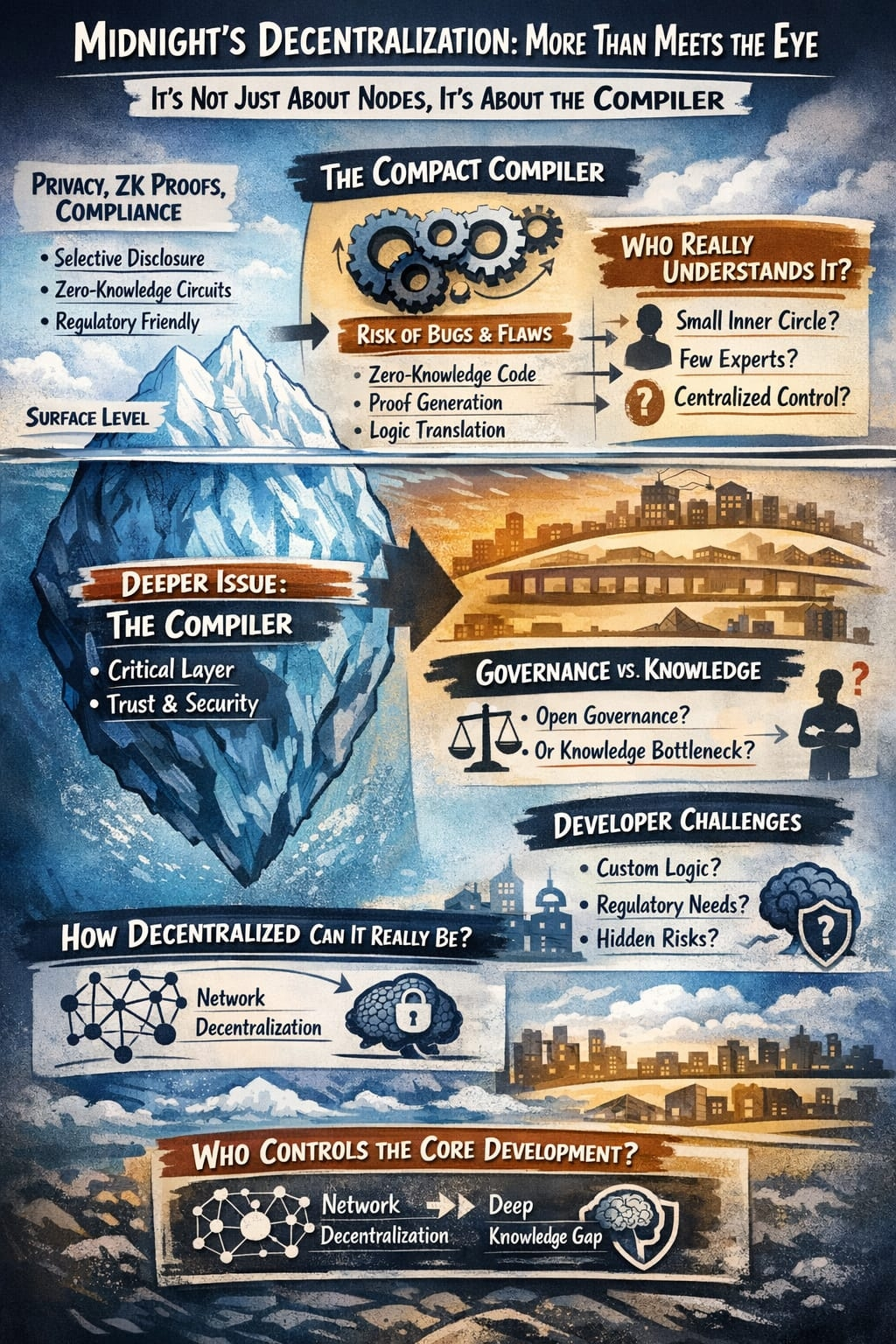
Most of the conversation around Midnight stays at the surface level: privacy, selective disclosure, zero-knowledge, compliance-friendly design. That’s usually where people stop. And sure, those things are part of the story.
But I think something more important sits underneath all of that, and it doesn’t get nearly enough attention.
It’s the compiler.
That probably sounds like a small technical detail at first, but I don’t think it is.
When you look closely, the compiler is not some background tool quietly doing its job off to the side. It sits right in the middle of how developers actually build on Midnight.
Midnight relies on a language called Compact. Developers use it to write applications, define logic, and decide how private information is handled inside the system. That code is then compiled into zero-knowledge circuits and the rest of the machinery needed for the app to function.
So this isn’t just normal smart contract development.
It’s code being translated into something much more sensitive — and that changes the stakes completely.
If there’s a bug in a normal smart contract, that’s already bad. But if there’s a problem in the compiler or in the circuit-generation layer of a zero-knowledge system, the risk feels different.
The issue is not only that the application might behave incorrectly.
The issue is that the proof itself could end up reflecting the wrong logic while still appearing valid from the outside.
That’s what makes this harder to dismiss.
This is also why I don’t think the usual response — that every chain depends on core developers — really gets to the heart of it.
Yes, every serious ecosystem has a small group of people who understand the deepest parts of the stack. That’s normal.
But Midnight is not just another smart contract platform.
Its entire pitch depends on privacy logic working exactly the way it’s supposed to.
That makes the compiler more than just a tool for developers.
It becomes part of the trust model itself.
And that’s where the discomfort starts.
Compact was built by Shielded Technologies, and even though it has since been moved under the Linux Foundation Decentralized Trust and renamed Minokawa, I’m not convinced that alone solves the deeper issue.
It definitely helps.
It’s the right move.
It gives the language a more neutral home.
But paper and reality are not the same thing.
You can move a codebase into open governance.
You can place it under a foundation.
You can make the repository public and invite broader participation.
None of that instantly creates a wide pool of people who actually understand the system deeply enough to change it safely.
Especially not in a zero-knowledge environment, where subtle mistakes can carry much bigger consequences.
That’s the part I keep coming back to.
Who really understands this stack well enough to shape it?
Not in theory.
Not in marketing language.
Not in the usual “community-driven” way projects like to describe themselves once they start talking about decentralization.
I mean in practice.
Who can look at Compact or Minokawa, understand how private state is being handled, understand how the circuits are being generated, understand where the edge cases are hiding, and confidently contribute to the parts that matter most?
If the answer is still mostly the people at Shielded, then I think it’s fair to say that a meaningful part of Midnight is still centralized — even if the network becomes more open over time.
And that matters more than people think.
Because sooner or later, this stops being an abstract decentralization debate and becomes a real limitation for the ecosystem.
Imagine a team trying to build something serious on Midnight.
Maybe they need custom disclosure logic for a regulated use case.
Maybe they have to respond quickly to legal requirements in a specific jurisdiction.
Maybe they need functionality that the current language or tooling doesn’t support cleanly yet.
What happens then?
If they can’t safely extend the system themselves, and if only a small inner circle can implement those changes with confidence, then the roadmap of that inner circle starts shaping the roadmap of the entire ecosystem.
That’s the bottleneck.
At that point, Midnight may still be permissionless in the narrow sense that nobody is stopping you from deploying.
But practical freedom is not just about whether you’re allowed in.
It’s also about whether the ecosystem is broad enough to adapt without constantly depending on one company or one concentrated pool of expertise.
That’s why I think the decentralization conversation around Midnight still feels incomplete.
People talk about validators, governance, token distribution, ecosystem growth. All of that matters.
But they often skip over the layer that actually determines what developers can safely express inside the system.
And with Midnight, that layer matters more than usual because the whole promise of the network depends on private logic being translated correctly.
So I don’t think the right question is simply whether Midnight is decentralized.
That feels too blunt to be useful.
The better question is this:
How decentralized can Midnight really become if the most critical development layer still depends on a very small group of people who truly understand it?
That doesn’t mean Midnight is failing.
It doesn’t mean the project is dishonest.
And it doesn’t mean the move to Minokawa under LFDT was meaningless.
I think that step was important.
Probably necessary.
I just don’t think it finishes the story.
To me, Midnight looks like a project that may decentralize at the network level faster than it decentralizes at the knowledge level.
And in a system built around zero-knowledge proofs, that gap matters a lot.
Because real decentralization is not only about who runs nodes.
It’s also about who can shape the language, review the logic, catch the dangerous mistakes, and participate in the hardest technical decisions without having to defer to the original builders every time.
And I’m not sure Midnight is there yet.
That’s really the whole concern.
Not that Midnight is fake.
Not that it has no value.
Not that privacy as a model is broken.
Just that the deepest layer of control may still sit closer to the center than many people want to admit.
And until that changes, I think Midnight’s decentralization story is still unfinished.
#night @MidnightNetwork $NIGHT