
Midnight feels like a response to something this market has quietly tolerated for too long.
For years, I have watched projects take familiar flaws, wrap them in better language, and present them as progress. The mechanics rarely change. The framing does. Crypto has a habit of renaming friction and calling it innovation.
Midnight doesn’t completely escape that pattern — but it does seem to be pointing at a real problem instead of dancing around it.
Most chains normalized overexposure.
Every wallet traceable.
Every transaction visible.
Every interaction permanently exposed.
This was labeled “transparency,” as if the word itself solved the tradeoffs. But over time, it started to feel less like accountability and more like leakage. Not intentional openness — just default exposure with no boundaries.
That distinction matters.
What makes Midnight interesting is that it doesn’t try to make everything invisible. That would be easy to dismiss. Instead, it challenges a deeper assumption: that verification requires full visibility.
It doesn’t.
Something can be proven valid without revealing everything underneath it. That idea sounds obvious when stated plainly, but the industry has spent years building systems that treat proof and exposure as the same thing.
Midnight seems to reject that equivalence.
The NIGHT and DUST Dynamic
Part of that shift shows up in how the network is structured.
NIGHT exists as the core asset. But DUST is what actually gets consumed during usage.
And it doesn’t behave like a typical fee model.
It feels less like spending and more like drawing down capacity — a subtle but important difference. Most token systems are just recycled pressure loops designed around speculation and holding behavior. This model, at least on the surface, looks like it was designed with actual network usage in mind.
That doesn’t guarantee success.
But it suggests intent.
Where Most Systems Break
The real test isn’t the idea. It never is.
The real test is what happens when people actually use it.
Does it feel natural?
Or does it turn into paperwork?
This is where most well-designed systems fail. Not in theory — in handling. Users don’t care about architecture if interaction feels heavy. The moment friction becomes visible, the illusion breaks.
Midnight hasn’t reached that stage yet. And when it does, that’s where the real evaluation begins.
Controlled Rollout vs. Decentralization Theater
Another thing worth noting: Midnight isn’t pretending to be fully formed.
It’s entering the market in a controlled, structured way.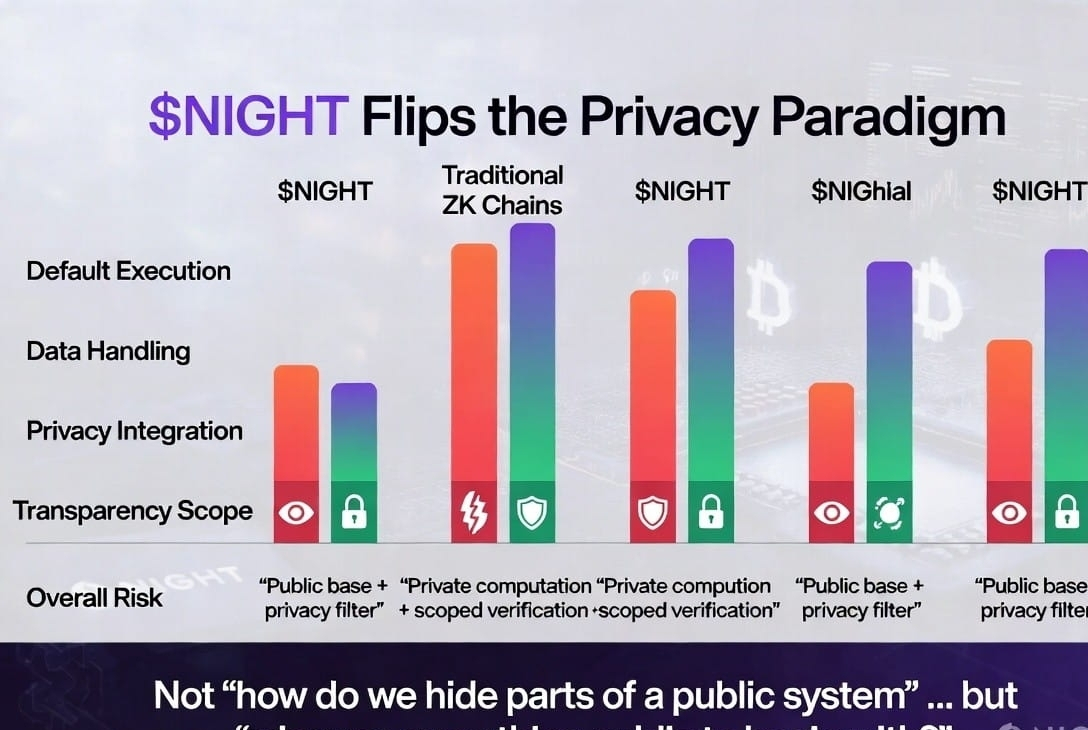
That honesty stands out.
Crypto has a long history of performing decentralization before actually achieving it. Messy rollouts get reframed as purity. Weak coordination gets labeled as freedom.
Midnight doesn’t seem to be playing that game as aggressively.
And that matters — because structure always comes with tradeoffs. Especially in a system built around privacy and controlled disclosure.
The Real Tension
The tension here isn’t a side detail.
It is the story.
A system that promises privacy, selective disclosure, and protected data has to prove that those guarantees survive contact with reality. Not just technically — but socially, economically, and operationally.
Because that’s where things usually break:
Tooling friction
Misaligned user expectations
Hidden centralization points
Governance that only works under ideal conditions
These aren’t edge cases. They’re patterns.
And they don’t show up in whitepapers. They show up after people start using the system.
Watching, Not Assuming
Midnight doesn’t feel like a recycled idea.
Not yet.
It feels more deliberate than that. Like it’s built with the awareness that crypto has spent years confusing openness with usefulness — and that maybe trust doesn’t require full exposure.
That’s enough to keep it interesting.
But not enough to assume success.
Because the real question hasn’t been answered yet:
What happens when the system reaches the point where clean ideas stop protecting it?
What holds up when reality starts pushing back?
Midnight might be right.
And if it is, then a lot of what this market accepted as “normal” was never truly functional — just familiar.
And familiarity can last a long time.
Right up until someone builds around the damage it was quietly causing.
#night @MidnightNetwork $NIGHT
