
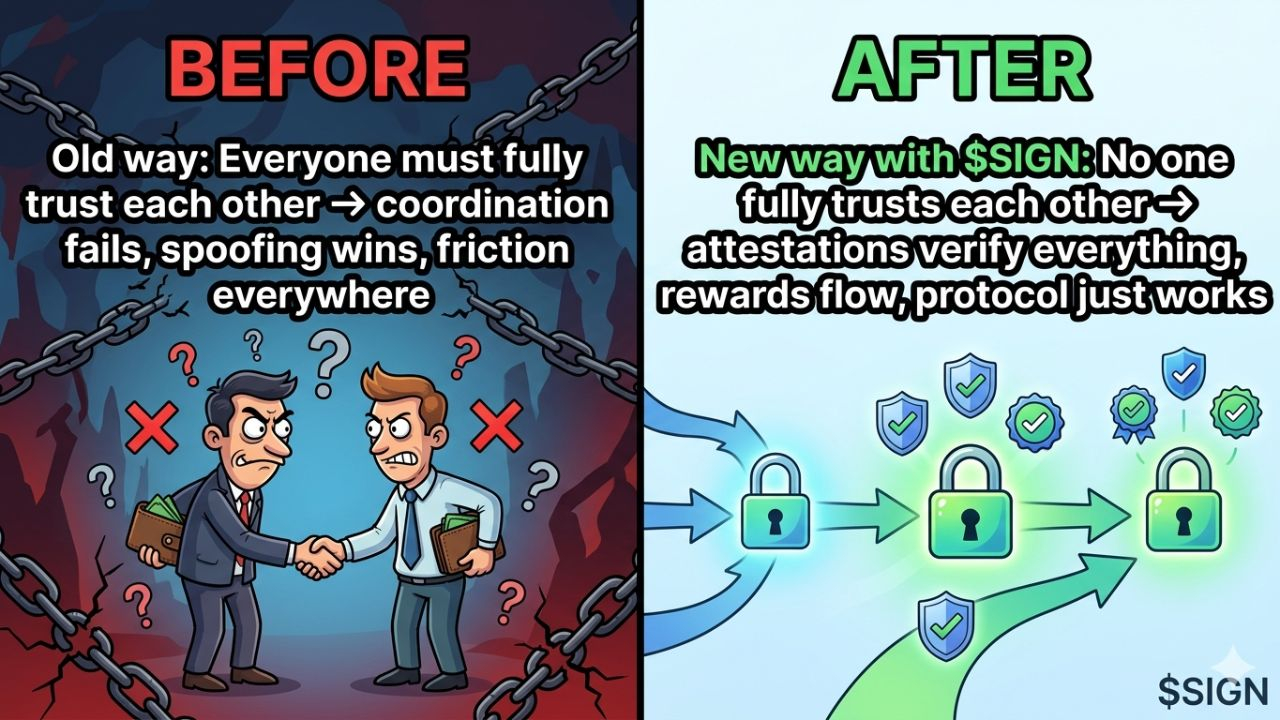
Closed my last position around 2 AM, nothing dramatic, just a clean exit on a Base pair that had been grinding sideways for days. Poured coffee, opened the laptop out of habit, and there it was: the Orange Basic Income program on Sign Protocol had flipped live on March 23. 100 million $SIGN earmarked, Season 1 already pushing up to 25 million in rewards for anyone proving self-custody through on-chain attestations. Not some vague airdrop tease. Actual distribution logic kicking in, tied directly to the protocol’s attestation schemas. I pulled up the token contract — 0x868fced65edbf0056c4163515dd840e9f287a4c3 on Etherscan — and watched the early flows. Nothing flashy, but the mechanism was humming.
the moment the dashboard refreshed
I’d been ignoring $SIGN for weeks, same way most traders do when the narrative is all “trustless verification” and “omni-chain attestations.” Sounded abstract. Then the dashboard refreshed and I saw the first wave of self-custody proofs hitting the chain. No KYC gatekeeper. No custodian vouching for you. Just an attestation — signed, schema-verified, queryable across Ethereum, Base, whatever — that says “this wallet holds these tokens, period.” And the protocol pays out SIGN rewards based on that proof alone.
That’s when the core thing hit me. Sign Protocol doesn’t work because everyone trusts each other. It works precisely because almost no one does. The whole design assumes issuers, holders, and verifiers start from zero trust. You don’t need to believe the other party; the cryptographic attestation does the heavy lifting. I thought back to last month’s mess where a DeFi project required manual screenshots for a points program. Total disaster. One wallet spoof, one fake CSV, and the whole thing collapsed. Here? The attestation schema makes the claim verifiable without asking anyone to take your word for it.
honestly the part that still bugs me
There’s a simple conceptual model that keeps looping in my head: three quiet gears. First gear is raw distrust — the default state between any two parties on-chain. Second is the attestation itself, the lightweight, schema-defined record that lives forever and can be queried instantly. Third is SIGN, the token that prices governance, fees, and now these incentive distributions. Turn the distrust up and the gears spin faster. The protocol doesn’t fight the lack of trust; it monetizes it.
I watched it in real time with the OBI rollout. Two timely examples stood out. One, a small team running a DAO treasury wanted to distribute grants without revealing exact holdings to every voter — they attested the minimum threshold instead. Verifiers checked the proof, not the balances. Two, a liquidity provider I know attested their position size across three chains to qualify for boosted rewards; no single bridge or oracle had to be trusted. The behavior feels intuitive once you see it: on-chain attestations reduce coordination friction exactly where old trust models used to create it.
Of course the skepticism creeps in around 3 AM. What if a schema gets gamed? What if someone floods the registry with low-quality attestations and dilutes the signal? The protocol has revocation and expiration mechanics, sure, but scale that to nation-state level or enterprise compliance and the attack surface grows. I caught myself correcting the thought mid-scroll — wait, actually, that’s the point again. The system is built for adversarial conditions. It doesn’t pretend harmony exists; it just gives every participant the tools to verify independently.
3:42 AM and this finally clicked
Lately I’ve been thinking about how most Web3 incentives still lean on some form of central honesty. Custodial proofs, off-chain oracles, “trust us” dashboards. Sign flips the script. It turns the absence of trust into the feature. The recent on-chain rewards shift via Orange Basic Income isn’t marketing fluff — it’s the protocol eating its own dog food, proving that even incentive alignment can run on attestations alone.
I’m not rushing to ape anything. Just sitting here with cold coffee, watching the early reward claims settle on the explorer. The forward play feels clear for builders who actually need verifiable data without middlemen: credentialing, compliance rails, cross-chain reputation, even simple things like proof-of-human for governance. But it also raises the quiet question of whether the rest of the space is ready to operate in a world where no one has to take anyone’s word for anything.
How long until more protocols start requiring an attestation as table stakes instead of a promise? That’s the part I’m still chewing on.
@SignOfficial #SignDigitalSovereignInfra