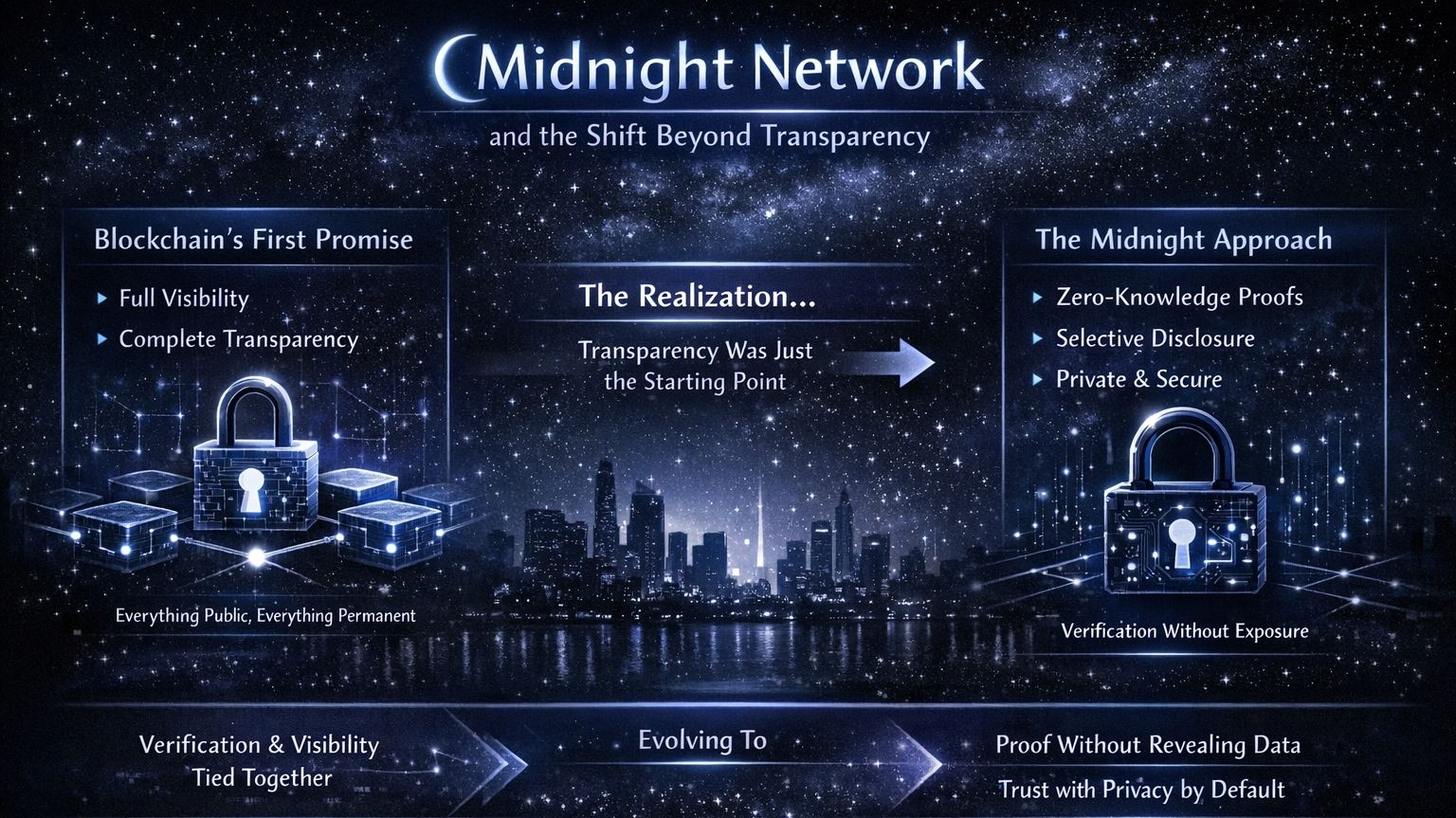
@MidnightNetwork If you go back to the early days of blockchain, transparency wasn’t just a feature — it was the breakthrough. For the first time, you could verify a system without trusting anyone inside it. Everything was visible, everything auditable, everything permanent. It solved a problem that had existed for decades.
But solutions, especially in technology, rarely stay perfect as they scale.
What begins as clarity can slowly turn into rigidity. What feels empowering in small systems can feel limiting in larger ones. And that’s more or less what happened with blockchain transparency. It worked exactly as intended, but it didn’t evolve alongside the kinds of use cases people eventually wanted to build.
Because real-world systems don’t operate on full visibility.
They operate on context.
You reveal what’s necessary for a specific interaction and keep the rest contained. Not because you’re trying to hide something, but because information has boundaries. Financial systems respect that. Businesses depend on it. Even individuals, in everyday life, rely on it constantly.
Blockchain, in its purest form, ignored that nuance.
And that’s where Midnight Network starts to feel less like an innovation and more like an adjustment that was always coming.
What Midnight introduces isn’t a rejection of transparency, but a refinement of it. It separates two ideas that have been tightly linked since the beginning: verification and visibility. Using zero-knowledge cryptography, the network can prove that something is correct without exposing the data behind it. The rules are enforced, consensus is maintained, but the details don’t have to be public.
That changes how the system behaves.
Because once visibility is no longer mandatory, blockchain stops feeling like a broadcast layer and starts feeling more like infrastructure. Something that works beneath the surface rather than constantly displaying itself. It still guarantees correctness, but it doesn’t demand attention in the process.
That shift is subtle, but it opens up a different kind of design space.
Developers are no longer forced to choose between decentralization and confidentiality. Applications can be built with more realistic assumptions about how data should be handled. Financial interactions can remain private. Identity systems can verify attributes without exposing personal details. Business logic can exist on-chain without becoming public knowledge.
These aren’t abstract benefits. They’re practical requirements.
Because the next phase of blockchain isn’t just about proving that the technology works. It’s about making it compatible with environments that already exist. Enterprises, institutions, and even individual users bring expectations with them — expectations shaped by systems where privacy is normal, not optional.
Midnight seems to recognize that.
Instead of competing on the usual metrics speed, cost, throughput it focuses on something less visible but arguably more important: how information flows through the system. What gets revealed, what stays hidden, and how trust is maintained across that boundary.
Of course, this introduces new challenges.
Zero-knowledge systems are complex by nature. They require careful implementation, strong assumptions, and time to mature. There are also open questions around usability, developer adoption, and how privacy fits into broader regulatory frameworks. None of this is trivial.
But complexity isn’t necessarily a drawback. Sometimes it’s a sign that a system is moving closer to reality.
Because reality is rarely simple.
And blockchain, if it’s going to move beyond niche use cases, has to deal with that complexity. It has to support different levels of visibility, different types of interactions, different expectations around data.
Midnight doesn’t solve all of that. But it points in a direction where those problems can at least be addressed.
And that direction feels consistent with how other technologies have evolved.
The early internet prioritized openness. Over time, it layered in security, privacy, and control. Not to replace openness, but to make it usable at scale. Blockchain seems to be following a similar path. Transparency remains important, but it’s no longer the only priority.
Balance becomes the goal.
Verification without unnecessary exposure. Trust without full visibility. Systems that are open where they need to be, and private where they should be.
Midnight Network sits somewhere in that transition.
Not as a dramatic reinvention, but as a quiet correction. A recognition that the first version of blockchain solved one problem extremely well, but left another one unresolved.
And now that second problem how to handle information responsibly in a decentralized system is becoming harder to ignore.
Because in the end, technology doesn’t just need to work.
It needs to fit.
@MidnightNetwork #night $NIGHT