
What keeps me looking at Sign Protocol is that it doesn’t feel like it’s trying to hide weak design behind big language.
I’ve seen that pattern too many times. Same pitch, different wording. More complexity presented as innovation, but underneath it’s still the same friction, the same inefficiency, just wrapped better. And eventually, most of it fades the same way.
Sign doesn’t hit me like that.
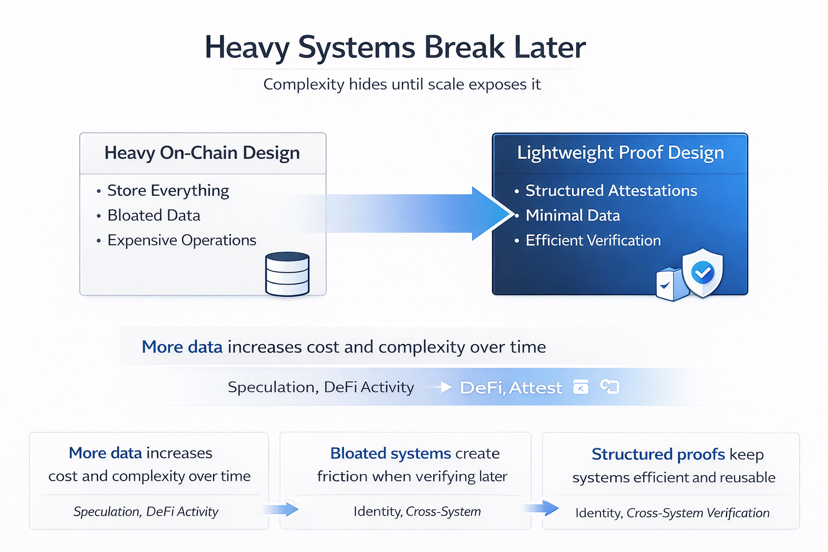
If anything, it feels like it’s pointing at something crypto still hasn’t really cleaned up. Too much data, too much clutter, too many systems dragging unnecessary weight just because “on-chain” is treated like a default answer.
I don’t think that’s always the right move.
Putting more data on-chain doesn’t automatically make things more trustworthy. A lot of the time, it just makes everything heavier. More expensive to run, harder to read, harder to maintain. And when you actually need to verify something later, it doesn’t simplify anything… it complicates it.
That’s where Sign starts to stand out a bit.
It doesn’t feel obsessed with storing everything. It feels more focused on making proof usable. Clean structure, clear attestations, less unnecessary baggage. It’s a quieter approach, but it makes sense the more I think about it.
Because simple fixes tend to get ignored here.
They’re not exciting enough. They don’t sell easily. But after watching enough projects fail, I’ve stopped caring about what sounds impressive. I care more about whether something actually removes friction or just repackages it.
With Sign, I can at least see the intent.
The goal doesn’t seem to be turning every interaction into a heavy on-chain object. It’s keeping the proof layer intact without dragging around everything else that slows systems down later.
And that matters more than people realize.
Crypto has normalized a lot of bad infrastructure. Fragmented data, awkward logic, expensive writes… systems that technically function, but become painful the moment you need to trace something properly. Then it turns into manual work again. More confusion. More noise.
Sign looks like it’s trying to reduce that.
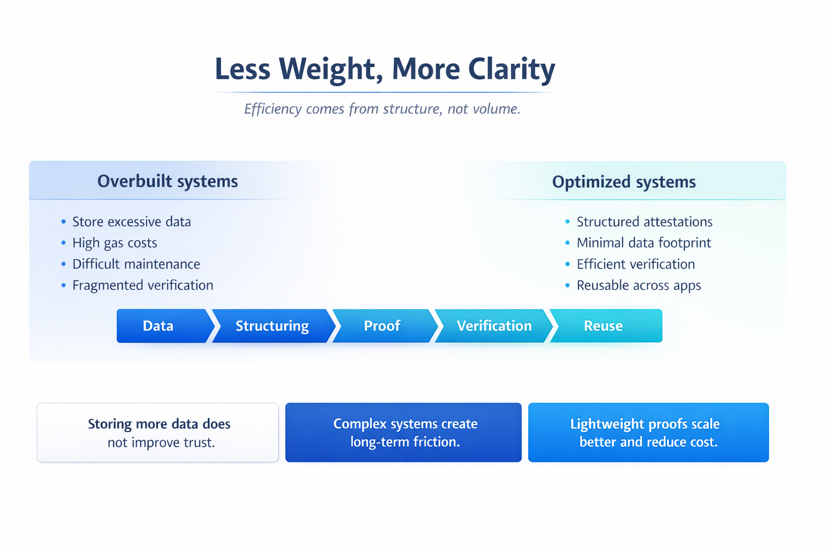
Not by adding more layers, but by making things lighter. More structured, easier to reuse, easier to verify without rebuilding context every time.
That’s the part I keep coming back to.
Because the cost of bad design doesn’t show up immediately. It shows up later, when systems scale and everything becomes harder to manage. That’s when you realize how much unnecessary weight has been carried the whole time.
I’m not assuming this solves everything.
There’s still execution risk, adoption risk, the usual question of whether something useful actually becomes necessary. I’m always watching for where it breaks, because every system does at some point.
But I can see the direction.
It’s not trying to make things bigger. It’s trying to make them lighter. And in a space that keeps adding complexity on top of itself, that’s a different kind of approach.
I’m not watching it because I think the market suddenly understands this.
I’m watching it because I’ve seen what happens when systems get too heavy, and this at least feels like an attempt to avoid that.
Maybe it works. Maybe it doesn’t.
But for now, it feels like it’s addressing something real.
And that’s enough to keep it on my radar.