
In the fast-moving world of crypto, most projects get slotted quickly into familiar buckets: DeFi yield farmer, meme coin, Layer-1 blockchain, or NFT marketplace. Sign Protocol

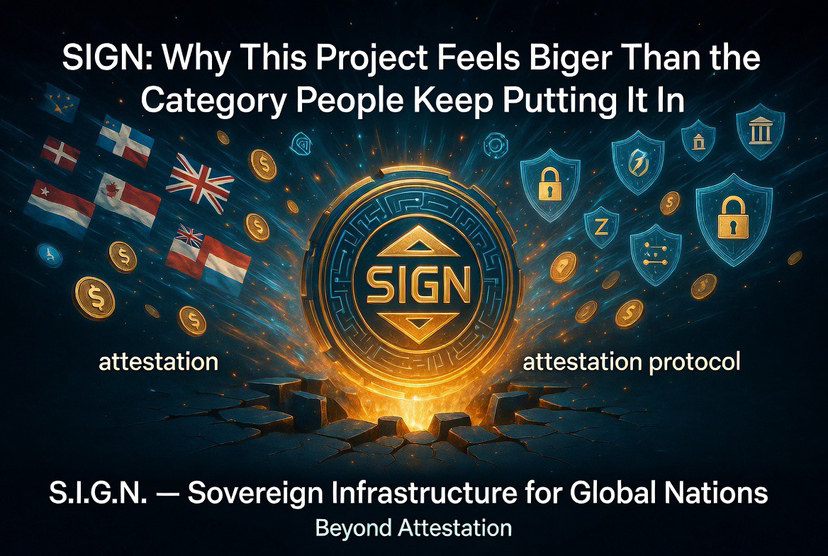
$SIGN keeps getting the “attestation” or “verifiable credentials” label, which is technically accurate but misses the scale of what it’s actually building. At its core, Sign isn’t just another infrastructure play—it’s sovereign-grade digital infrastructure for national systems of money, identity, and capital. That ambition makes it feel fundamentally bigger than the narrow category observers often assign it.
Sign Protocol functions as an omni-chain attestation layer. It allows anyone to create, issue, and verify structured, tamper-proof records across blockchains like Ethereum, Solana, TON, and others. Think of it as a universal evidence layer: digital signatures and attestations that prove facts without revealing unnecessary private details, powered by zero-knowledge proofs for privacy. Developers and institutions can define schemas for credentials—whether it’s a KYC approval, a property title, a vaccination record, or a CBDC transaction log—and have them verifiable anywhere.
What elevates Sign beyond typical attestation tools is its evolution into S.I.G.N. (Sovereign Infrastructure for Global Nations). The project positions itself as the shared evidence backbone for entire national digital systems. Governments need reliable ways to issue money (CBDCs), manage identity at scale, and distribute capital transparently while maintaining control and compliance. Sign delivers exactly that: inspection-ready evidence that separates policy logic from cryptographic proof. It supports both public transparency on chains like BNB Chain and private enterprise-grade deployments (e.g., using Hyperledger Fabric) for confidentiality.
This isn’t theoretical. Sign has already powered systems serving over 50 million users and distributing more than $2 billion in digital assets. Real-world pilots include CBDC explorations in places like Kyrgyzstan and national ID initiatives in Sierra Leone, alongside collaborations in the UAE. These aren’t small DeFi experiments—they’re foundational infrastructure that governments can adopt while tapping global liquidity and interoperability. By Q3 2026, Sign’s digital currency components are slated for broader national-scale deployment.
Why does this feel bigger than the “attestation protocol” box? Most crypto infrastructure stays within the permissionless, retail-driven ecosystem: wallets, bridges, oracles, or DEXs competing for TVL and user fees. Sign targets the gatekeepers—governments and institutions—that control real-world adoption of blockchain at population scale. Crypto has long talked about bridging to traditional finance and real-world assets, but few projects are built from the ground up for bureaucratic rigor, regulatory inspection, and sovereign control. Sign separates the “what” (policy decided by nations) from the “how” (cryptographic evidence anyone can verify). This makes it durable in ways hype-driven projects aren’t.
Critics might still view it through a token lens: $SIGN powers the ecosystem, incentivizing attestations, verification, and network participation. But the narrative around price or short-term utility often undersells the long-term vision. In a world racing toward tokenized economies, digital identities, and programmable money, the demand for trusted, cross-chain evidence layers will be enormous. Sign isn’t chasing retail hype cycles; it’s quietly positioning as the plumbing for the next phase of blockchain—where nations integrate digital assets without losing sovereignty.
Of course, execution risks remain high. Government adoption moves slowly, regulatory landscapes vary wildly, and competing standards could emerge. Yet the project’s focus on real deployments, privacy-preserving tech, and multi-chain reach gives it staying power that many “infrastructure” tokens lack.
Ultimately, Sign feels bigger because it addresses a repeating requirement across money, identity, and capital systems: verifiable truth at scale. While the market buckets it with other Web3 tools, its trajectory points toward becoming foundational digital infrastructure for entire economies. In crypto’s maturation from speculation to settlement, projects like Sign that solve coordination and trust at the sovereign level may prove to be the ones that matter most in the long run.
#Sign #TrumpSeeksQuickEndToIranWar #OilPricesDrop #TrumpSaysIranWarHasBeenWon