
I had a small moment recently that stuck with me more than it should have.
Nothing dramatic.
Just moving between a few platforms, checking some data, trying to confirm something simple.
And I noticed what I was actually doing.
Not verifying.
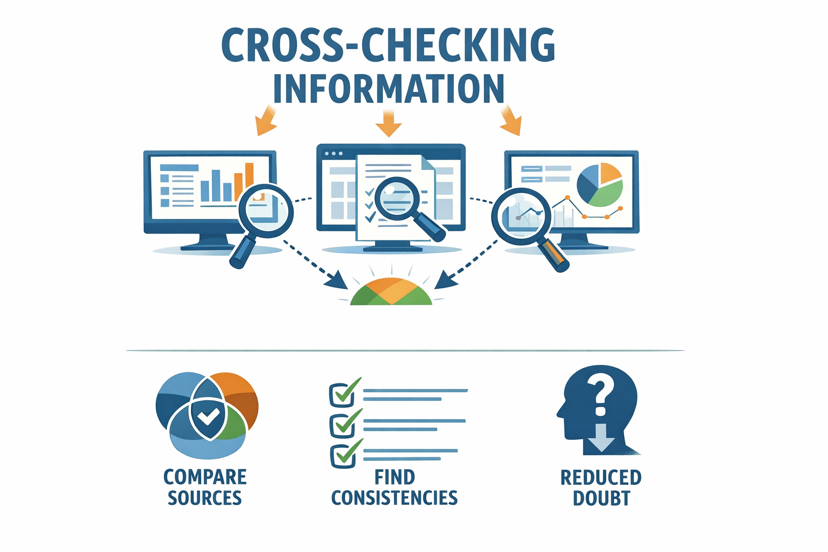
Cross-checking.
I wasn’t trusting any single source.
I was comparing multiple ones, looking for overlap, consistency… something that felt reliable.
And even then, it wasn’t certainty.
It was just reduced doubt.
That’s when this started to feel more real to me.
Because for all the talk about trustless systems…
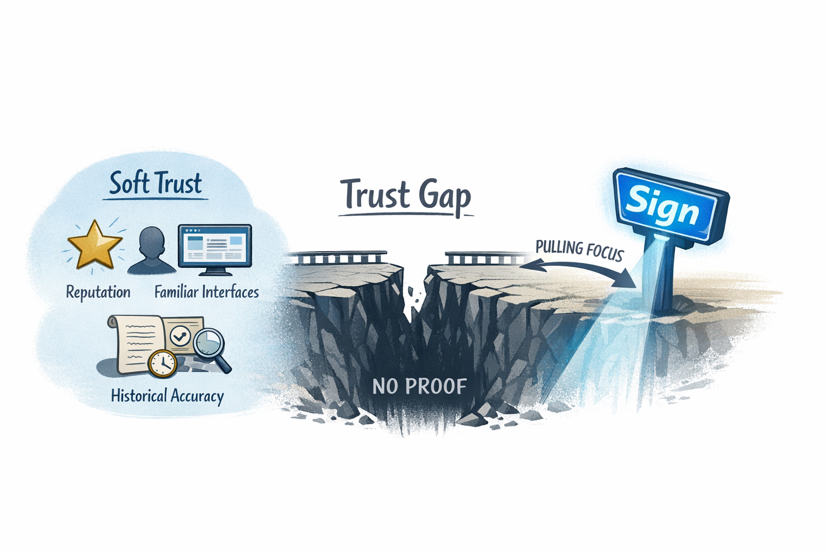
most of what we do still relies on soft trust.
Reputation. Familiar interfaces. Historical accuracy.
Not proof.
Sign keeps pulling me back to that gap.
Not because it solves it completely — I’m not convinced it does yet —
but because it forces you to notice it.
I’ve been in situations before where something looked correct…
until it wasn’t.
Data mismatches. Delayed updates. Conflicting states across platforms.
Nothing catastrophic.
Just enough friction to remind you that things aren’t as deterministic as they seem.
And the response is always the same.
Check another source.
Then another.
Then maybe one more.
We build our own temporary consensus in real time.
That’s not scalable.
It works for individuals.
It doesn’t work for systems.
So when I look at this now, I’m not thinking about tokens or campaigns.
I’m thinking about that behavior.
That constant need to reconfirm things we should already know.
But here’s where I hesitate.
Turning everything into something provable…
doesn’t automatically make it usable.
Proof has overhead.
It adds steps.
It requires alignment between systems that don’t naturally coordinate.
I’ve seen tools that were technically better…
but never adopted because they slowed things down.
Even slightly.
And “slightly” is enough for most people to avoid it.
So I’m stuck in this split view.
On one side, the problem feels real.
I’ve experienced it enough times to know it’s not theoretical.
On the other side, the solution has to be seamless enough that people don’t feel it.
And that’s a hard balance.
Right now, I don’t know if this crosses that line.
It might.
Or it might remain something that makes sense conceptually…
but doesn’t fit into how people actually operate day to day.
What I do know is this:
The current way we handle trust — even in crypto — is more fragile than we admit.
And most of us only notice it in small moments.
Moments we forget quickly.
I’m trying not to ignore those moments anymore.
Because they’re probably pointing to something bigger.
I’m not convinced yet.
But I’m paying more attention than I was before.
And that alone feels like a signal… even if I can’t fully explain why.
#SignDigitalSovereignInfra @SignOfficial $SIGN
