
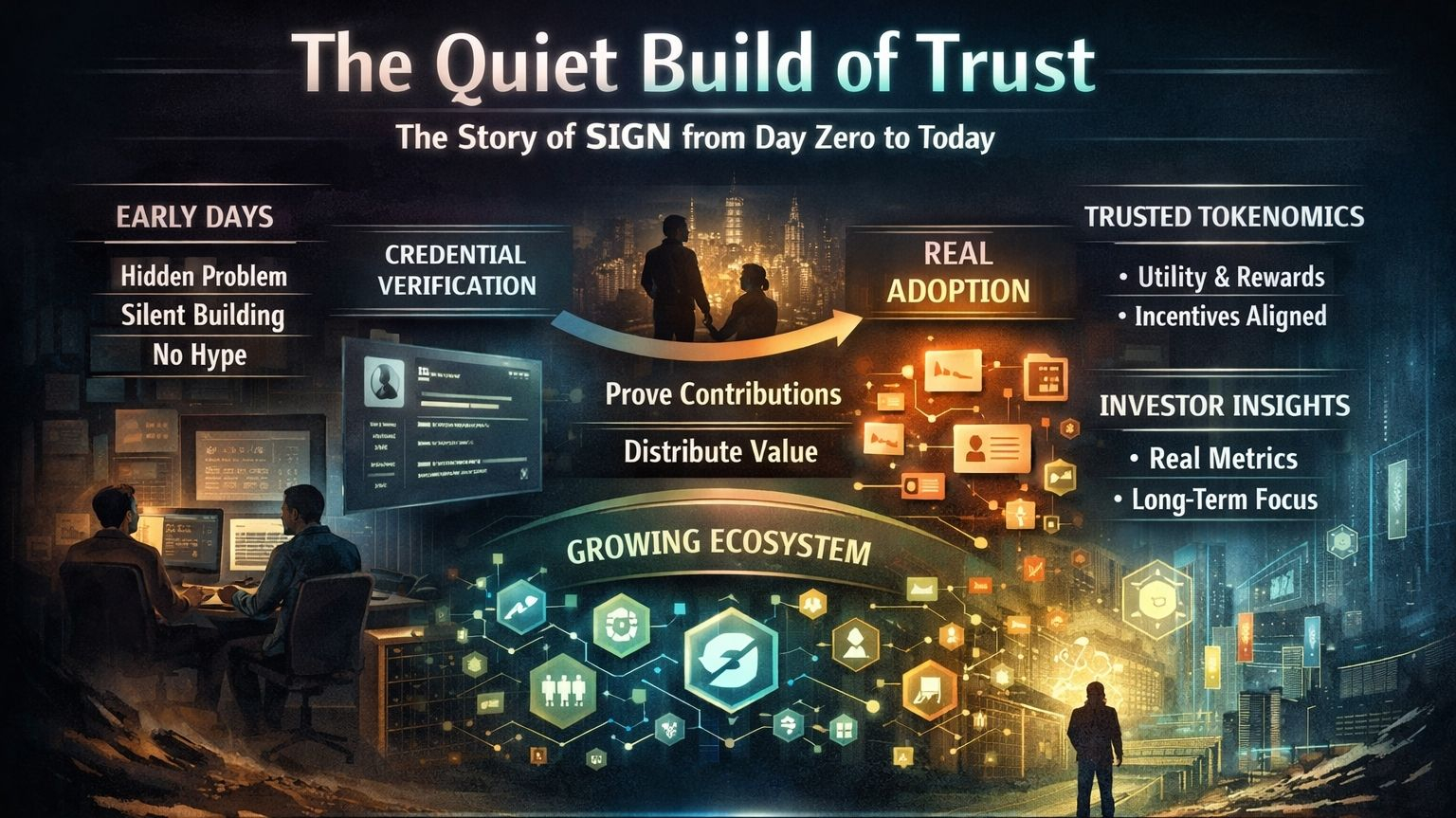
Where the Idea Began: A Problem Most People Ignored
If I go back to where this story really starts, it doesn’t begin with hype or price charts. It begins with a frustration that almost everyone in crypto has felt but very few have tried to solve properly.
In the early days of Web3, teams were moving fast. Tokens were launching, communities were forming, and capital was flowing. But underneath all that movement, something was broken. People couldn’t prove who contributed what. Rewards were often unclear. Distribution felt unfair. And identity in a decentralized world was still… fragile.
From what I’m seeing, the founders behind SIGN didn’t start by asking, “How do we build the next big token?”
They started by asking a much quieter but more important question:
How do you create trust in a trustless system?
That question became the seed.
Many of the early contributors came from backgrounds in cryptography, distributed systems, and real-world data infrastructure. Some had seen how identity works in traditional systems. Others had seen how broken it becomes in open networks. And slowly, the idea formed that maybe the next evolution of crypto wouldn’t be another DeFi protocol or NFT trend… but infrastructure that quietly powers everything.
That’s where SIGN was born.
The Early Days: Building Without Attention
In the beginning, there wasn’t much noise around SIGN. No big marketing pushes. No viral campaigns. Just a small group of builders trying to solve a very technical, very real problem.
I think this phase is where most projects fail.
Because building infrastructure is slow. It’s not exciting to explain. It doesn’t give instant feedback. And it definitely doesn’t attract quick hype.
They had to figure out how to create a system where credentials could be verified without exposing sensitive data. They had to design a way to distribute tokens based on proof, not assumptions. And they had to do all of this in a decentralized environment where trust isn’t given — it has to be engineered.
There were technical challenges, of course. Scalability issues. Data integrity questions. How to prevent manipulation. How to make the system usable, not just secure.
But there were also human challenges.
Convincing early users to try something new. Explaining why this matters when most people were focused on price. Building confidence without overpromising.
And slowly… they kept building.
Step by Step: Turning an Idea into Technology
What stands out to me is how SIGN didn’t try to do everything at once. They focused on layers.
First, they worked on credential verification. Not just simple identity, but meaningful proof. Who contributed to a project? Who completed a task? Who actually deserves a reward?
Then came the distribution layer. Once you can verify contribution, the next logical step is to distribute value based on that proof. This is where things start to get powerful.
Because now, instead of guessing who deserves tokens… the system can show it.
They also focused heavily on interoperability. Because a system like this only becomes valuable if it can connect across ecosystems. If it works in isolation, it doesn’t scale.
From what I’m seeing, they weren’t just building a product.
They were building a foundation.
The Community: From Observers to Believers
At first, the community around SIGN was small. Mostly developers, early researchers, and people who understood the deeper problems of Web3.
But over time, something interesting started happening.
Projects began experimenting with it. Small teams started using SIGN to manage distributions. Contributors began to see a system where their work could actually be recognized fairly.
And that’s when the shift happens.
Because once real users start to feel value, the narrative changes.
It’s no longer just “another crypto project.”
It becomes something people rely on.
I’m seeing more conversations around fairness, transparency, and verifiable contribution. And SIGN seems to sit right at the center of that discussion.
Real Adoption: When Utility Becomes Clear
There’s a moment in every project’s life where things start to click.
For SIGN, that moment seems to come when real-world use cases begin to stack up. Airdrops become smarter. Contributor rewards become more precise. Communities become more organized.
It becomes clear that this isn’t just about credentials.
It’s about coordination.
And coordination is one of the hardest problems in decentralized systems.
If this continues, I think we’ll see SIGN become less visible as a “project” and more visible as an underlying layer that people don’t even think about — but depend on.
The Token: More Than Just a Currency
Now, when we talk about the token, this is where things get interesting.
Because the $SIGN token isn’t just there for trading. It’s designed to play a role inside the system.
It acts as a medium of value for distribution. It aligns incentives between users, contributors, and builders. And it creates a feedback loop where participation strengthens the network.
From what I’m seeing, the tokenomics are structured around usage, not just speculation.
Instead of rewarding only early investors, the system leans toward rewarding meaningful participation. That means contributors, validators, and long-term users all have a role.
There’s also a balance between supply and demand that seems intentional. Not overly aggressive emissions, but not restrictive either. Enough to incentivize growth, but controlled enough to avoid dilution.
And I think that balance matters more than people realize.
Because token design isn’t just economics.
It’s behavior engineering.
Why This Model Matters: Incentives Shape Everything
The reason the team chose this kind of model becomes clearer when you look at the problem they’re solving.
If you want fair distribution, you can’t rely on hype.
You need systems that reward proof.
If you want long-term holders, you can’t just promise gains.
You need real utility.
If you want a strong network, you can’t centralize decisions.
You need aligned incentives.
SIGN’s model seems to connect all of these.
It’s not perfect. No system is. But it’s trying to solve the right problems.
What Serious Investors Are Watching
When I step back and think about what actually matters here, it’s not just price.
Serious participants are watching deeper signals.
They’re looking at how many projects are integrating SIGN. They’re watching how often credentials are being issued and verified. They’re tracking how tokens are being distributed and whether that distribution is actually fair.
They’re also paying attention to retention.
Are users coming back?
Are contributors staying engaged?
Is the system becoming more useful over time?
Because those are the indicators of real growth.
Not noise. Not hype.
Strength.
The Ecosystem: Quiet Expansion
One of the most interesting things I’m noticing is how the ecosystem around SIGN is growing quietly.
New tools are being built. Integrations are expanding. More use cases are emerging.
But it’s not loud.
And maybe that’s the point.
Because infrastructure doesn’t need to be loud.
It needs to be reliable.
If this continues, I think we’ll see SIGN embedded in places people don’t even realize. Powering systems behind the scenes. Enabling fairness without needing attention.
The Risk and the Reality
Of course, none of this is guaranteed.
The space is competitive. Technology evolves quickly. And even the best ideas can struggle if adoption slows or execution falls short.
There’s also the challenge of education. Not everyone understands why this matters yet. And without understanding, adoption takes time.
So yes, there is risk.
But there’s also something else.
The Hope: Building What Actually Lasts
When I look at SIGN, I don’t see a project trying to win attention.
I see a system trying to solve a foundational problem.
And those are the kinds of things that tend to last.
It’s still early. There’s still a long way to go. But it feels like something real is being built here.
Something that doesn’t just ride the wave…
but shapes what comes next.
And if this continues — if the technology keeps improving, if the community keeps growing, if real utility keeps expanding — then SIGN might not just be another name in crypto.
It might become part of the infrastructure that defines it.
And honestly, that’s where the real value is created.
