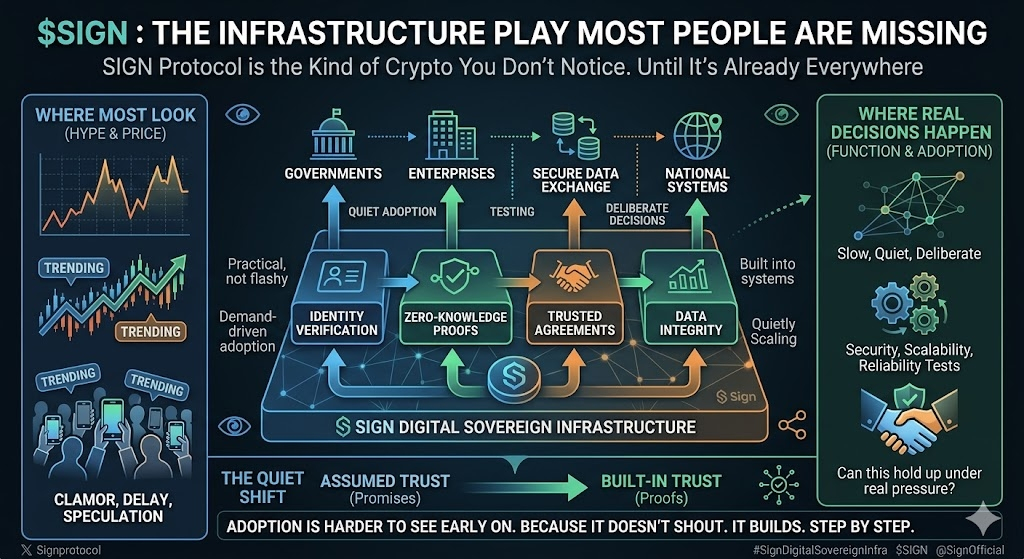
Sign protocol is the Kind of Crypto You Don’t Notice. Until It’s Already Everywhere.In crypto, most of us are trained to look in one place.Charts.Price.Hype.We refresh, we compare, we wait for something to “move” before we decide it matters.But over time, I’ve started to realize something a bit uncomfortable…The biggest things in this space don’t start where we’re looking.They don’t begin on timelines or trend lists.They begin quietly, somewhere else entirely.And by the time they show up in front of us, they’re already in motion.That’s kind of how I’ve started seeing $SIGN .
Where Real Decisions Actually Happen.There’s this assumption that if something is important in crypto, it will be loud.People will talk about it.Big accounts will post threads.You’ll feel it everywhere.But when it comes to infrastructure, especially something governments might use, it’s the opposite.It’s slow.Quiet.Deliberate.
Decisions happen behind closed doors. Not because it’s secretive, but because it has to be careful.If a government is choosing a system for identity, agreements, or national-level data.they don’t guess.They test everything.They look at security, scalability, reliability.They ask one simple question again and again.
“Can this hold up under real pressure?”
Not for a week.
Not for a cycle.
But for years.
What Made Me Look Twice at SIGN
At first, I didn’t really think much of it.
“Another protocol.”
“Another infrastructure layer.”
We’ve all seen that before.
But then I started noticing something strange.It wasn’t loud.It wasn’t trending.But it kept appearing.Different contexts.Different conversations.Different people.Not hype just presence.And when something keeps showing up without trying to grab attention, I usually take a second look.It’s Not About Hype It’s About Function.That’s what made me start thinking about this differently.What if trust wasn’t something we had to “give” in the first place.What if it didn’t depend on who’s behind a project, or how convincing something sounds.What if it was just built into the system.That idea sounds simple, but it changes a lot.Because the moment you move from assumed trust to something you can actually verify, the whole dynamic shifts. You’re no longer relying on reputation or noise. You’re relying on structure.Something either holds up, or it doesn’t.And from there, things start to look different.Identity, for example. Right now, it’s mostly tied to platforms. Accounts, profiles, logins. You exist inside systems.
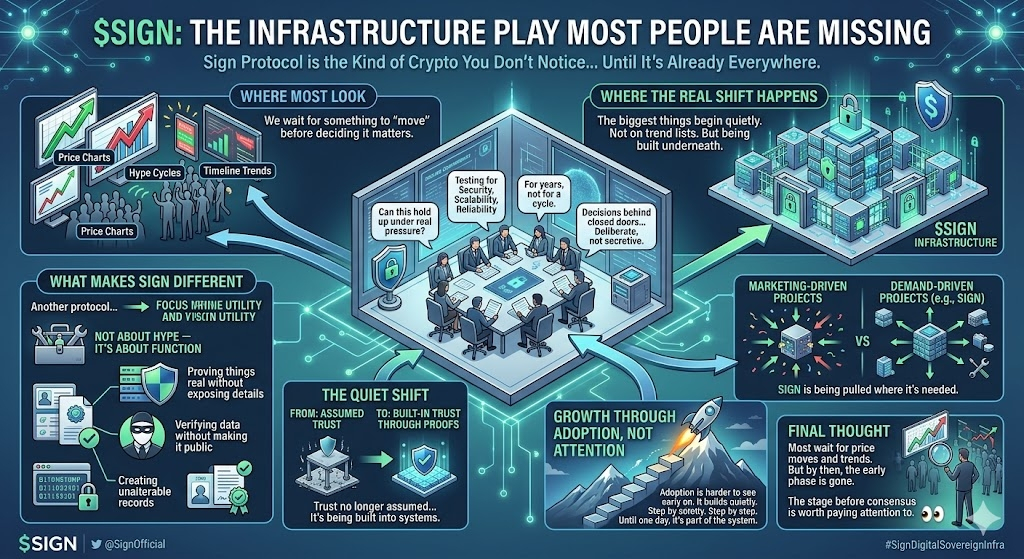
But very little of that actually moves with you in a meaningful way.If trust is engineered, identity becomes more than that. It becomes something you carry.A way to prove something is real without giving everything away behind it.That alone changes how systems can interact.Even agreements start to feel different under this lens. Instead of being static, written once and left as-is, they can become something you can check over time. Not just “trust this was done,” but “verify that it still holds.”None of this is loud.And that’s probably why it’s easy to miss.We’re used to things that matter showing up with noise. Big announcements, big reactions, constant discussion. That’s how attention works here.But infrastructure doesn’t really follow that pattern.It shows up quietly. Solves something specific. Then slowly starts appearing in more places. Not all at once, not in a way that feels obvious just consistently enough that you begin to notice it.That’s more or less how I started looking at $SIGN .At first, it didn’t stand out. It just felt like another protocol doing something around verification. Nothing new on the surface.But it kept coming up.Different contexts. Different conversations. No hype around it, just presence.The more I read, the more it felt like SIGN isn’t trying to be exciting.It’s trying to be useful.And those are very different things.At its core, it deals with identity, verification, and proof.Not in a flashy way.In a practical way.Things like Proving something is real without exposing everything behind itVerifying data without making it publicCreating records that can’t be altered later.
That might not sound exciting at first.But if you think about it… that’s the base layer of almosteverything.Identity.Ownership.Agreements.Trust.The Quiet Shift.What really caught my attention wasn’t a single feature.It was the direction.There’s a shift happening where “trust” is no longer just assumed.It’s being built into systems.Not through promises.Through proofs.And SIGN seems to sit right in the middle of that shift.Not as a loud player.But as something being placed underneath.Why It Feels Different.Most projects try to pull attention toward them.SIGN feels like it’s being pulled into places where it’s needed.That’s a very different dynamic.One is marketing-driven.The other is demand driven.And when something starts getting used before it gets widely talked about… that’s usually not random.Before It Becomes ObviousI’m not saying this is the next big thing.I’m not saying it’s guaranteed.Crypto doesn’t work like that.But I am saying this:Some projects grow through attention.Others grow through adoption.And adoption is harder to see early on.Because it doesn’t shout.It builds.Quietly.Step by step.Until one day, you realize it’s already part of the system.
Final Thought
Most people wait for confirmation.
Price moves.
Trends.
Consensus.
But by then, the early phase is gone.Right now, SIGN still feels like something people are not fully paying attention to yet.And sometimes that’s exactly the stage worth paying attention to.
#SignDigitalSovereignInfra $SIGN @SignOfficial