
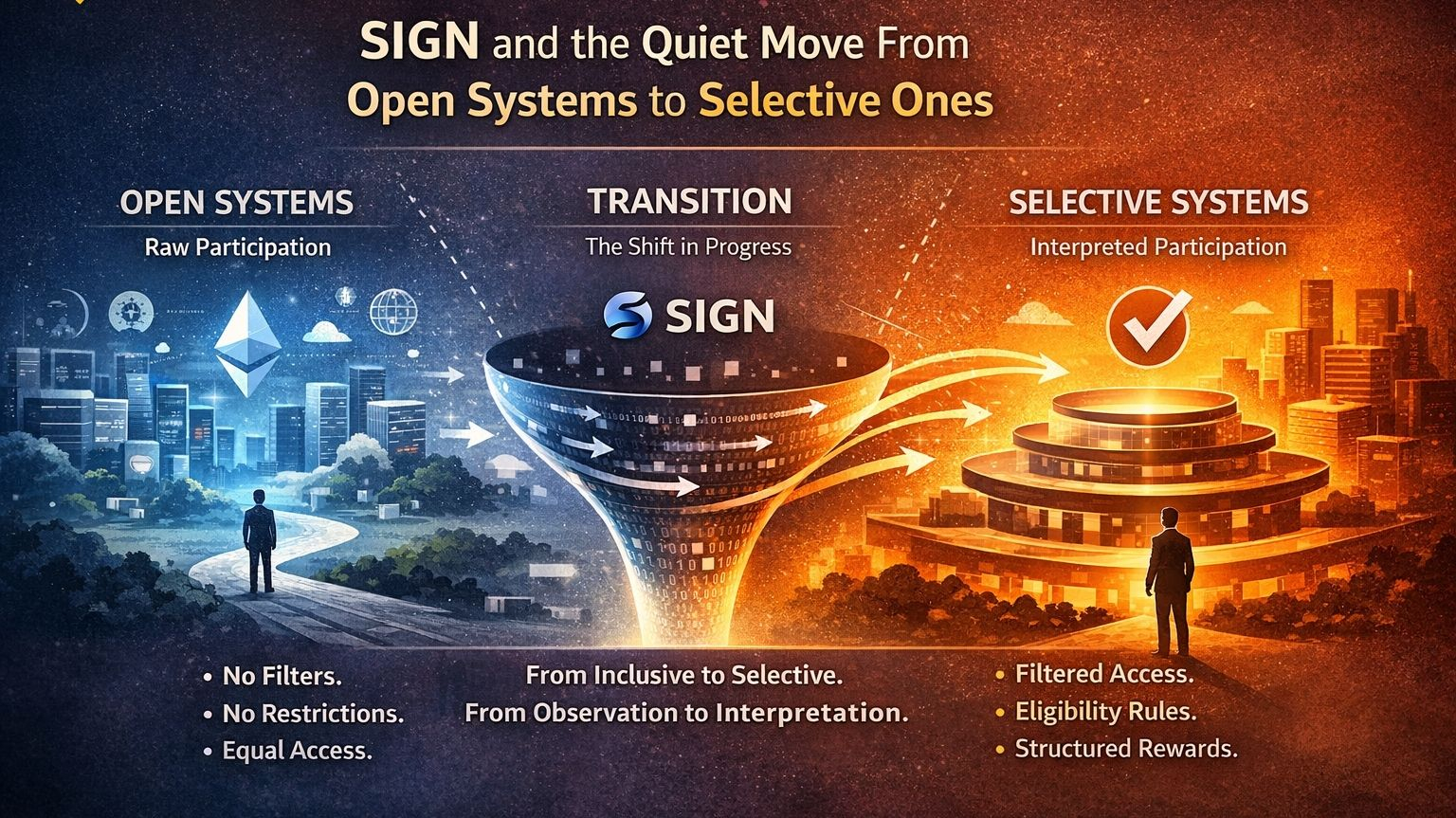
@SignOfficial There was a time when Web3 felt simple.
You connect a wallet, interact, and you’re in. No questions. No layers. No interpretation. The system didn’t try to understand you. It didn’t try to rank you. It just recorded what you did.
That simplicity came with flaws, but it also came with freedom.
You didn’t have to fit a pattern. You didn’t have to prove anything beyond basic activity. The network didn’t ask who you were or whether you “deserved” anything. It just existed, and you participated.
That version of the system is starting to fade.
Not suddenly. Not dramatically.
Just slowly… and very deliberately.
SIGN sits right inside that shift.
On the surface, it looks like an improvement. A way to clean up incentives. A way to make distribution smarter. A way to reward real users instead of noise. All of that is true, at least to some extent.
But underneath, something deeper is happening.
The system is becoming selective.
Not everyone is treated the same anymore. Not every action carries equal weight. Not every user fits the model the network is starting to recognize.
That’s the part people don’t always say out loud.
SIGN doesn’t just record activity. It interprets it.
It introduces a layer that decides which behavior counts, which patterns qualify, and which users fit into the structure it understands. That layer is built through credentials, eligibility rules, and distribution logic.
At first, it feels like clarity.
Because the old system was messy. Anyone could farm it. Anyone could game it. Signals were weak, and rewards often missed the people they were meant for.
So filtering feels like progress.
And in many ways, it is.
But filtering also creates boundaries.
Once a system starts filtering, it stops being fully open. It becomes shaped. Guided. Defined by the rules it uses to separate signal from noise.
Those rules don’t just reflect behavior.
They shape it.
Users start adjusting. Not consciously at first, but gradually. They learn what gets recognized. They learn what qualifies. They move toward the patterns that fit the system.
Over time, participation stops being completely free.
It becomes optimized.
That’s the subtle trade-off.
You gain precision, but you lose some neutrality.
You gain structure, but you introduce preference.
And preference, once embedded into infrastructure, is hard to see clearly.
What makes SIGN interesting is how early it sits in this transition.
It’s not the end state. It’s the beginning of a more structured Web3, where systems don’t just observe what happens they decide what matters.
That changes more than rewards.
It changes identity.
Your wallet is no longer just a container. It becomes a signal the system reads. A history it evaluates. A pattern it responds to differently depending on what it sees.
That doesn’t mean control in the obvious sense.
There are no restrictions. No bans. No hard barriers.
But there is direction.
The system starts guiding behavior through incentives, through visibility, through recognition. It doesn’t tell you what to do it makes certain actions more valuable than others.
And that’s enough.
Because in any incentive-driven environment, value shapes behavior.
The question is whether that shaping remains balanced.
I’ve seen this space move through enough cycles to recognize the pattern. Systems start open, then slowly introduce structure to fix problems. The structure works, but it also narrows the range of acceptable behavior.
At some point, the system becomes predictable.
Not because users are simple, but because the system rewards simplicity.
SIGN isn’t there yet.
But it’s close enough to that path that it’s worth paying attention.
Because this isn’t just about one protocol.
It’s about direction.
Web3 is moving from open systems to selective systems. From raw participation to interpreted participation. From equal treatment to differentiated treatment.
SIGN is one of the clearest examples of that shift.
It doesn’t shout it. It doesn’t frame it that way.
But it builds it into the structure.
And once structure changes, everything else follows.
Rewards feel different.
Participation feels different.
Even identity starts to feel different.
Not worse. Not better.
Just… more defined.
And maybe that’s where this space was always heading.
The early phase proved that open systems could exist. The next phase is figuring out how to make them work without collapsing under their own noise.
SIGN is part of that solution.
But like any solution, it comes with its own set of questions.
How much structure is too much?
How much filtering becomes control?
And at what point does optimization replace freedom?
Those aren’t questions the protocol answers.
They’re questions the ecosystem will have to deal with as it grows into this new shape.
For now, SIGN sits right in the middle of that transition.
Not fully open.
Not fully controlled.
Just structured enough to change how the system behaves.
And that’s usually where the most important shifts begin.