
I think people misread EthSign when they look at it only as a signing app.
That is the obvious way to see it, of course. A cleaner contract workflow. Wallet-connected execution. A more crypto-native version of getting documents signed without dragging people through the old legal-tech mess. Useful, practical, easy enough to understand.
But the more interesting part was never just the signature.
What seems clearer now, looking at Sign’s current positioning, is that EthSign exposed a bigger infrastructure problem before the broader stack had the language for it. A signed agreement is not that valuable if it stays trapped inside the app that produced it. The real institutional problem starts right after signing. Can another system verify that an agreement exists? Can a regulator inspect proof without pulling the whole document into view? Can another application rely on that fact later without rebuilding trust from scratch? That is much closer to infrastructure than to software convenience.
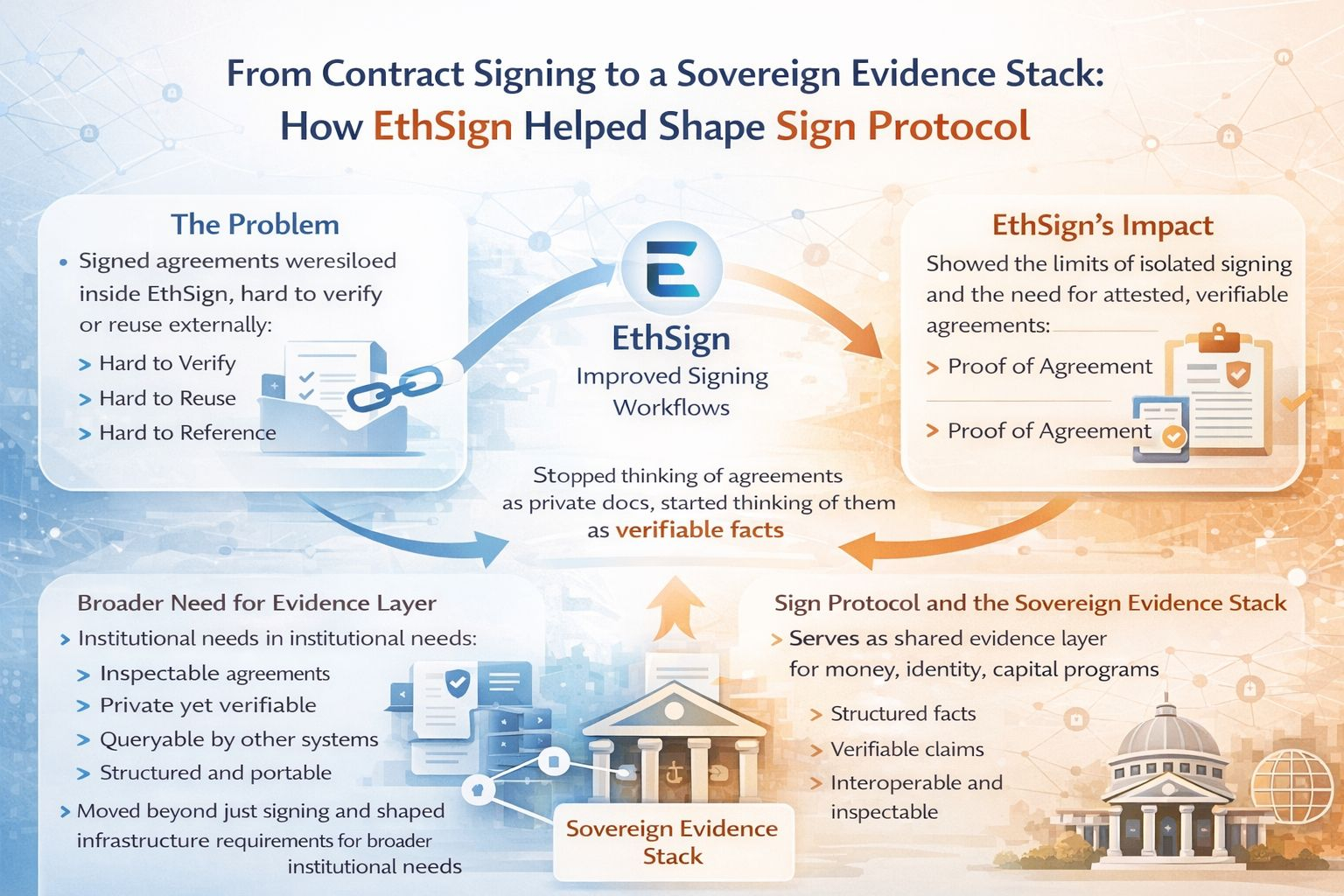
And honestly, I think EthSign is where that design pressure became visible.
The old EthSign case study says this pretty directly. It describes the contracts made through EthSign as secure but “siloed,” limited to the parties and contexts immediately involved. That word matters. Siloed. Because once agreements are siloed, they are hard to reuse, hard to reference, and hard to turn into operational evidence for anything beyond the signing event itself. EthSign’s answer was not just “improve signing.” It was “Proof of Agreement,” built through Sign Protocol, so that the existence of an agreement could be attested to and verified by third parties without exposing sensitive contract details.
That feels like a small product feature if you read it casually. I do not think it was.
I think that is one of the clearest early signs of where Sign was headed.
Because the moment you stop treating a contract as a private document and start treating its existence, status, or execution as a verifiable claim, you have already stepped into a different category of system design. You are no longer building only for counterparties. You are building for auditors, platforms, registries, capital programs, compliance checks, and institutions that need to rely on facts without inheriting full document exposure. That is basically the logic of an evidence layer.
And that logic now sits at the center of how Sign describes itself.
The current docs frame S.I.G.N. as “sovereign-grade digital infrastructure” for national systems of money, identity, and capital, with Sign Protocol serving as the shared evidence layer across those deployments. EthSign is still there, but now it is presented as one of several products that can plug into that stack when agreement and signature workflows are needed. That is a major shift in emphasis. The product that once looked like the front door now reads more like an early proving ground for the deeper architecture.
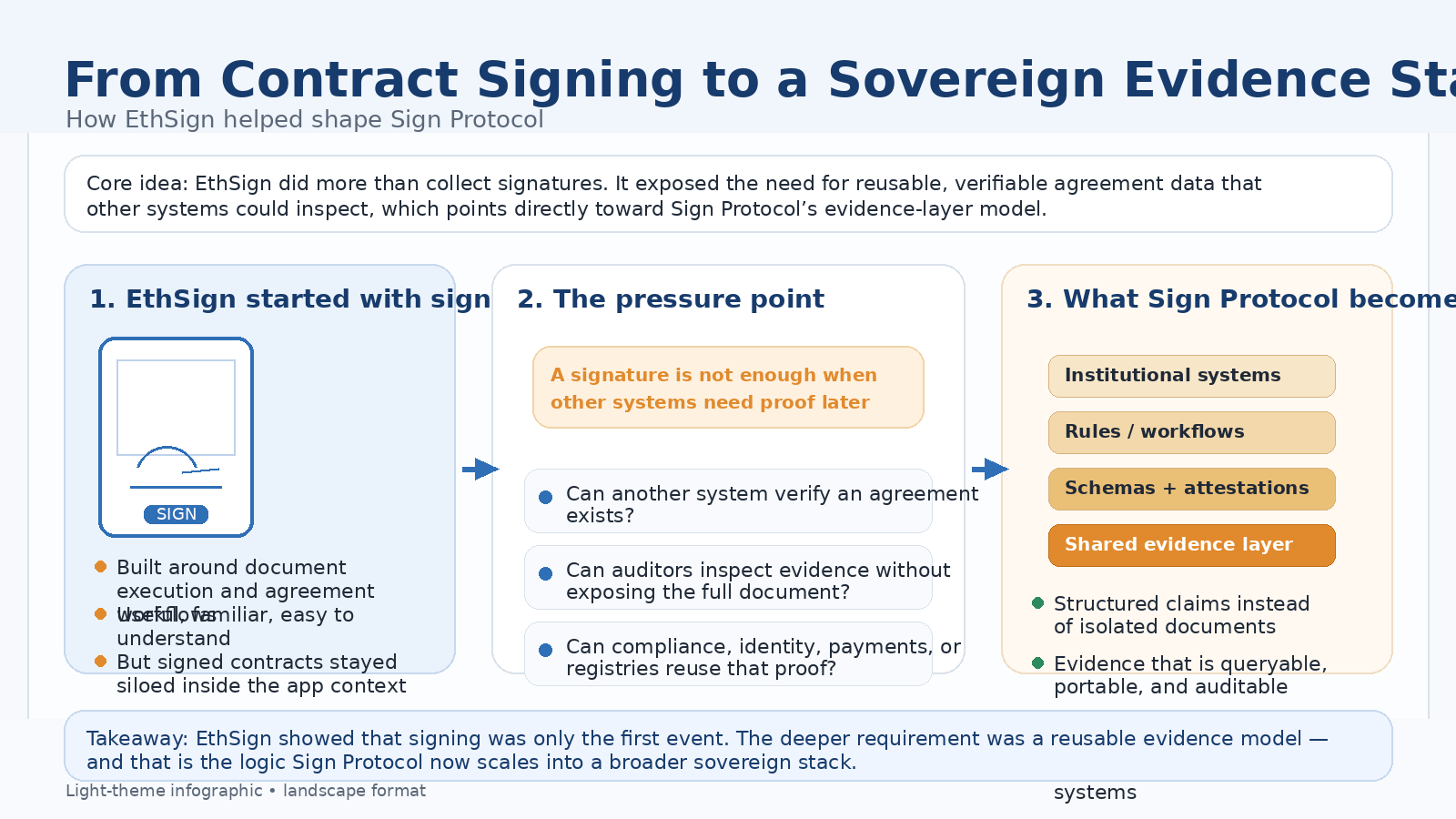
What changed, I think, is not just scope. It is abstraction.
EthSign seems to have forced the question of what a signature really becomes once other systems need to interact with it. Not the document itself, necessarily. Not the full text. But the fact that an agreement happened, who witnessed it, when it completed, which schema defines it, and how another system can query or verify that state later. The EthSign case study even shows schema fields built around this exact move: chain type, signer address, CID, contract ID, timestamp. That is not just a UX layer for paperwork. That is a structured evidence model trying to make agreements legible to machines and institutions.
That is why I do not see EthSign as some side product that happened to coexist with Sign Protocol.
I see it more as one of the places where the limits of isolated signing became impossible to ignore.
A signing tool can solve execution. It cannot, by itself, solve portability of trust. It cannot make one agreement cleanly reusable across systems. It cannot automatically turn a private signing event into inspection-ready evidence for a larger institutional workflow. Once you try to do that, you need schemas, attestations, query layers, privacy models, indexing, and verifiable references. In other words, you need the machinery that Sign Protocol now openly describes as the evidence layer for sovereign and institutional workloads.
So when people ask how EthSign helped shape Sign Protocol, my answer is probably this:
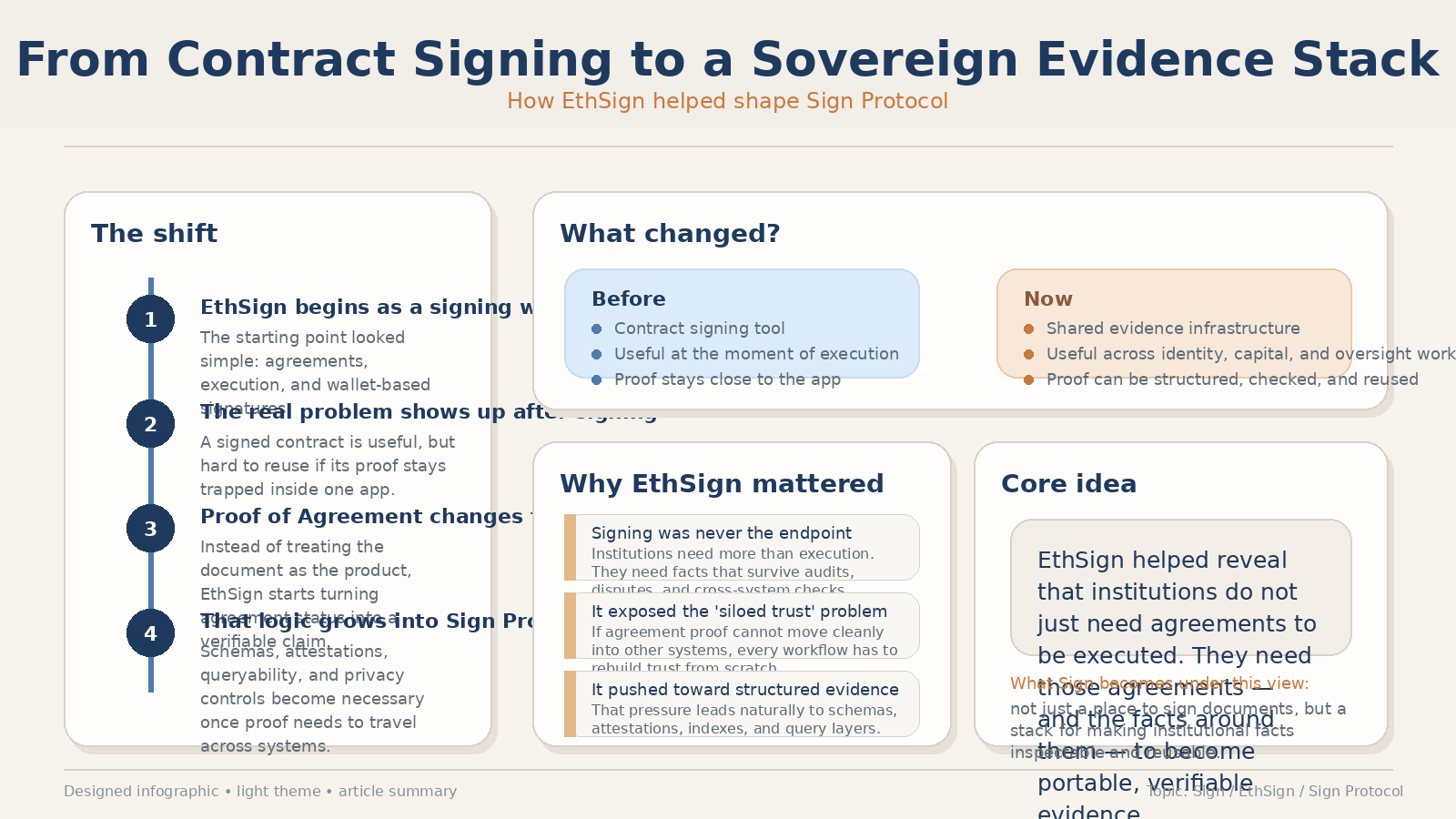
EthSign revealed that signing was never the finish line. It was the first structured event in a longer chain of proof.
That matters more now because Sign is no longer presenting itself as a set of loosely related crypto tools. The newer framing is much broader and much heavier. S.I.G.N. is described as a system-level architecture that has to remain governable, auditable, interoperable, and operable at national scale. Across those contexts, the repeated need is what the docs call inspection-ready evidence: who approved what, under which authority, when it happened, and what proof supports it. Once you read that, it becomes harder to see EthSign as just an app for agreements. It starts to look like one of the earliest interfaces where Sign learned what evidence infrastructure actually has to do.
I still would not oversell it.
There is always a risk of rewriting product history too neatly, as if everything was destined to become sovereign infrastructure from day one. Maybe it was not. Maybe EthSign began as exactly what it looked like: a useful signing product that later ran into the limits of siloed trust. That is a more believable story to me anyway. Real infrastructure often starts there. A narrow tool hits a wall, and that wall turns out to be architectural. Then the product either stays narrow or it grows a theory of the system around it.
Sign seems to have done the second thing.
What I find compelling is not that EthSign signed contracts. A lot of products can do that. What is more telling is that it seems to have pushed Sign toward a harder realization: institutions do not just need agreements to be executed. They need those agreements, and the facts around them, to survive contact with other systems. They need proof that can travel.
That is when contract signing stops being a workflow.
That is when it starts becoming part of a sovereign evidence stack.
@SignOfficial #SignDigitalSovereignInfra $SIGN
