
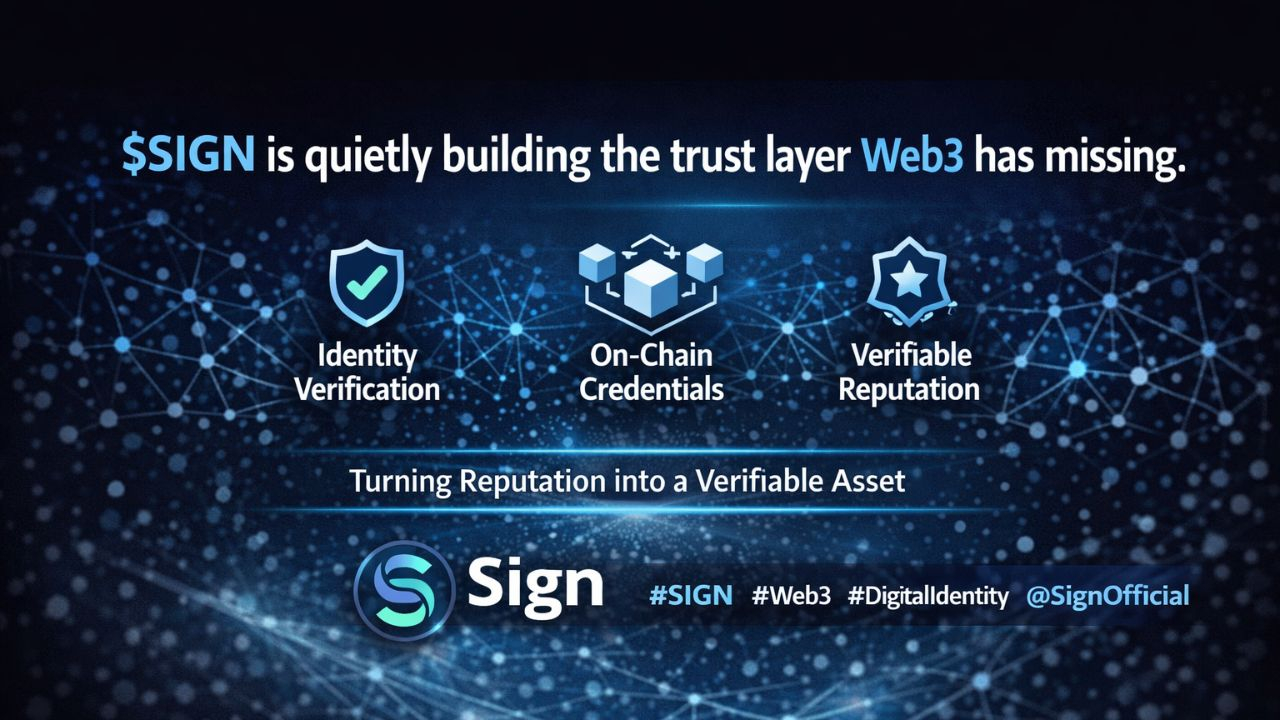
#SignDigitalSovereignInfra @SignOfficial
Introduction
One of the biggest contradictions in Web3 is this: while blockchain removes the need for trust, real-world applications still depend on it. Whether it's identity verification, credentials, or reputation, trust remains a fundamental layer that most decentralized systems struggle to handle efficiently.
This is where $SIGN steps in.
Rather than trying to replace existing systems, Sign is building something far more powerful — a universal framework for verifiable digital identity and credentials.
The Core Problem: Trust is Fragmented
In today’s digital world, identity is scattered across platforms:
Emails for communication
Wallets for transactions
Social profiles for reputation
Documents for verification
None of these systems talk to each other in a secure, unified way.
In Web3, this becomes even more complex:
Wallets are anonymous
Sybil attacks are common
Reputation is hard to verify
Without a reliable identity layer, scaling trust becomes nearly impossible.
What is $SIGN?
Sign is a protocol that enables users and organizations to create, verify, and store on-chain attestations.
Think of it like this:
Instead of claiming something → you can prove it
Instead of trusting blindly → you can verify instantly
These attestations can represent:
Identity verification
Proof of participation
Credentials and achievements
Business registrations
Reputation scores
All of this is cryptographically secured and easily accessible.
Why $SIGN atters
1. Real Digital Identity
Sign allows users to own their identity instead of relying on centralized platforms. Your credentials live with you, not with a company.
2. Sybil Resistance
By verifying uniqueness and credibility, Sign helps prevent fake accounts and manipulation — a huge issue in Web3 ecosystems.
3. Seamless Verification
No more endless forms or manual checks. With Sign, verification can happen in seconds.
4. Cross-Platform Trust
Attestations created in one ecosystem can be used across multiple platforms, creating a unified trust layer.
Real-World Use Cases
Airdrops & Token Distribution → Fair and Sybil-resistant
DAO Governance → Voting based on verified reputation
Hiring & Freelancing → Verified skills and experience
Business Registration → Fast, transparent verification
Social Networks → Authentic, reputation-based interactions
The Bigger Vision
Sign isn’t just another crypto project chasing hype.
It’s building infrastructure for a future where:
Identity is self-owned
Reputation is portable
Trust is programmable
This is what Web3 has been missing — not another token, but a foundation for credibility.
Conclusion
$SIGN presents a shift from anonymous interaction to verifiable participation.
In a space filled with speculation, Sign is focused on something much more valuable:
making trust scalable, transparent, and decentralized.
As Web3 continues to evolve, projects like Sign won’t just be relevant — they’ll be essential.